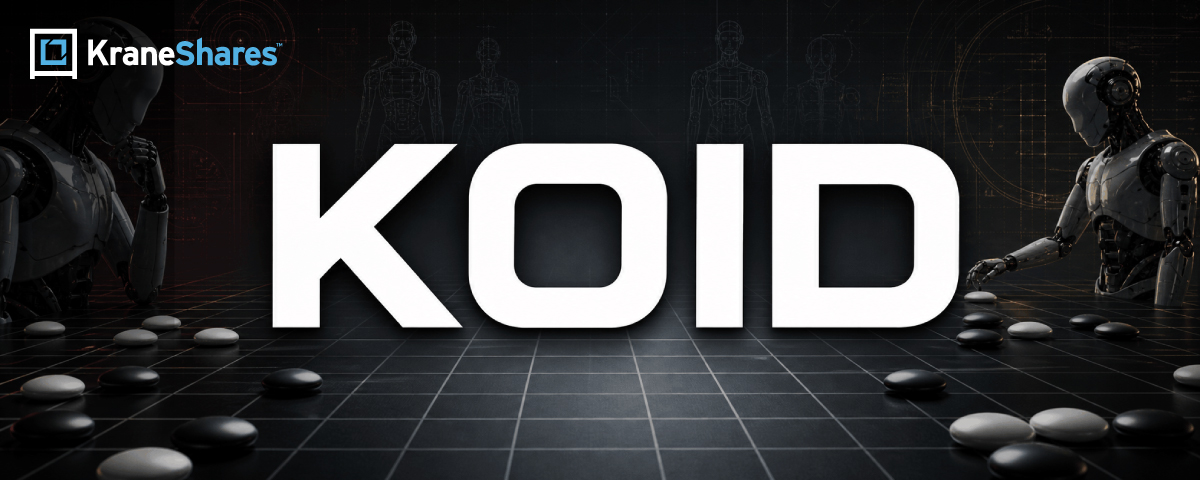
Humanoid Robot ETF KOID: Did We Just Witness A “Move 37” Moment For Physical AI?
By  Cole Wenner
In 2016, the world's second-ranked Go player, Lee Sedol, faced off against Google's DeepMind Lab-developed computer program AlphaGo in a best-of-5 match.
For those not familiar, the board game Go originated in ancient China and is estimated to be more than 2,500 years old.1 It is a sophisticated strategy game that relies heavily on pattern recognition and has more than 300 times as many move options as chess.2
An artificial intelligence (AI) breakthrough happened in AlphaGo's second match against Lee. According to the Wall Street Journal, "Lee saw a move that he believed no professional Go player would have made. In fact, the DeepMind team calculated the chances of a human playing it at one in 10,000."3 Sedol had to go on a midgame break to comprehend what he saw and came back to what is now known as "Move 37," aka the 37th move in their match together.
The move was so unusual that at first, spectators, commentators, and Lee himself believed it was a mistake. Everyone soon realized it was a genius move that marked one of the first moments when an AI program demonstrated it was not just mimicking humans but could discover effective strategies that might be outside human intuition.
Ten years later, at the second World Humanoid Robot Games in Beijing, we have now witnessed what we believe is another "Move 37" moment, but this time with physical AI.
Team Tiangong's Omni Robot Steals The Show With A New Running Motion It Was Not Programmed To Do
Team Tiangong's robots delivered several record-setting running performances at the second Robot Games, but one in particular stood out to spectators.
Why?
Well, Team Tiangong's Omni humanoid, which won the 400m in 45.66 seconds, taught itself an unusual running motion it wasn't programmed to do through reinforcement learning in a simulated environment. While the robot was designed with a typical human running motion, it found that rapidly swinging its mechanical arms (as a human would) wasted battery power and caused severe joint friction and heat. So, through trial and error in its simulated training environment, it realized that a tucked-arm running motion (now referred to as the "Shy run") was much more efficient.
Additionally, to compensate for the loss of stabilization provided by an arm-swing motion, which counteracts the momentum of its legs, it taught itself a rapid waist-twisting movement to offset that momentum instead. This new, funky running motion was an example of AI finding the most efficient way to run based on factors like energy, heat, and stability.
It is also important to note that this unconventional running technique was only possible because of the hardware the robot was built with. If the robot's mechanical design, balance, joint performance (actuators), and heat management systems were not as advanced, it would never have been able to invent this more efficient running style.
While funny looking, we believe this is a serious breakthrough in physical AI. AI coordinated the robot's joints, torso, and center of gravity to optimize the movement of a real machine under energy, thermal, and balance constraints. Just as "Move 37" demonstrated in the digital realm that AI can make its own strategic decisions independent of human intuition, the Tiangong team demonstrated that AI can manipulate and optimize real-life systems, such as humanoids, in the physical world.
For additional coverage of the Second World Humanoid Games from KraneShares Cultural Analyst Xiabing Su, who attended the event herself, visit KraneShares' YouTube Channel.
Growth Is Our Main Takeaway From The Second Beijing World Humanoid Robot Games
Overall, Beijing's second World Humanoid Robot Games was dramatically larger than its debut just one year ago.
This year's event brought together 2,056 robots from 666 teams across 16 countries and regions.4 Last year, about 500 robots from 280 teams competed.4 Additionally, the second robot Olympics expanded to 51 events (from 26 in year one), and included 30 competitive events and 21 scenario-based challenges spanning categories like industrial assembly, hospitality, household services, firefighting, and rescue.4
In the Smart Charging Service challenge, for example, humanoid robots had 30 minutes to unplug charging connectors, charge three vehicles, and return each connector to its original position.5
In the power-tool assembly challenge, private robotics company LinkerBot won gold after autonomously installing 18 screws in five minutes, with no human intervention.5
In the restaurant-service event, a robot from private company GalBot won while operating fully autonomously, using the company's AstraBrain embodied AI model to make decisions.6 Galbot was able to complete a series of tasks based on on-site voice commands, including locating and microwaving food, preparing drinks, and delivering a fully correct order to a designated table in 6 minutes and 55 seconds with "precise force control and no errors."6
Each task, whether sprinting, gripping an object, or navigating an obstacle, requires multiple systems to work at once. A humanoid robot needs AI computing and control software to make decisions, sensors and machine vision to interpret its surroundings, and motors, actuators, reducers, batteries, and mechanical systems to translate that intelligence into movement.
The World Humanoid Robot Games make this ecosystem visible.
Firms like Goldman Sachs believe humanoids will be integrated into our world at scale in the coming years and have recently become more bullish on the sector. The firm revised its humanoid shipment estimates, raising them over fourfold from its previous outlook, with its base case now at 6.5 million units in 2035, up from 1.4 million.7
Why The Games Matter For Humanoid Robotics ETF KOID
Humanoid robots may be the stars of the competition, but we believe the opportunity is larger than the robot makers themselves.
Competing robots may differ in design and developer, but they generally rely on the same foundational technologies and components. As capabilities improve and commercial use cases broaden, value creation may occur across the entire physical AI stack.
This is why the KraneShares Global Humanoid and Physical AI Index ETF (KOID) provides exposure to humanoid makers and the broader ecosystem behind physical AI.
Humanoid robotics ETF KOID is an equal-weight strategy that is designed to provide broad global exposure to the humanoid robotics ecosystem, from companies that design and manufacture humanoid robots to the supply chains that provide key components for humanoids and physical AI. This investment strategy aims to reduce reliance on predicting which robot platform, company, or country will emerge as a leader, and instead capture broad sector growth.
AI ETF AGIX Has Private Physical AI Exposure
KraneShares' AI ETF AGIX, the KraneShares Public-Private AI & Technology ETF, provides exposure to both public and private companies. AGIX is an actively managed strategy led by AI-native investors and has a three‑bucket framework (AI Hardware, AI Infrastructure, and AI Applications) that is designed to sit on top of the evolving AI story and capture value across the AI ecosystem.
AGIX's private company sleeve includes direct exposure to two physical AI companies: Apptronik and the newest private stock addition to the AGIX portfolio, Standard Bots Company.
Apptronik is working to commercialize a human-form-factor robot that can operate in spaces built for people. Standard Bots focuses on AI-enabled industrial automation through task-specific robotics. Both approaches seek to bring intelligent machines into real working environments, but each addresses different customer needs and commercialization timelines.
For a closer look at AGIX's recent private-company additions, which include companies working across prediction markets, frontier AI models, photonics, and autonomous driving systems, see AI ETF AGIX: Introducing the New Class of Private Investments & Performance Update.
A Global Theme With Multiple Paths
The Robot Olympics offer a snapshot of a fast-growing global field: more teams, more robots, more events, and increasingly demanding tests of mobility, manipulation, perception, and autonomy.
KOID is designed to provide differentiated public-market exposure to the global humanoid robotics and physical AI ecosystem. AGIX complements that exposure through selected private physical AI companies, including Apptronik and Standard Bots, while also investing across the broader AI hardware, infrastructure, and applications landscape.
Holdings are subject to change.
For KOID standard performance, top 10 holdings, risks, and other fund information, please click here.
For AGIX standard performance, top 10 holdings, risks, and other fund information, please click here.
Citations:
- US-China Today, "The Game of Go: Ancient Applications and Contemporary Connotations," as of 6/6/2016. Retrieved on 8/31/2026.
- Business Insider, "Why Go is so much harder for AI to beat than chess," as of 3/10/2016. Retrieved on 8/31/2026.
- Wall Street Journal, "Move 37 Is the Moment AI Changes Everything. It's Suddenly Happening Everywhere," as of 8/7/2026.
- Emre Aytekin, "World Humanoid Robot Games continue in Beijing," as of 8/24/2026.
- People's Daily, "A closer look at second World Humanoid Robot Games," as of 8/31/2026.
- PR Newswire, "100% win rate! Galaxy General sweeps gold medals in the three most challenging events at the Family, Catering, and Supermarket competitions, dominating the Humanoid Robot Games," as of 8/27/2026.
- ZeroHedge, "Goldman Upgrades Humanoid Forecast By 4 Times As Warehouses Become Ground Zero For Deployments," as of 8/31/2026.