AGIX: The First ETF To Own Anthropic & S-1 Filing Analysis Plus Q3 Update
By  Derek Yan, CFA &
 Cole Wenner
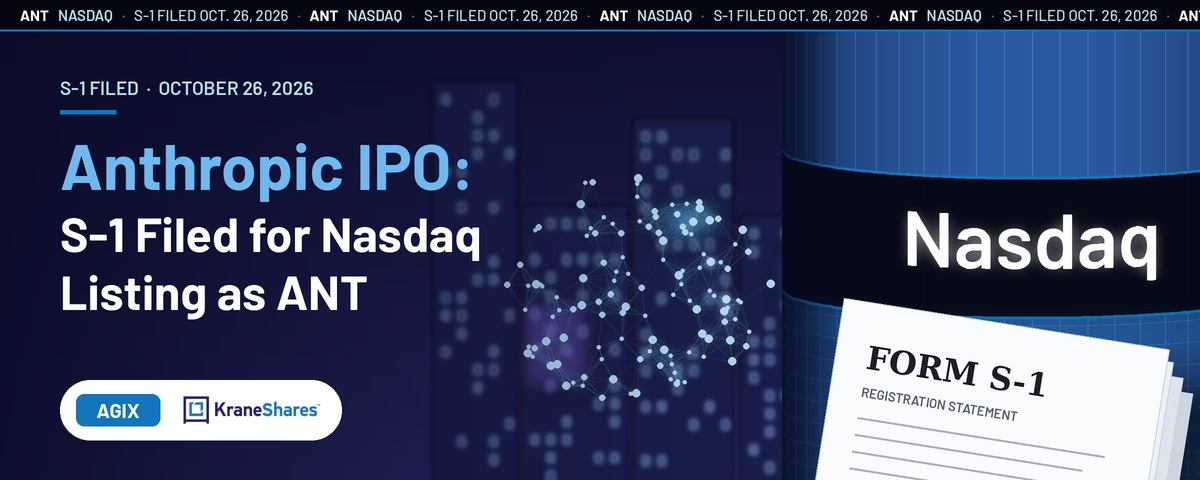
Anthropic has filed to go public, and AI ETF AGIX has been invested since the beginning of 2025.1
The KraneShares Public-Private AI & Technology ETF was the first ETF to add Anthropic to its portfolio.1 KraneShares invested in February 2025 at a $61.5 billion valuation, well before Anthropic reached its rumored $1.5 trillion IPO valuation and became one of the most talked about names in AI.1,2
Since then, AGIX has also added other pioneering AI-related private companies, including General Intuition, Nuro, Apptronik, Ayar Labs, Standard Bots, and Polymarket.*
Now that Anthropic has filed its S-1 to go public, the investment world is captivated by what it contains. So, let's dive into what the Anthropic IPO filing tells us.
Inside the Anthropic IPO Filing: Strong Revenue Growth
On October 26, 2026, the company behind Claude publicly released its S-1, the registration statement a company files with the Securities and Exchange Commission (SEC) before an initial public offering (IPO). Anthropic has applied to list on Nasdaq under the ticker ANT, and The Wall Street Journal reports that the company is targeting the week of November 16, 2026, for the Anthropic IPO.2
On November 2, 2026, Anthropic released its Q3 S-1A, detailing the company's performance for the third quarter.3
Until now, investors have pieced together Anthropic's story from funding announcements and headlines. The S-1 and S-1A let us see the business from the inside: who is paying for Claude, how much they spend, and what it costs to deliver.
We believe the filing tells a clear story in four parts: Claude has earned a place within the world's largest companies, those customers keep spending more, each dollar of compute generates more revenue, and the business has reached its first quarter of operating profitability.

Start with the top line. Anthropic's quarterly revenue grew from $376 million in Q1 2025 to $11.555 billion in Q2 2026, a more than 30-fold increase in five quarters. First-half 2026 revenue totaled $16.286 billion, compared with $1.163 billion a year earlier.4 In Q3 2026, revenue reached $17 billion, which outpaced total 1H revenue for Anthropic in 2026.3
Importantly, these are recognized revenues, meaning sales Anthropic has actually earned and booked, not annualized run rates that project one strong month across a full year. In our view, that makes the growth even more compelling.
Claude Has Already Earned a Seat in Corporate America
The next question is who is paying. According to the Anthropic IPO filing, the answer is many of the largest companies in the world.
As of September 30, 2026, more than 11,900 customers each generated at least $100,000 in trailing-twelve-month (TTM) revenue for Anthropic, meaning revenue over the prior 12 months. That group included all 10 of the Fortune 10, more than half of the Fortune 500, and more than 30% of the Global 2000, Forbes' annual ranking of the world's largest public companies.5

The industry breakdown is just as powerful. Among the 10 largest Fortune 500 companies in each sector, Claude has all 10 companies in software, internet, and banking as customers, along with nine of 10 in pharmaceuticals and semiconductors. We think that breadth matters.
We also believe there is plenty of room left to grow. In Q3 2026, Anthropic revenue from qualifying publicly traded Fortune 500 customers averaged less than 0.1% of those customers' total expenses. Among its 10 largest Fortune 500 customers, that share was still below 1%, but more than eight times the broader average.5
We see this as the classic "land and expand" pattern familiar from enterprise software: first get in the door, then grow as the product proves its value. Anthropic has landed, and the gap between its heaviest users and everyone else suggests the expansion phase may still be in its early stages. Since company expenses include many costs AI cannot address, we view these ratios as a measurement of depth, not a revenue target.
Customers Who Use Claude Keep Spending More
The customer count tells the expansion story. Customers generating at least $100,000 in TTM revenue grew from about 20 in December 2023 to 200 in December 2024, 1,500 in December 2025, and more than 11,900 by September 2026.5

Just as telling is how much existing customers are spending. Anthropic reported net revenue retention (NRR) of approximately 900% as of September 30, 2026. NRR compares what a group of customers spends today with what the same group spent a year earlier, after accounting for customers who spend more, spend less, or leave. At approximately 900%, revenue from the qualifying customer cohort in the three months ended September 30, 2026 was about nine times its revenue in the corresponding three-month period a year earlier.6 The metric excludes Claude Pro and Max subscribers.6
Software companies often point to NRR above 120% as a sign of strong customer expansion. In our view, a figure like 900% suggests customers are not just renewing Claude; they are continually finding new work for it.
Growth is also spreading across the customer base. The top five customers' share of quarterly revenue fell from about 36% in Q1 2026 to 21% in Q3, even as revenue from each of those five customers reached a record.7 The largest customers are still growing, and everyone else is growing faster.

Scale Is Making Anthropic More Efficient
Every response Claude produces runs on compute, the specialized chips, servers, and data center capacity used to build and run AI models. Compute is one of the highest costs in AI, which makes one disclosure in the S-1 especially important.
Quarterly revenue per dollar of compute and infrastructure expense rose from about $0.40 in Q1 2025 to $2.08 in Q2 2026, a roughly 5.2-fold improvement. In Q2 2026, revenue grew about 1,368% year over year (YoY), while compute and infrastructure expense grew roughly 300%.4,8 In Q3 2026, revenue grew about 1,200% YoY.3

Put simply, revenue is now outrunning the cost of producing it. We think this is one of the filing's most important takeaways because it answers a common question about AI companies: does growth simply mean spending more on chips? Anthropic's numbers suggest scale is making the business more efficient. Because the expense figure also covers research and internal use, the ratio is a broad efficiency measure rather than a profit margin.8
Anthropic credits advances in training (teaching a model) and inference (running it to answer requests) to its ability to shift workloads across different chip platforms. It also says Opus 5.5 lowered customer cost per task by about 40% versus Opus 5.8 We believe falling costs could be a powerful growth driver. When a task becomes cheaper, customers tend to find more tasks worth handing to AI.
The Anthropic IPO Arrives Alongside a Profitability Milestone
That efficiency is starting to show up in profits. Anthropic's operating margin, the share of revenue left after the costs of running the business, improved from negative 249% in Q1 2025 to positive 8% in Q2 2026. Operating income reached $974 million in Q2, compared with a $1.2 billion operating loss a year earlier.4
In Q3 2026, adjusted operating margin reached 15%, while operating margin was -3%. Net loss for Q3 2026 was -$23.3 billion; however, the company stated that it was due to "an increase in valuation, net loss includes a $21.9 billion non-cash charge related to a change in fair value of convertible notes, derivative liabilities, and SAFEs."3

One profitable quarter is a milestone rather than a finish line, and the first half as a whole still showed a $693 million operating loss. But in our view, the direction is what matters most: Anthropic crossed into operating profitability while still growing at an extraordinary pace.
The headline net loss also needs context. Of the $80.748 billion first-half net loss, approximately $72.4 billion came from changes in the fair value of convertible notes and similar financing instruments.10 Convertible notes are a form of debt that can turn into shares. As Anthropic's valuation rose, those notes became more valuable, and accounting rules record that increase as a loss. In other words, most of the net loss reflects Anthropic's rising value, not cash spent running the business. The same holds true for the Q3 net loss.3
Anthropic is also planning ahead. It typically commits to long-term compute 12 to 18 months before that capacity becomes available, and it expects to rely more on pricier short-term capacity in the near term, which may weigh on margins.9 We read this as a company preparing for the demand it expects to arrive, and IPO proceeds could help support that buildout.
The Bigger Prize: Knowledge Work
We believe the market Anthropic is pursuing is far larger than the software industry. The company estimates that knowledge work, meaning jobs centered on analysis, writing, coding, and decision-making, represented more than $40 trillion in global annual economic value in 2025, based on knowledge-worker wages.11
That figure measures the underlying economic pool, not a revenue forecast, but it reframes the opportunity. Traditional software competes for technology budgets. AI that performs useful work can compete for a share of what companies spend getting work done. We believe this helps explain why adoption is spreading so quickly across industries.
Anthropic sees an impact well beyond the office, too. In its S-1, the company states that "AI will profoundly accelerate the rate of progress in biology and medicine, potentially curing diseases that have plagued humanity for millennia, including cancer, Alzheimer's disease, heart disease, rare genetic diseases, and other major infectious diseases."
The filing also makes the economic case. Anthropic states that "AI can be a powerful lever for economic growth. As a general-purpose technology, it has the potential to raise productivity across every sector of the economy. Productivity growth in advanced economies has stagnated in recent decades... AI could reverse this trend."
In our view, that is the opportunity at the heart of the Anthropic IPO: technology that does not just support work, but helps the economy produce more of it.
Weighing the Risks of the Anthropic IPO
No IPO is without risk, and Anthropic's S-1 was unusually candid about its own. The filing devotes 93 pages to risk factors, the section where a company lays out what could hurt its business or its stock.
Timing is the first consideration. The Anthropic IPO is set to arrive during one of the busiest stretches for markets this year. The U.S. midterm elections, which will decide control of Congress, take place on November 3, 2026, roughly two weeks before Anthropic's targeted listing window.
The macro backdrop is shifting, too. In September, the Federal Reserve raised interest rates for the first time since 2023 and signaled that another hike could come before year-end, as consumer prices rose 3.7% from a year earlier.12,13 Higher rates tend to weigh most on growth stocks, whose value depends heavily on future earnings. Meanwhile, renewed tensions involving Iran pushed Brent crude, the global oil benchmark, above $116 a barrel in late October.14
AI stocks have felt it as well. Big tech earnings have been mixed, and recent results from companies such as Alphabet and Intel have weighed on AI supply chain stocks worldwide. Any of these factors could affect how the Anthropic IPO is priced and how the stock trades in its early days.
Competition is another consideration. OpenAI, Anthropic's best-known rival, has been widely reported to be preparing for its own public listing, while Google and lower-cost open-weight models from China compete for many of the same customers.
Then there is a risk few companies would ever put in writing. Anthropic's S-1 discusses the potential for advanced AI to cause catastrophic harm, including risks to humanity itself. It is highly unusual for a company to disclose a risk of this scale in an IPO filing. However, Anthropic also stated in its filing that the company "is a deeply values-driven organization, founded in large part to help the world realize AI's benefits and avoid its dangers." We think this speaks to how powerful the underlying technology is and how seriously Anthropic takes its responsibility for building it.
Recently, Anthropic limited Claude Mythos Preview, its most advanced model at the time, to a small group of trusted organizations through Project Glasswing rather than releasing it broadly.15
We believe this approach is a competitive advantage. Banks, healthcare companies, and other regulated businesses need AI they can trust, and those are exactly the industries where Claude has been winning customers. For a technology this powerful, a reputation for responsibility may prove to be one of Anthropic's most valuable assets.
What the Anthropic IPO Means for AI ETF AGIX
AI ETF AGIX is designed to continually capture the full AI stack as new developments happen, from chips and infrastructure to the models and applications built on top. What sets it apart is its public-private structure: the fund can hold direct positions in private AI companies that are often available only to venture funds and institutions.
From here, we will be watching customer expansion, cash generation, and margins as new compute comes online. We think the Anthropic IPO will be a landmark event. But for AGIX investors, we believe the bigger story is the one the S-1 and S-1A tell: a business growing fast, becoming more efficient, and reaching deeper into the global economy.
Holdings are as of 10/30/2026 and are subject to change. For holding weights, please click here.*
For AGIX top 10 holdings, risks, standard performance, and other fund information, please click here.
Citations:
- Data from Bloomberg and KraneShares as of 10/30/2026.
- The Wall Street Journal, Anthropic Unveils Paperwork for Blockbuster IPO, October 26, 2026.
- Anthropic S-1A, as filed with the Securities and Exchange Commission on November 2, 2026.
- Anthropic S-1 filed October 26, 2026, MD&A, Quarterly Consolidated Statements of Operations, pp. 157-158.
- Anthropic S-1 filed October 26, 2026, Growth Strategy and Investments and MD&A, Customer Adoption and Expansion, p. 143. Customer threshold is at least $100,000 in TTM revenue.
- Anthropic S-1 filed October 26, 2026, Select Defined Terms, pp. 2-3, and MD&A, Adoption of Claude, p. 135. NRR excludes Claude Pro and Max.
- Anthropic S-1 filed October 26, 2026, MD&A, Customer Adoption and Expansion, pp. 143-144.
- Anthropic S-1 filed October 26, 2026, Strengths of Our Financial Model, pp. 10-11, and MD&A, Compute Efficiency, pp. 135-136.
- Anthropic S-1 filed October 26, 2026, MD&A, Our Financial Model, pp. 133-134, and Liquidity and Capital Resources.
- Anthropic S-1 filed October 26, 2026, Summary Consolidated Financial Data, pp. 22-23, and the consolidated financial statements.
- Anthropic S-1 filed October 26, 2026, A Near-Term Opportunity to Transform Cognitive Work, pp. 7-8, and Industry, Market, and Other Data, p. 123.
- Federal Reserve, FOMC statement, September 16, 2026, and minutes of the September 15-16, 2026 meeting.
- U.S. Bureau of Labor Statistics, Consumer Price Index, September 2026, released October 14, 2026.
- Reuters, Brent crude settlement of $116.72 a barrel, October 23, 2026.
- Anthropic, Project Glasswing, anthropic.com/glasswing.