A Comprehensive Guide on How to Get Started With AI ETFs: From Frontier AI Models to Semiconductors
By  Cole Wenner
We believe artificial intelligence (AI) is shaping up to be a megacycle, and the numbers behind it are hard to ignore.
Goldman Sachs Research estimates approximately $1 trillion in global AI-related investment in 2026, including $581 billion in the United States.¹ The International Data Corporation (IDC), a premier global market intelligence, research, and advisory firm, forecasts $1.3 trillion in annual worldwide AI spending by 2029, driven by expanding investment in AI-enabled applications and systems.²
But AI is not a single trade; it is a stack.
At the top are the frontier models and the companies building them. Beneath them sit the chips, memory, and optical links that power AI data centers. And beyond the data center, AI is starting to take physical form. Morgan Stanley estimates the humanoid robotics market could surpass $5 trillion by 2050.³
The opportunity also keeps moving. As one bottleneck eases, another emerges, whether in compute, memory, data transfer, or motion.
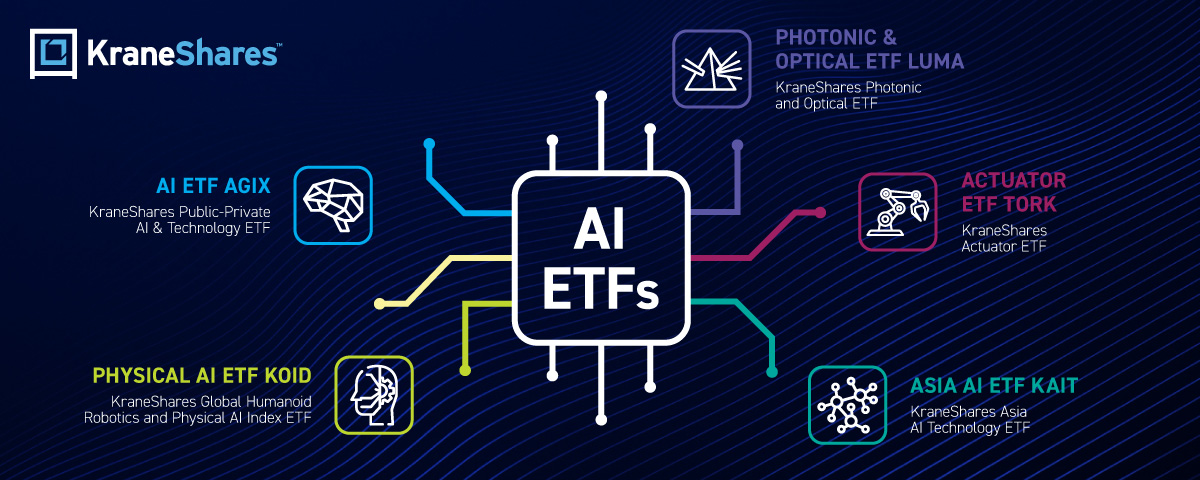
This guide walks through five AI ETFs, each targeting a different layer of the AI opportunity, and how investors can use them to gain exposure.
AI ETF AGIX: Broad AI Exposure Plus Direct Private Company Exposure
AGIX is designed to be a broad "catch-all" basket for companies driving AI advancements. Its holdings aim to span the full stack, from the hardware powering compute and the infrastructure that trains and runs models to the software and applications built on top of them. As the AI ecosystem evolves, AGIX is built to evolve with it.
Additionally, many of the companies driving AI forward aren't publicly traded.
Frontier model developers, robotics startups, and next-generation hardware companies often stay private for years. Their funding rounds are typically open only to venture funds and institutional investors. Since most traditional ETFs hold only publicly traded securities, direct access to this part of the market may be limited for many investors.
What sets AGIX apart is its public-private structure. The fund can hold direct capitalization-table positions in private AI companies, offering investors another way to participate in parts of the ecosystem not fully represented in public equity markets.
AGIX currently has private company exposure to Anthropic, General Intuition, Apptronik, Ayar Labs, Standard Bots, Nuro, and Polymarket.* Together, these companies touch nearly every theme in this guide, from frontier models to optical interconnects to robotics.
Since AI ETF AGIX's inception, this structure has meaningfully contributed to outperformance relative to its own benchmark, the Solactive Worldline Artificial General Intelligence Index, and the Nasdaq-100 Index, a widely recognized technology and growth benchmark.

For performance data current to the last month-end, please visit kraneshares.com/etf/agix.
For investors seeking a single core AI holding, AGIX may be a natural starting point.
Asia AI ETF KAIT: Investing Across AI's Shifting Bottlenecks
Every AI model runs on physical hardware. Much of that hardware is made in Asia.
China, Taiwan, South Korea, and Japan supply many of the advanced semiconductors, high-bandwidth memory (HBM), manufacturing equipment, packaging, and optical components needed to expand AI computing capacity. Without them, the global data center buildout would stall.
The challenge is that AI's constraints rarely stay put.
As AI accelerators shipped in large volumes, HBM became scarce, since each chip relies on stacks of fast memory to feed it data.4 As clusters scaled, pressure spread to the optical links connecting thousands of chips.4 Further down the supply chain, demand has surged for multilayer ceramic capacitors (MLCCs), which help stabilize power in AI servers, and for the advanced printed circuit boards (PCBs) that tie everything together.4
Each of these pressure points has a strong presence of Asia-based companies.
Asia AI ETF KAIT provides exposure to what we believe are the best Asia-based companies across the AI supply chain. Rather than betting on a single component, KAIT is designed to capture opportunities as bottlenecks shift from one part of the supply chain to the next.
KAIT may also help differentiate portfolios concentrated in U.S. technology giants, many of which may depend on the same Asian suppliers.

Photonic & Optical ETF LUMA: Capturing the Data Transfer Bottleneck in AI Data Centers
One of those bottlenecks deserves a closer look.
Training a frontier model requires thousands of graphics processing units (GPUs) working as a single system, constantly exchanging data. The faster that data moves, the more useful the compute becomes. Traditional copper wiring struggles to keep up at these speeds and distances, consuming more power and generating more heat as bandwidth demands climb.
Photonic and optical technologies transmit data using light rather than electrical signals, enabling higher bandwidth and greater energy efficiency. Optical transceivers, lasers, fiber, and emerging approaches such as co-packaged optics are becoming essential building blocks of the modern AI data center.
Photonic & Optical ETF LUMA focuses on the companies developing these technologies. It is an AI ETF because, as models grow larger, moving data is becoming as critical as processing it.

Physical AI ETF KOID: First Came Digital AI, Now Physical AI
So far, AI has largely lived on screens. That is starting to change.
Physical AI refers to AI-powered machines that can perceive, make decisions, and act in the real world. Humanoid robots are the most visible example. Advances in AI models now allow robots to learn tasks, understand their surroundings, and adapt in ways rule-based machines never could.
But software is only half the equation.
While AI provides the "brain," humanoid robots also need sensors, motors, controllers, precision components, and actuators to turn software commands into reliable movement. Advanced software alone cannot enable high-performance robots without the specialized hardware needed to move, balance, lift, reach, and grip.
Physical AI ETF KOID provides broad exposure across the humanoid robotics and physical AI ecosystem. That includes companies developing humanoids, the AI chips and software powering them, and the component suppliers that bring them to life.
With a potential $5 trillion market by 2050, KOID offers a way to invest in physical AI without having to pick which humanoid maker will win.3

Actuator ETF TORK: Physical AI's Glaring Bottleneck
Within physical AI, one component stands out.
Actuators are the motion systems that make robots move. They combine motors, reducers, screws, and bearings to convert electrical energy into precise physical motion. A humanoid has dozens of them, in every joint from the shoulders to the fingertips.
They are also expensive. According to TrendForce's February 2025 publication, the "Movement Plane" accounts for approximately 55% of a robot's total cost.5
A humanoid is only as good as the parts and components it's made with. No matter how advanced the software is, if the body can't execute, the humanoid is rendered useless. Building actuators that are strong, compact, precise, and affordable at scale remains one of the biggest hurdles to mass production.
Actuator ETF TORK offers targeted exposure to the companies building actuators and the motion systems that enable robotic movement. While KOID captures the broad physical AI ecosystem, TORK zeroes in on what we believe is one of the most critical and most costly bottlenecks.

Building AI Exposure, One Layer at a Time
AI is not one opportunity. There are many, and they keep shifting. Whether investors start broad or go targeted, the goal is the same: positioning for AI's growth wherever the next bottleneck emerges.
Each of the five KraneShares AI ETFs discussed is best viewed as a building block within an AI sleeve of a broader emerging technology allocation. AGIX may serve as a broad core, combining public AI leaders with direct exposure to private innovators. From there, investors can add targeted exposure where they see the greatest potential, whether that's Asia's supply chain through KAIT, optical data transfer through LUMA, or physical AI through KOID and TORK.
How much weight each strategy deserves depends on an investor’s goals and existing technology exposure. KraneShares is continually researching how these strategies work together as AI evolves. Please email [email protected] for more information on how to structure a portfolio using these five ETF strategies.
AI ETF Frequently Asked Questions (FAQ):
What are AI ETFs?
AI ETFs are exchange-traded funds that invest in companies that actively contribute to or are positioned to benefit from AI advancements. AI ETFs can hold a basket of AI-related public securities and, in certain cases, private companies. An AI ETF can also provide differentiated exposure to the AI ecosystem across industries and geographies through a single publicly traded fund, rather than requiring investors to select individual AI stocks.
Unlike a broad technology ETF, an AI ETF may target a specific segment of the AI value chain, including:
- Advanced foundries, packaging, and high-bandwidth memory
- Humanoid robotics, actuators, autonomous systems, and other forms of physical AI
- Data centers, servers, networking, power, and cooling infrastructure
- Optical networking, photonics, and specialty materials
- Companies in Asia’s AI supply chain, including component manufacturers and equipment providers
For investors considering how to invest in AI, AI ETFs can offer a structured way to gain exposure across several parts of this fast-evolving ecosystem.
See our comprehensive AI ETF list for more information on our AI ETFs.
To learn more about the basics of ETF trading, please refer to ETF Trading 101.
Why invest in AI?
We believe AI represents a significant technology transition and a potential multi-decade investment opportunity. The investment case extends beyond the success of any one chatbot, chipmaker, or software platform: building, deploying, and applying AI requires an interconnected ecosystem of companies across hardware, infrastructure, software, and physical AI.
Research from major financial institutions and industry analysts illustrates the potential scale of this opportunity:
- A global investment cycle: Goldman Sachs Research estimates approximately $1 trillion in global AI-related investment in 2026, including $581 billion in the United States.1
- Growing spending on AI adoption: IDC forecasts $1.3 trillion in annual worldwide AI spending by 2029, driven by expanding investment in AI-enabled applications and systems.2
- Expansion into the physical world: Morgan Stanley estimates the humanoid robotics market could surpass $5 trillion by 2050, although it expects adoption to remain relatively slow until the mid-2030s.3
The companies spending on AI are not the only potential beneficiaries. Their investments can create demand for semiconductor manufacturing, memory, advanced packaging, networking, and optical technologies, while physical AI requires specialized motors, sensors, and dozens of motion systems (actuators). Investors can therefore consider both companies developing AI products and the suppliers providing the infrastructure and components that those products require.
This expanding ecosystem is central to our investment thesis: participating in AI does not have to mean identifying a single winning model, platform, or company. However, the growth of a technology does not guarantee the success of every business associated with it, making the choice of investment approach important.
Why invest in AI ETFs?
AI ETFs can make this expanding opportunity set more accessible. Rather than selecting and maintaining a portfolio of individual AI stocks, investors can use a professionally managed basket of securities to pursue exposure to a defined part of the ecosystem.
Depending on the strategy, potential advantages include:
- Multiple ways to participate: Investors can choose broad exposure across AI hardware, infrastructure, and applications, or focus on a particular opportunity, such as humanoid robotics, Asia’s AI supply chain, actuators, or photonics.
- Access to global specialists: An AI ETF can bring together companies across different markets, including Asian foundries, memory manufacturers, packaging providers, and component suppliers, through a single U.S.-listed fund.
- Ongoing portfolio management: Security selection and portfolio changes are handled through the fund’s investment process, whether guided by an index methodology or active management, rather than requiring investors to manage every underlying position themselves.
KraneShares offers AI ETFs designed around these different approaches:
- AI ETF AGIX seeks broad exposure across AI hardware, infrastructure, and applications, alongside selective direct investments in private AI and technology companies.
- Physical AI ETF KOID focuses on humanoid robotics and physical AI, including robot developers and their component supply chains.
- Asia AI ETF KAIT focuses on Asian companies supporting the global AI buildout, including foundries, memory, packaging, semiconductor equipment, and optical networking.
- Actuator ETF TORK targets actuators and their components, the motion systems that enable robots to move and interact with the physical world.
- Photonic and Optical ETF LUMA focuses on optical interconnects, transceivers, fiber-optic cables, and related light-based infrastructure.
What are the risks associated with AI ETFs?
An AI ETF is subject to market risk, meaning its value can rise or fall, and an investor could lose money. AI-focused ETFs may also be exposed to thematic, technology-sector, concentration, valuation, competitive, regulatory, cybersecurity, supply-chain, and geopolitical risks.
AI companies operate in a rapidly evolving and competitive environment, which can make it hard for investors to stay up to date. Revenue expectations may depend on uncertain adoption rates, data-center spending, enterprise software budgets, access to advanced chips, electricity availability, and evolving rules around data, privacy, intellectual property, and AI deployment. These dynamics can create volatility, but they can also shift potential opportunities across the AI value chain as new infrastructure constraints and technology needs emerge.
Certain AI ETF strategies can also carry specialized risks. Asia-focused AI supply-chain exposure may involve foreign-market, currency, geopolitical, and trade-policy risks. Physical AI strategies may be affected by industrial cycles, manufacturing demand, safety regulations, and execution challenges. Private-company exposure can add valuation and liquidity risks.
The AI opportunity spans multiple technologies, companies, and regions. Investors may consider AI ETFs as a way to pursue exposure to multiple companies across the ecosystem rather than relying on a single company or AI segment. KraneShares AI ETFs offer distinct ways to access broad AI, physical AI, Asia’s supply chain, actuators, and photonics. An AI ETF should be considered as part of a broader portfolio and investment process.
*Holdings are as of 10/15/2026 and are subject to change.
Holdings are subject to change.
For AGIX top 10 holdings, risks, standard performance, and other fund information, please click here.
For KAIT top 10 holdings, risks, standard performance, and other fund information, please click here.
For LUMA top 10 holdings, risks, standard performance, and other fund information, please click here.
For KOID top 10 holdings, risks, standard performance, and other fund information, please click here.
For TORK top 10 holdings, risks, standard performance, and other fund information, please click here.
Citations:
- Goldman Sachs Research, "Global AI Investment Is Forecast to Exceed $1 Trillion in 2026," August 7, 2026.
- IDC, "Agentic AI to Dominate IT Budget Expansion Over Next Five Years, Exceeding 26% of Worldwide IT Spending, and $1.3 Trillion in 2029, According to IDC," August 26, 2025.
- Morgan Stanley, "Humanoids: A $5 Trillion Market," May 14, 2025.
- Microchip USA, "The AI Hardware Shortage Beyond GPUs: 8 Components Facing Supply Constraints in 2026," as of 9/9/2026.
- TrendForce, "Humanoid Robots to Become the Next US-China Battleground, with Price Differentiation and Tiered Applications as Emerging Trends, Says TrendForce," February 24, 2025.