Actuator ETF TORK: Investing In Physical AI’s Motion Bottleneck
By  Cole Wenner
Robots need hardware that can translate software commands into precise, reliable movement. That hardware is the actuator: the motion system that allows a robot to lift, reach, grip, and walk.
Actuation and mechanical components currently represent an estimated 55% of humanoid robot hardware costs.¹ With humanoids such as Tesla's Optimus using upwards of 30 actuators per unit, broader adoption could translate into billions of actuators.² Morgan Stanley's projection of 1 billion humanoid robot shipments by 2050 highlights the potential scale of this opportunity as well.³
Actuator ETF TORK, the KraneShares Actuator ETF, is designed to provide targeted exposure to companies building those motion systems. The portfolio includes manufacturers of actuators and suppliers of the motors, precision reducers, controllers, sensors, and other components that make controlled movement possible.
We believe TORK is a "picks and shovels" investment in the hardware used across the physical AI ecosystem, which has humanoids at its center.
How Do Actuators Work & Why Are They Important?
A robot's intelligence is only useful if its body can execute the task.
Recognizing an object and deciding how to pick it up are software challenges. Reaching for it, applying enough pressure to hold it, and moving it without damage require coordinated mechanical systems. A robot may understand the instructions, but its ability to carry them out depends on the quality of its actuators.
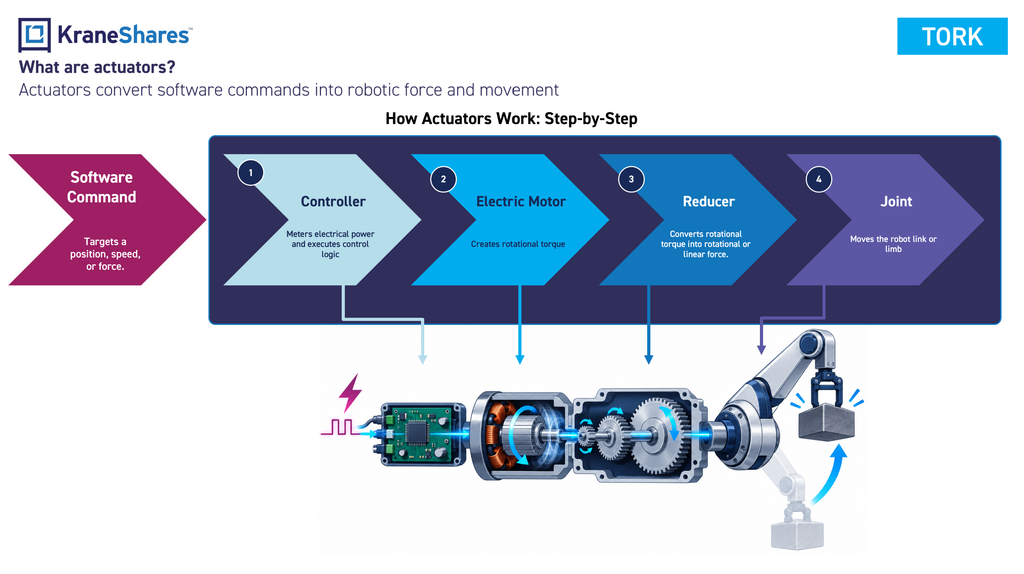
The controller manages electrical power and executes control logic; the motor creates torque; the transmission adapts that output to the movement required; and the joint moves the robot's limb. Sensors provide feedback so the system can adjust its position, speed, and force. Each component contributes to turning an AI command into a physical action.
What Does The Actuator Supply Chain Look Like?
The actuator supply chain spans four complementary categories. Together, these businesses supply the hardware and feedback systems needed to make robotic movement useful.
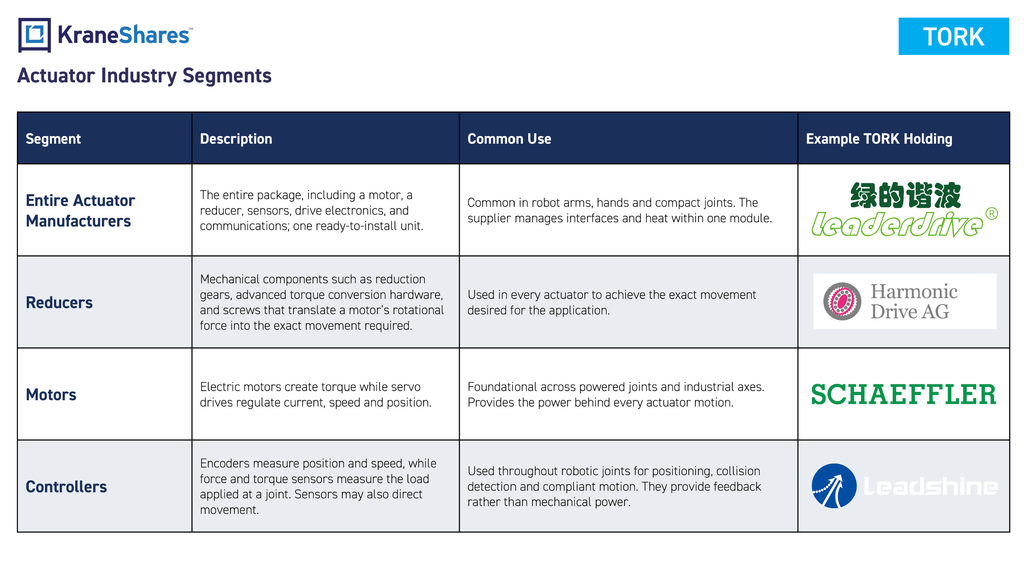
These categories address different parts of the same engineering challenge: delivering useful force within a compact, efficient, and reliable system.
A humanoid's shoulder must lift weight. Its legs must support its body and respond to changing balance. Its hands must manipulate objects with much finer control. Those tasks place different demands on actuator size, strength, responsiveness, and precision.
The number of actuators can also increase as robot designs become more capable. Tesla Optimus was designed using 28 body actuators and more than 50 miniature actuators in its hands.4 The investment opportunity depends not only on how many robots are produced, but also on the number and sophistication of the motion systems within each robot.
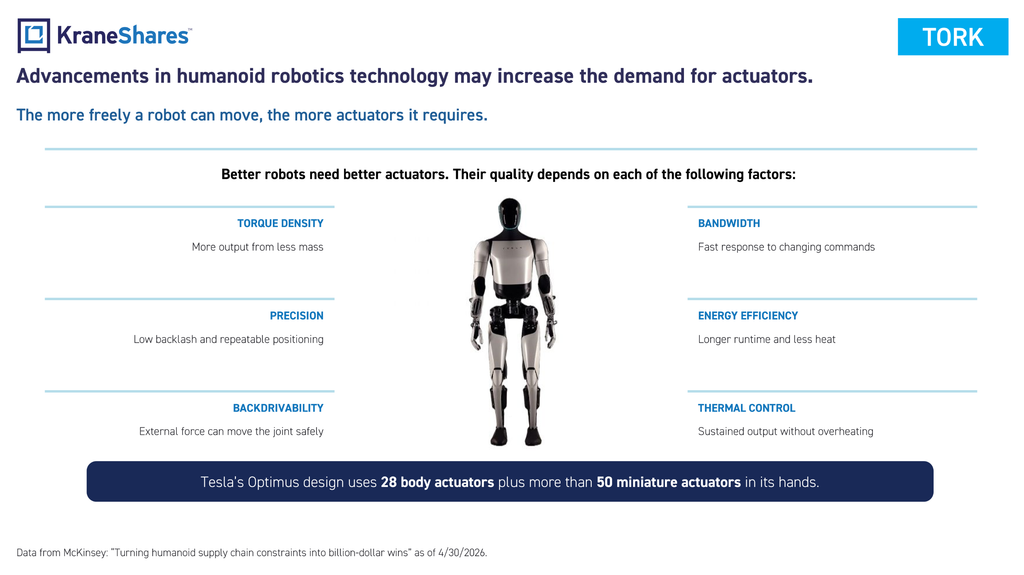
Improving one characteristic does not eliminate the need for the others. A powerful joint is less useful if it is too heavy, consumes too much energy, or cannot sustain its output. We believe the suppliers that help solve those trade-offs may become "winners" as humanoid designs advance.
Established Industrial Applications For Actuators
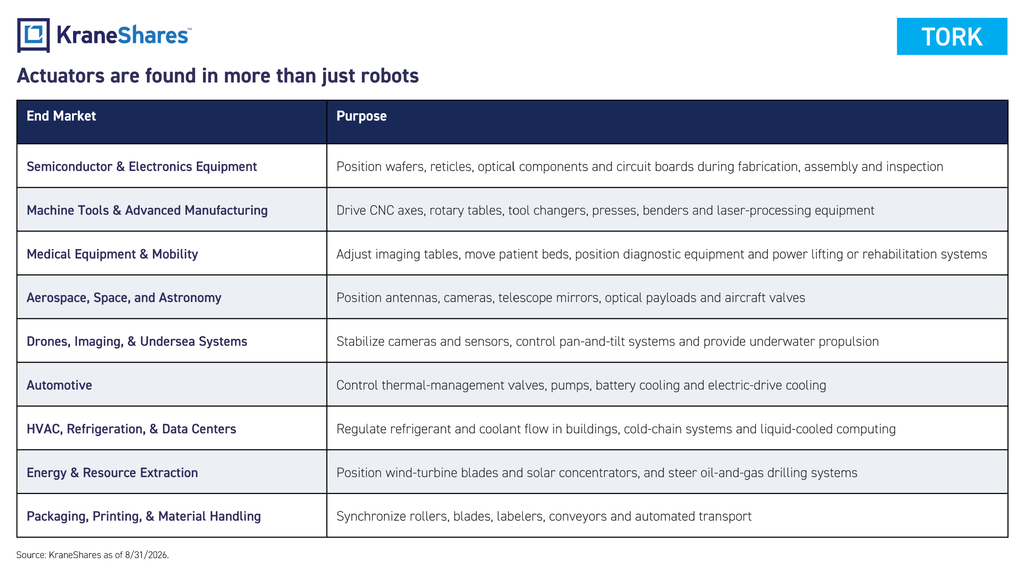
Humanoid robotics is an emerging market, but many of the companies supplying its motion systems already serve established industries. Actuators and precision-motion components are used in semiconductor equipment, machine tools, medical devices, aerospace systems, automotive applications, and material handling.
Those applications provide an important distinction between investing in robot developers and investing in their suppliers. An actuator company may participate in humanoid development while continuing to supply equipment manufacturers in other markets. That means the company's opportunity may extend beyond a single robot platform.
In semiconductor manufacturing, motion systems position wafers and optical components. In medical equipment, they adjust imaging tables and support rehabilitation devices. In industrial automation, they drive machine-tool axes, conveyors, and packaging equipment. Each application requires controlled movement, even when the machine looks nothing like a humanoid.
Actuator ETF TORK: Investing Across Motion Systems
We believe physical AI is increasingly becoming a motion-system challenge. More capable models can improve how robots interpret their surroundings and plan tasks, but executing those tasks requires motors, transmissions, and integrated joints that work together reliably.
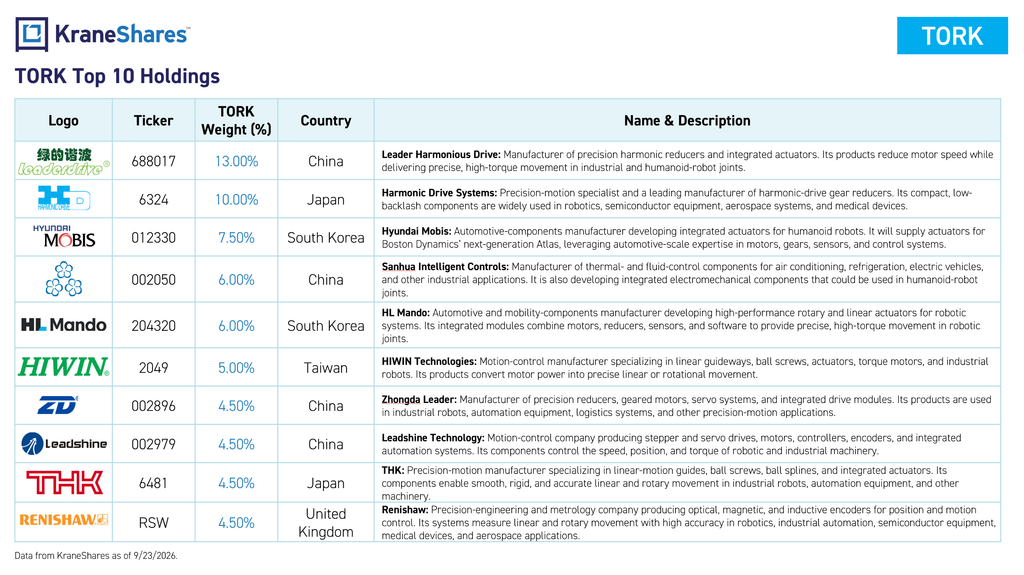
TORK's portfolio centers on the mechanical systems responsible for converting software commands into useful movement. As of September 23, reducers represented 49.2% of portfolio exposure, complete actuator manufacturers 27.8%, motors 18.5%, and controllers 4.5%.5 TORK offers a more focused allocation to motion-system suppliers within the broader physical AI ecosystem.
The leading humanoid platform may change as the industry develops. We believe the need to generate, transmit, measure, and control movement is likely to remain. TORK is designed to give investors targeted exposure to the companies building that physical foundation.
Additionally, TORK is designed to complement broader robotics exposure, which investors can get exposure to through the KraneShares Global Humanoid Robotics and Physical AI Index ETF (Ticker: KOID).
How Do TORK and KOID Complement Each Other?
KOID and TORK approach the same opportunity at different levels.
KOID offers exposure to humanoid robot makers and the broader supply chain behind them, including AI computing, sensing, mechanical systems, and critical materials. We believe that breadth is valuable because progress in humanoid robotics depends on several technologies advancing together, and the companies capturing that growth may extend beyond the manufacturers of finished robots.
TORK concentrates on the motion systems within that ecosystem. The funds overlap in their exposure to actuation, but TORK offers investors a more targeted allocation to the suppliers that turn AI commands into controlled movement. We believe that focus is valuable because better intelligence alone cannot solve the physical challenges of lifting, gripping, and walking.
Together, KOID and TORK allow investors to combine broad participation in humanoid development with a concentrated investment in what we believe to be one of the critical bottlenecks in physical AI.
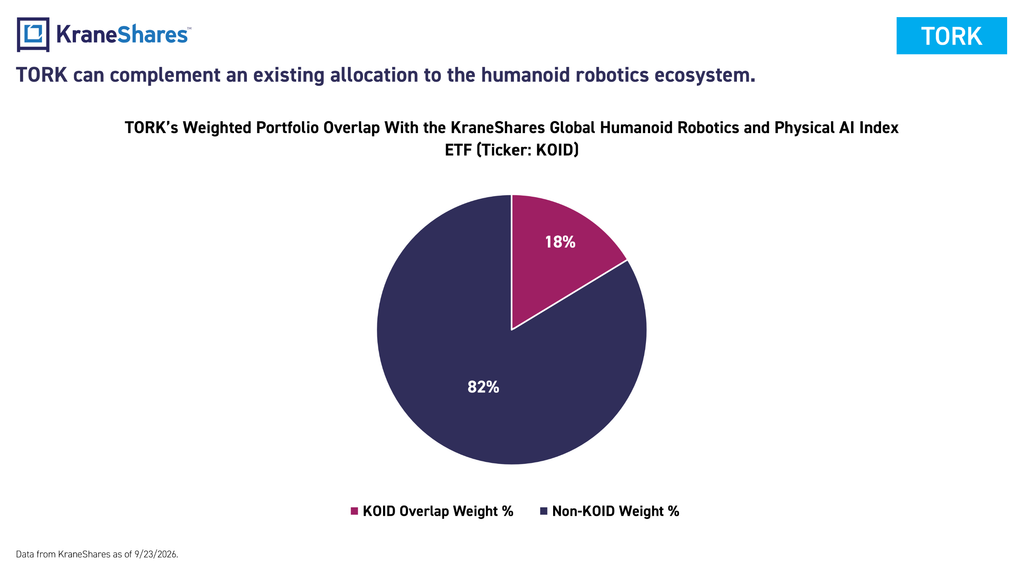
Holdings are subject to change.
For TORK top 10 holdings, risks, standard performance, and other fund information, please click here.
Citations:
- Data from TrendForce, "Humanoid Robots to Become the Next US-China Battleground," as of 2/24/2025.
- Data from Morgan Stanley Research, "The Humanoid 100," as of 2/6/2025.
- Data from Morgan Stanley Research, "Humanoids: A $5 Trillion Market," as of 12/31/2025.
- Data from McKinsey, "Turning humanoid supply chain constraints into billion-dollar wins," as of 4/30/2026.
- Data from Bloomberg as of 9/23/2026.
Term Definitions
Actuator: A system that converts energy and control commands into mechanical force or movement.
Torque: A turning force produced by a motor or applied at a joint.
Reducer: A mechanical transmission that reduces motor speed while increasing output torque.
Backlash: Mechanical play within a transmission that can affect positioning accuracy.
Backdrivability: The ability of an external force to move a joint through its drive mechanism.
Encoder: A sensor that measures position or movement and provides feedback to a control system.
Integrated actuator: A motion module combining components such as a motor, transmission, sensors, and drive electronics.
Physical AI: AI applied to machines that perceive and act in the physical world.
Total addressable market: The theoretical annual revenue opportunity for a market.