Are China’s AI Models The New Global Stars?
By  Henry Greene
China's AI models may be becoming the new global stars. Certain US and global technology firms have reported using lower-cost, China-developed large language models (LLMs) for certain applications.
We believe this development could significantly benefit China's internet sector by providing AI leaders, including KWEB holdings Minimax, Z.ai, Alibaba, and Tencent, with a stable and diversified revenue stream. It may also lead global markets to recognize these firms for the central roles they play not only in China's AI ecosystem, but also in AI development globally. Meanwhile, China-based models may benefit from increasing pricing power, while US-based models may become less profitable if they must lower prices to compete.
Our China internet and AI ETF the KraneShares CSI China Internet ETF (Ticker: KWEB) has expanded the scope of its portfolio to include new categories of internet companies, including large language model (LLM) providers like Minimax, data center operators like GDS Holdings, and enterprise cloud firms like Kingdee International, following a change to its index methodology. We believe these additions reflect the evolution of web-based businesses globally in recent years and mean that KWEB may fully represent AI-enabled internet development in China. It may also help KWEB capture opportunities from the rising popularity of China's AI models.
Why China's LLMs?
China's LLM providers, such as Alibaba's Qwen, DeepSeek, Tencent's Hunyuan, Baidu's Ernie Bot, Z.ai, and Minimax, offer what they may see as an attractive value proposition to global corporations. We believe LLMs from these providers generally offer greater versatility, open architecture, and significantly lower token pricing than their US counterparts, like Anthropic and OpenAI.
Earlier this year, businesses worldwide expressed concerns about rapidly rising bills from Anthropic and OpenAI. Many are now shifting their workloads toward cheaper alternatives, which often include China-based, open-source, and open-weight models.1 Based on published token pricing data, China-based models are charging as little as 18 cents per million tokens, compared to an average of around $4 for top U.S. models.2
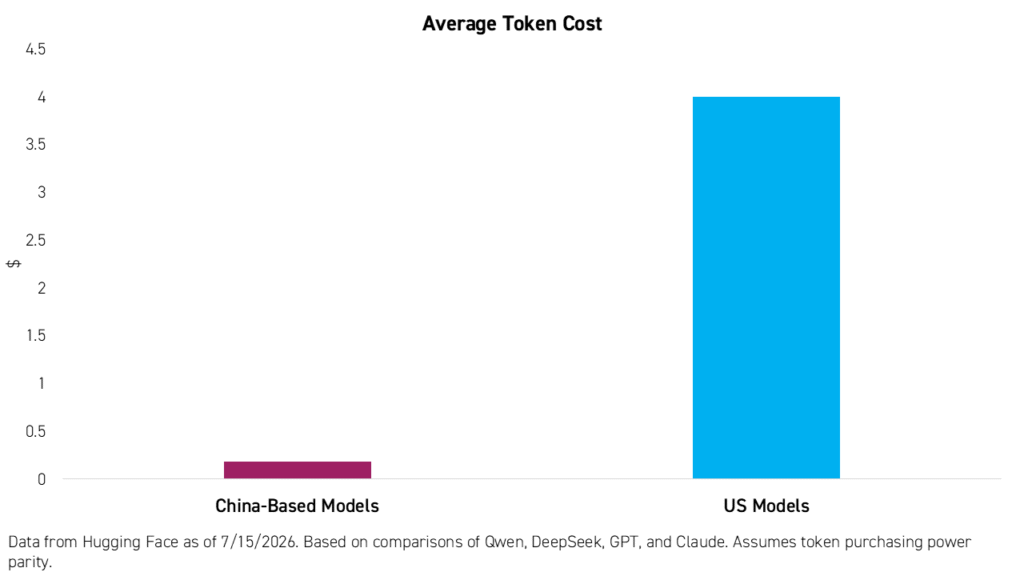
Of course, in life as in business, you tend to get what you pay for and China's LLMs are not always the most cutting-edge. However, in our view, they offer unique advantages that make for a compelling overall value proposition for certain customers.
Most China-based models, including Alibaba's Qwen, are highly versatile and can be customized down to the parameter level, a feature also called being "open weight". This means that companies can run them on their own infrastructure, fine-tune them internally, and avoid paying premium compute prices for every workload. That matters, especially for coding assistants, customer service, enterprise search, and internal automation tasks, where the absolute best, most cutting-edge model is not always economically justified.
Using the most cutting-edge model to direct calls, for example, is comparable to buying a Ferrari just to take trips to the grocery store. A simple, reliable model works just fine for this task, which is unlikely to become more complicated or even benefit at all from updates.
Evidence of US and Global Adoption
Thousands of US-based startups, companies, and academic researchers are now relying on China's open-source models, according to data from Hugging Face.2 At the same time, many of Silicon Valley's AI startups have built applications at least partly based on open-source models from DeepSeek, Moonshot AI, and Z.ai.3
Shopify and Airbnb have touted the benefits of Alibaba's Qwen 3 for scaling AI features. Meanwhile, Airbnb's CEO Brian Chesky said that the booking site relies heavily on Alibaba's Qwen because it is "very good, fast, and cheap."4 Lastly, cryptocurrency platform Coinbase said it has begun using open-weight models from Z.ai to cut nearly half its AI spending, despite increased token use.5
Price Advantage & Segmentation
Companies are likely to reserve premium U.S. models for high-stakes reasoning and frontier use cases. At the same time, we believe they will increasingly shift routine generation, support, and coding tasks to cheaper, open-weight models developed in China. This means that while China-based models are likely to see increasing demand from global corporations, they are unlikely to fully replace existing, premium models in key areas.
Why Now?
Several structural forces are converging all at the same time:
- Cost Inflation in Frontier AI: Seemingly, certain enterprises are reacting to rising inference bills from premium U.S. models by shifting noncritical workloads to lower-cost alternatives.
- Geopolitical Fragmentation: Export controls and procurement restrictions are creating parallel technology stacks, which increases the value and diversity of non-U.S. options.
- Cap-Ex Strategy Divergence: While US hyperscalers are investing heavily in their underlying semiconductor supply chain, their China-based counterparts have focused more on users’ needs today, providing them with subsidies and concessions and, in some cases, foregoing near-term profitability. In our view, this has led to a glut of affordable models and compute coming from China.
Implications for Investors
For investors, we believe the key takeaway is that China AI is moving from a domestic substitution story to a global price-disruption story, especially in model inference. The direct beneficiaries may include the China-based open-weight model developers and cloud providers that support those models. These include KWEB holdings Minimax, Z.ai, Alibaba, and Tencent, which are companies that KWEB currently offers exposure to.
Markets have already placed a premium on China's model makers, leading to strong performance that we believe has been driven by the assumption that they can compete with major US models on cost and efficiency. KWEB holdings Minimax and Z.ai, which focus exclusively on delivering and customizing models, are up 88% and 661%, respectively, since their IPOs on January 9th and 8th of this year, respectively, as of August 24, 2026.
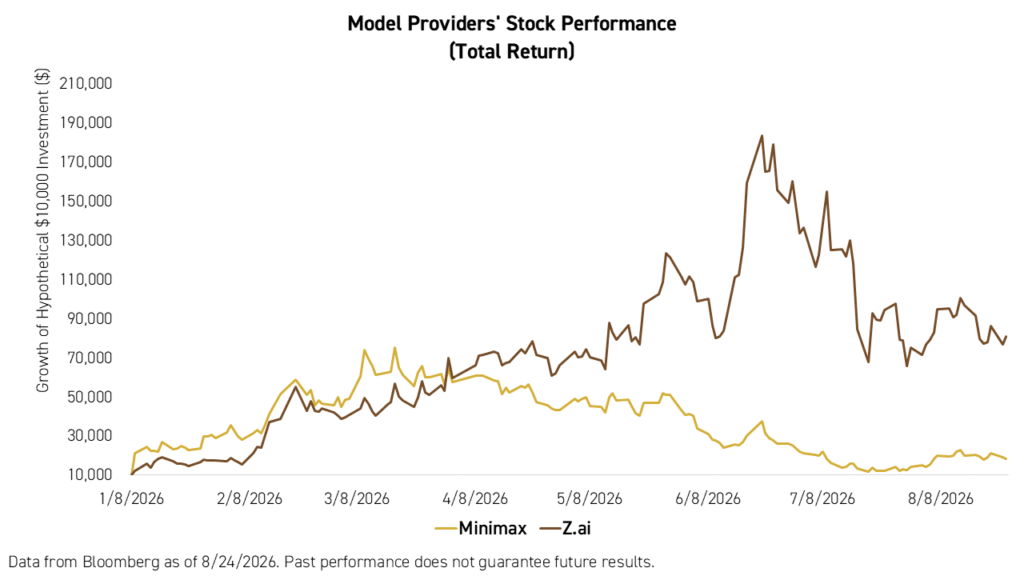
These model makers may be able to improve their profitability as markets search for an equilibrium price for AI model compute. AI models generally charge for usage through tokens, but they can also charge a subscription fee for access to premium features. Anthropic and OpenAI charge subscription fees for premium features, while also offering free versions. China's AI models, on the other hand, are generally free to use initially and download, but additional compute is charged through tokens. The token price is where the difference lies, with US models charging up to 22 times more, on average, for tokens.
We believe token prices will normalize on the global market over time. This could be a significant opportunity for China's model makers. If markets approach normalization, China's models may be able to raise their prices and increase their profitability, all while maintaining free access and free downloads to keep their flexibility and competitive edge. US-based models, on the other hand, will likely need to lower their token prices, which could negatively impact their profitability, in our opinion.
Conclusion
We believe China's AI models may be becoming the latest global AI stars as US and global technology firms seem to be increasingly using them for simple workloads, taking advantage of significant cost savings. We believe this development could significantly benefit China's internet sector by providing AI leaders, including KWEB holdings Minimax, Alibaba, and Tencent, with a diversified revenue stream. It may also help global markets recognize these firms for the central roles they play not only in China's AI ecosystem, but also in AI development globally. Meanwhile, China's model makers may have a chance to increase their token prices as the global market searches for an equilibrium price.
Citations:
- Tong, Anna. "Cheaper AI is Better: Soaring Bills Are Reshaping How Businesses Choose Models," Reuters. June 29, 2026.
- Data from Hugging Face as of 7/15/2026.
- Gordon, Nicholas. "China's Moonshot, Z.ai, and DeepSeek are challenging Silicon Valley's AI cost structure," Fortune. July 26, 2026.
- Sircar, Anisha. "Airbnb CEO Brian Chesky Called Chinese AI Fast And Cheap. Now Congress Wants Answers," Forbes. May 21, 2026.
- "Coinbase Switches to Chinese AI, Cutting Costs," The Chosun Daily. June 29, 2026.
KWEB Holdings Mentioned:
- Minimax (0.17% of KWEB Net Assets as of 8/27/2026)
- Z.ai (0.88% of KWEB Net Assets as of 8/27/2026)
- Kingdee International (1.20% of KWEB Net Assets as of 8/27/2026)
- GDS Holdings (1.58% of KWEB Net Assets as of 8/27/2026)