Healthcare ETF: Treatment Breakthroughs Make China A Medical Destination
By  Henry Greene
The Wall Street Journal recently published an article about a New Zealander who, after struggling to fight his non-Hodgkin lymphoma through available methods, flew to China to receive CAR-T therapy, a new way to treat cancer that was not yet available in his home country. The therapy worked and, according to the article, the patient achieved complete remission.
In our view, foreign patients traveling to China for advanced cancer treatments may provide one indicator of growing interest in the country's health care innovation ecosystem. Their willingness to cross borders, pay out of pocket, and manage the complexity of treatment abroad suggests that China increasingly competes not only on cost, but also on differentiated therapies, clinical capacity, and speed of access. Shanghai Sino United Hospital reportedly treated roughly three dozen CAR-T patients from 12 countries after opening the treatment pathway to international patients.1
CAR-T therapy is a personalized cancer treatment that removes disease-fighting immune cells called T cells from a patient, modifies them in a laboratory so they can recognize a specific marker on cancer cells, multiplies them, and returns them to the patient. Unlike chemotherapy, which uses drugs that circulate through the body and kill rapidly dividing cells—including some healthy cells—CAR-T seeks to direct the patient's own immune system toward a defined target and can continue working after infusion.2 China is advancing this approach at scale: A 2026 global analysis identified 1,006 Chinese CAR-T trials, compared with only 549 in the United States.3 In June 2026, China approved the world's first approved CAR-T therapy for a solid tumor.4
The investment significance extends beyond medical-tourism revenue. We believe this may be evidence that China is evolving from a fast-follower and low-cost manufacturer into a source of globally relevant medical intellectual property. Our China Healthcare ETF the KraneShares MSCI All China Health Care Index ETF (Ticker: KURE) may offer investors exposure to this evolution.
Medical Tourism: A Key Signal
During the first half of 2026, Chinese innovative-drug developers completed 81 overseas licensing transactions with aggregate potential deal value of approximately $110 billion.5 The reported value of these deals exceeded $120 billion by September 2026, with oncology among the key therapeutic areas attracting foreign partners.6 This follows the trend of increasing outbound pharmaceutical deals coming out of China, which historically saw far more deals to license foreign-developed drugs inside of the country, a practice that is also known as in-licensing. Outbound licensing deals surged to 186 in 2025 from only 70 in 2024.

Inbound patients and outbound licensing reinforce one another: We believe patient preferences may indicate the clinical relevance of therapies already available in China, while multinational pharmaceutical companies validate the scientific and commercial value of Chinese pipelines. Together, these trends indicate that global demand is beginning to recognize Chinese innovation at both the treatment and development levels.
Access Through KURE
Our China Healthcare ETF the KraneShares MSCI All China Health Care Index ETF (Ticker: KURE) provides a KURE provides a US-listed route to a portfolio of health care companies represented in the MSCI China All Shares Health Care 10/40 Index. KURE tracks the MSCI China All Shares Health Care 10/40 Index and holds healthcare companies listed in Mainland China, Hong Kong and the United States across biotechnology, pharmaceuticals, care providers, medical devices and traditional Chinese medicine.7
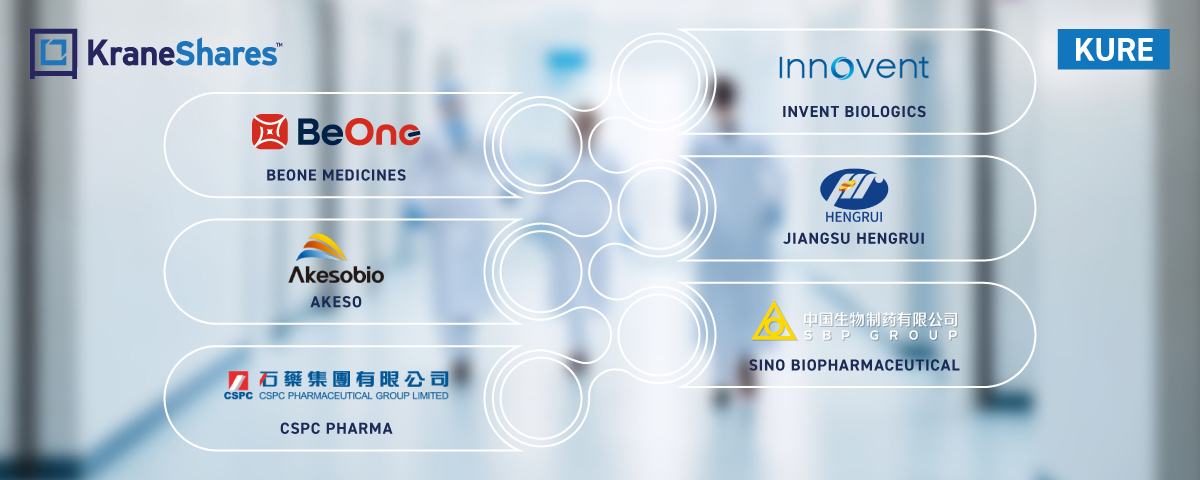
Within KURE, six holdings especially relevant to China's oncology innovation are Innovent Biologics, BeOne Medicines, Jiangsu Hengrui Pharmaceuticals, Akeso, Sino Biopharmaceutical, and CSPC Pharmaceutical Group. As of September 11, 2026, these companies represented 33.73% of KURE's net assets.7

Innovent Biologics
Innovent is KURE's largest holding and offers broad exposure to China's oncology ecosystem. Its commercial and development portfolio covers lung cancer, gastrointestinal cancers, and hematologic malignancies, while its next-generation strategy includes immuno-oncology combinations, antibody-drug conjugates and multi-specific candidates.8 The company could benefit from greater international confidence in clinical data from China, additional licensing partnerships, and rising domestic adoption of innovative therapies.
BeOne Medicines
BeOne is a China-founded oncology company achieving global commercial reach. It develops treatments across blood, lung, breast, gynecologic, gastrointestinal, and rare cancers, combining internal discovery with global clinical development and commercialization.9 Its presence in KURE gives investors exposure to oncology innovation originating from China but monetized across multiple markets.
Jiangsu Hengrui
Jiangsu Hengrui markets 16 oncology medicines in China, is advancing nearly 60 oncology candidates, and conducts more than 150 clinical trials across major oncology programs.10 Potential business drivers include domestic adoption of innovative drugs and overseas licensing opportunities.
Akeso
Akeso offers focused exposure to novel biologics and has an immunotherapy treatment that is currently being evaluated across numerous cancer settings.11 Akeso illustrates how China's health care companies are moving beyond follow-on products toward new therapeutic architectures that may be capable of attracting international clinical and commercial interest.
Sino Biopharmaceutical
Sino Biopharmaceutical combines an established commercial base with a growing innovative-oncology portfolio. Its 2025 acquisition of LaNova Medicines added antibody-drug conjugate and immuno-oncology capabilities, reinforcing a pipeline built around oncology, hepatology and cardiometabolic disease.12 The company offers broader exposure than a pure-play biotechnology firm and could benefit as Chinese cancer assets gain domestic adoption and international licensing value.
CSPC Pharmaceutical Group
CSPC provides exposure to several next-generation platforms, including antibody-drug conjugates, targeted therapies and CAR-T. Its oncology pipeline includes candidates for lung, breast, gastric and hematologic cancers, while its cell-therapy work includes an in-vivo CAR-T candidate authorized for clinical trials in China.13 This platform breadth makes CSPC a potential beneficiary of both China's treatment innovation and rising global interest in China-originated drugs.
KURE: A Basket Approach
Single-company biotechnology investing carries substantial clinical, regulatory and commercialization risk. KURE is designed to distribute that risk across multiple oncology developers and the broader healthcare value chain while retaining a 33.73% allocation to the above six companies that are involved in the field of oncology.
Conclusion
In our view, foreign patients seeking advanced treatments in China are a testament to the country's emergence as a health care innovator. While medical tourism is nothing new, China is different from other destinations. Rather than offering discounted platic surgeries or dental procedures, China is delivering cutting-edge science before it becomes available elsewhere. The more durable investment signal may not be the immediate revenue from inbound patients, but rather the external validation of China's scientific capabilities, clinical infrastructure, and ability to develop differentiated oncology products.
KURE offers access to this trend. Innovent, BeOne, Hengrui, Akeso, Sino Biopharmaceutical, and CSPC, which combined represent 33.73% of the fund as of September 11, 2026, provide focused exposure to oncology discovery, development, and commercialization, while the remainder of the ETF broadens potential participation across China's healthcare value chain. For investors seeking access to Chinese medical innovation without focusing on a single company or therapy, KURE may provide one potential way to gain exposure through a portfolio of health care companies.
The profitability of companies in the health care sector may be affected by government regulations and government health care programs, government reimbursement for medical expenses, increases or decreases in the cost of medical products and services, limited product lines, increased emphasis on the delivery of health care through outpatient services and product liability claims. Many health care companies are heavily dependent on patent protection, which may be time consuming and costly, and the expiration of a company's patent may adversely affect that company's profitability. Health care companies are subject to competitive forces that may result in pricing pressure, including price discounting, and may be thinly capitalized and susceptible to product obsolescence. Many new products in the health care sector require significant research and development and may be subject to regulatory approvals, which may be time consuming and costly and with no guarantee that the product will come to market.
Citations:
- Becker's Hospital Review. "China Becoming CAR-T Destination for US Patients: WSJ," Becker's Oncology September 7, 2026
- National Cancer Institute. "T-Cell Transfer Therapy," National Cancer Institute. September 23, 2019.
- Lai, C., et al. "A Global Multidimensional Analysis of the Chimeric Antigen Receptor T-Cell Therapy Landscape," PubMed Central. 2026.
- AABB. "China Approves World's First CAR-T Cell Therapy for Solid Tumors," AABB. June 30, 2026.
- Reuters. "China Innovative Drug Out-Licensing Deal Value Reaches New High in First Half 2026," Reuters. July 13, 2026.
- Xinhua. "China's Innovative Drugs Gain Wider Global Reach, Signaling Growing Recognition,” Xinhua. September 14, 2026.
- Data from KraneShares as of 9/11/2026.
- Innovent Biologics as of 8/24/2026.
- BeOne Medicines as of 8/24/2026
- Jiangsu Hengrui Pharmaceuticals as of 5/31/2026.
- Akeso as of 9/10/2026.
- Sino Biopharmaceutical. "JPM 2026: Sino Biopharm Leads in siRNA and Tumor Innovation," Sino Biopharmaceutical. January 15, 2026.
- CSPC Pharmaceutical Group as of 9/10/2026.
Definitions:
CAR-T cell therapy: A treatment that removes immune cells called T cells from a patient, modifies them in a laboratory so they can recognize a marker on cancer cells, multiplies them, and returns them to the patient through an infusion. The engineered cells then seek out and attack cancer cells carrying that marker.cancer+1
Chimeric antigen receptor (CAR): A laboratory-designed receptor added to a T cell. It acts like a specialized sensor that allows the cell to identify a particular protein on a cancer cell.cancer
Chemotherapy: Treatment using drugs that kill or stop the growth of rapidly dividing cells. Unlike CAR-T, chemotherapy generally circulates throughout the body and can damage healthy fast-growing cells as well as cancer cells.
Immunotherapy: A broad category of treatments that use or strengthen the immune system’s ability to recognize and attack cancer. CAR-T is one form of immunotherapy.
Targeted therapy: Treatment designed to interfere with a particular molecule, protein, or biological pathway that helps cancer grow. It is more selective than conventional chemotherapy, although it can still affect healthy cells.
Cell therapy: Treatment in which living cells are administered to a patient. In CAR-T therapy, the medicine is made from genetically modified immune cells.
Gene therapy or genetic engineering: The introduction, removal, or modification of genetic material in a cell. CAR-T production adds genetic instructions that tell T cells to make the cancer-recognizing CAR.
Infusion: The delivery of medicine, blood products, or cells into the bloodstream through a vein. CAR-T cells are normally returned to the patient this way.
T cell or T lymphocyte: A type of white blood cell that helps the immune system identify and destroy infected or abnormal cells. CAR-T therapy reprograms these cells to recognize cancer.
Immune system: The body’s network of cells, tissues, and organs that protects against infection and abnormal cells.
Monoclonal antibody: A laboratory-produced protein designed to bind to one specific target, such as a protein on a cancer cell.
Antibody-drug conjugate: A targeted medicine that links an antibody to a cancer-killing drug. The antibody guides the drug toward cells carrying a particular marker.
Remission: A period when the signs and symptoms of cancer have substantially decreased or disappeared. Remission does not always mean the cancer has been permanently cured.
Complete response or complete remission: The disappearance of all detectable signs of cancer following treatment. It does not necessarily guarantee that the disease will never return.
Biotechnology or biotech: The use of living cells, biological processes, or genetic technology to develop medicines and other products.
Biopharmaceutical: A medicine produced using biological systems, such as cells or proteins, rather than solely through conventional chemical synthesis.
Innovative drug: In the Chinese healthcare context, generally a newly developed medicine based on a novel molecule, biological mechanism, formulation, or therapeutic approach rather than a copy of an existing drug.
Multi-specific candidates refer to a fast-growing class of engineered therapeutic molecules—primarily multi-specific antibodies designed to bind to two or more distinct biological targets or epitopes simultaneously.