A Complete Guide to DeepSeek’s 2026 IPO: What It Means For China ETF KSTR
By  Henry Greene
DeepSeek has already demonstrated the ability to move markets as a private company. The AI startup's first "moment" in January of 2025 was a shock to global AI valuations: Its low-cost R1 model contributed to the selloff of $589 billion off Nvidia's market cap in a single session.1
We believe its second moment could be unfolding domestically: DeepSeek has hired CITIC Securities to prepare a STAR Market IPO in Shanghai, potentially at a valuation near $75 billion.2 If it achieves this valuation, it would potentially be positioned as an anchor name in China's broader wave of AI listings alongside Z.AI, MiniMax, and Moonshot.
We believe the IPO will test whether the onshore market can properly price and absorb one of China's most technically respected AI lab. It is the latest in a series of listings on China's premier domestic exchange for high-growth technology companies: the Shanghai Stock Exchange's STAR Market. Earlier this year, the STAR Market hosted the public market debuts of memory chip giant CXMT and robotics juggernaut Unitree.
However, unlike CXMT and Unitree, which are AI hardware plays, DeepSeek is a pure play on AI model development and commercialization like OpenAI and Anthropic. This would represent the first onshore listing of a non-physical AI company. Other China-based model providers have gone public in Hong Kong.
Why DeepSeek's IPO matters for China Technology & Semiconductor ETF KSTR
KraneShares has its own STAR Market ETF, the KraneShares China Technology & Semiconductor STAR 50 Index ETF (Ticker: KSTR), which tracks the SSE STAR 50 Index, a benchmark of the 50 largest and most liquid companies on the STAR Market. KSTR does not currently hold DeepSeek, and future index inclusion would depend entirely on where DeepSeek's market cap ends up after listing. DeepSeek is targeting a valuation of nearly $75 billion. That valuation would make DeepSeek the fifth-largest company listed on the STAR Market, based on market prices on September 28, 2026,3 potentially making it eligible for fast-track inclusion in the index.
DeepSeek IPO Status, Size, & Timeline
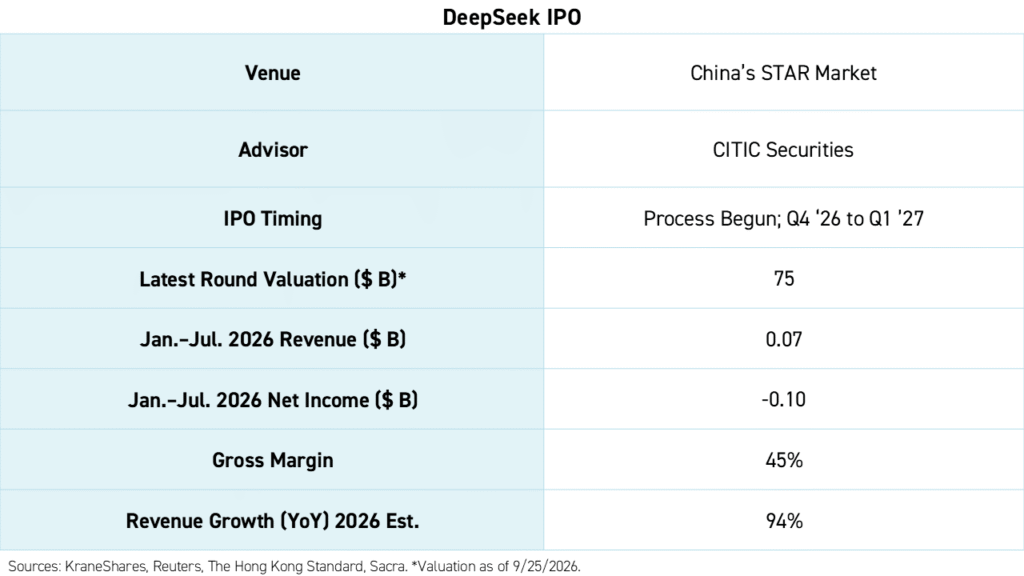
While a date has not been set for the IPO just yet, the public announcement that the company has hired CITIC Securities as a key underwriter for the listing is a sign that it is most likely happening. DeepSeek also recently named its first-ever CFO, Yan Wentao, a governance step that typically precedes a listing push.4 As such, we estimate the IPO will occur either in the fourth quarter of 2026 or the first quarter of 2027.
Estimates for DeepSeek's financials indicate that the company is growing revenues rapidly5 but remains unprofitable.6 While its hyper-efficient models have garnered worldwide attention, the AI lab has not yet reached the scale of US AI giants OpenAI and Anthropic. The open-source nature of the company's models means that it is more susceptible to intense competition, especially from well-funded hyper-scalers with their own model programs and massive cloud infrastructure, like Alibaba.
Nonetheless, we believe DeepSeek has demonstrated that it can monetize broad model adoption. Meanwhile, the startup continues to lower inference costs as it adjusts its models, which were already some of the most efficient globally, leading to potential profitability down the road.7
Cost Competition: DeepSeek vs. MiniMax & Z.AI
We believe the most relevant publicly listed companies to be compared with DeepSeek are pure play model providers MiniMax and Z.AI, both of which listed in Hong Kong in January. Notably, DeepSeek has achieved a higher gross margin than either company.
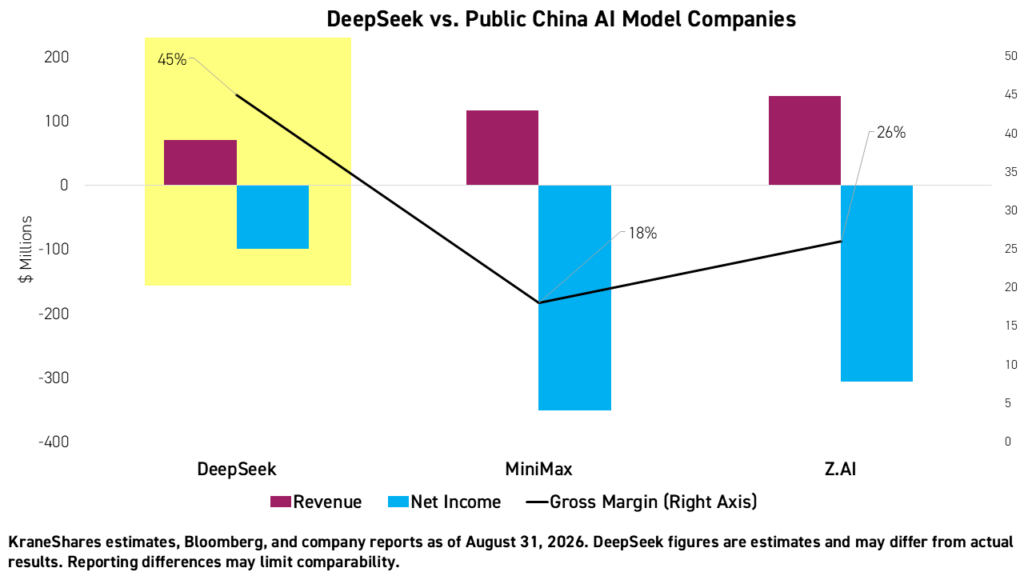
The higher gross margin could suggest that DeepSeek is paying significantly less for inference. We know that MiniMax, for example, purchases compute power from Alibaba Cloud. Assuming DeepSeek is paying the same per-unit rate for compute, its models are more than twice as efficient as MiniMax.
Furthermore, the cost gap has only widened in 2026. Z.AI's per-unit inference costs reportedly fell roughly 80% since the start of the year, lifting its gross margin significantly.8 Meanwhile, MiniMax has improved its gross margin by a more modest 6% since the start of the year.9 While both are making significant strides in cost reduction, DeepSeek is also making progress and from a much lower base.
DeepSeek's V4.1 Flash is said to deliver frontier-level agentic capability on par with GPT 5.6-Sol and Claude Opus.10 Rates start at a 60% lower cost compared to its previous top model.10
Frontier-level benchmark performance at a fraction of the price is precisely the dynamic that rattled global AI markets in January 2025. It will also likely be the same efficiency edge public investors will be betting on when DeepSeek lists. So far, DeepSeek continues to deliver.
DeepSeek: A Pure Play On China's Intellectual Property
Recent blockbuster STAR Market IPOs CXMT and Unitree were both AI hardware plays. DeepSeek, on the other hand, is a pure play on China-developed intellectual property. This is like the first "DeepSeek moment", which we believed demonstrated to the world that China can innovate in artificial intelligence, compete with US giants, and even call into question the expected demand levels for chip design giants like Nvidia.
The IPO is effectively their second act. The listing may offer a financial validation of this initial breakout moment. We believe the IPO could usher in a new phase for the development of China's onshore capital markets and the STAR Market, opening both up to more listings of companies whose key strength is intellectual property, as opposed to advanced manufacturing capabilities.
Conclusion
We believe the second "DeepSeek" moment is coming. This time, it is within China's onshore capital markets. This will be an important test case of whether China's onshore market, specifically the STAR Market, can properly value a pure play AI company without a physical AI component. DeepSeek is a pure play on China-developed intellectual property and the development and commercialization of AI models, akin to Anthropic and OpenAI in the United States. DeepSeek's key competitive advantage is efficiency and it continues to lower costs versus key China competitors MiniMax and Z.AI. Will this next "DeepSeek moment" will have the same power to move markets?
As of 9/28/2026, KSTR does not hold DeepSeek. There is no assurance that DeepSeek will complete an IPO or be included in KSTR's underlying index or portfolio.
Citations:
- Carew, Sinead. "DeepSeek sparks AI stock selloff; Nvidia post record market-cap loss," Reuters. January 27, 2025.
- Reuters Exclusive. "China's DeepSeek taps CITIC Securities for domestic IPO, sources say,” September 9, 2026.
- Data from Bloomberg as of 9/28/2026.
- Reuters. "China's DeepSeek hires dealmaker as CFO ahead of possible IPO," Reuters. September 14, 2026.
- Reuters. "China's DeepSeek annualised revenue run rate hits $1 billion, the Information reports," Reuters. September 24, 2026.
- Farooque, Mox. "DeepSeek Sends Strong Signal Ahead of Funding Push," Guru Focus. September 24, 2026.
- Brennan, Aoife. "From Cost Cutting to Capital Raising: DeepSeek Goes All In on new Model, In-House Chip, and IPO - Will It Reshape the U.S.-China AI Rivalry?" The Economy News. September 14, 2026.
- HKEX. "Z.AI: INTERUM RESULTS ANNOUNCEMENT FOR THE SIX MONTHS ENDED JUNE 30, 2026," Futu Bull. August 31, 2026.
- Press Release. "MiniMax Announces First Half 2026 Financial Results," MiniMax. August 26, 2026.
- DeepSeek, "Introducing DeepSeek-V4.1-Flash: smarter, faster, more efficient," as of 9/9/2026.