
Cannonball, Cavalry, or Complacency: Interpreting The Latest Chinese Government Economic Outlook In Advance Of The Next Trump-Xi Summit
By  Brendan Ahern &
  Cole Wenner
Is the Chinese government signaling that more meaningful economic stimulus focused on domestic consumption is coming? A recent four-part People's Daily commentary series, together with public statements from China's leading economic agencies, points to a sharpened focus on domestic consumption, housing stabilization, small-business support, and more effective fiscal and monetary policy.
The backdrop is mixed. China reported 4.7% gross domestic product (GDP) growth in the first half of 2026, within its 4.5% to 5.0% target range; the People's Daily series also argued that China accounted for roughly 30% of global growth.1 Yet officials have been candid about the weak spot: consumer demand.
Retail sales rose just 0.6% year-over-year (YoY) in July, down from 1.0% in June and below consensus expectations of 1.5%.2 Meanwhile, China's official non-manufacturing Purchasing Managers' Index (PMI) held at 49.0 in August, below the 50 threshold that separates expansion from contraction; the services business-activity index was 49.3.2 Together, we think the data reinforces Beijing's message that reviving household spending and service-sector activity has become an important policy priority.
With further fiscal and financial measures under consideration for the second half of 2026, as well as the Trump-Xi summit and the late-September Politburo meeting approaching, we believe investors may be underestimating the potential for policy, economic, and diplomatic upside.
An Authoritative Policy Signal
From August 22 through August 25, People's Daily published four articles under the "Zhong Caiwen" name, a collective pseudonym generally associated with China's Central Financial and Economic Affairs Commission. The pieces addressed China's economic resilience, its importance to global growth, first-half GDP performance, and the path toward "high-quality development."

The articles were constructive, but the final commentary carried the clearest policy signals. It stated that China would "continue to implement a more proactive fiscal policy and a moderately loose monetary policy," and called for "sustained efforts" to expand domestic demand. It also identified technological innovation, support for micro, small, and medium-sized enterprises, and real-estate stabilization as policy priorities.
The government's other messages were similarly direct. Following the June economic data release, the National Bureau of Statistics said that "the contradiction between strong domestic supply and weak demand is prominent." It subsequently cited Politburo guidance to "optimize and implement the policy of fiscal and financial coordination to promote domestic demand." Premier Li Qiang and the State Council likewise stated that "the problem of insufficient domestic demand is still prominent" and called for faster implementation of the plan to "expand domestic demand."
China's Ministry of Finance has provided the most explicit indication that further support may follow. Vice Minister Liao Min said policymakers were continuing to study new fiscal-financial coordination measures for the second half of 2026. Subsequent measures from the Ministry of Finance, People's Bank of China, and State Administration of Financial Regulation focused on improving loan availability for smaller businesses and strengthening fiscal-financial coordination to boost domestic demand.
Consumption and Innovation
The intended policy mix appears to be two-pronged: near-term support for consumption and longer-term investment in advanced industries. China's domestic demand weakness is closely tied to the knock-on effects of the housing downturn, which has weighed on confidence and household spending. Policymakers have therefore emphasized a range of potential supports, including consumer credit, small-business lending, housing stabilization, auto trade-in programs, and services consumption.
At the same time, China is reinforcing sectors that are already supporting growth. The Ministry of Industry and Information Technology has highlighted artificial intelligence (AI), smart robotics, sixth-generation wireless technology (6G), electric vehicles (EVs), new-energy storage, and other emerging "pillar industries." These themes complement China's role as a major supplier of AI-related hardware, including electronic components, communications equipment, semiconductors, and semiconductor materials, as well as clean-energy products such as EVs, solar panels, and wind turbine equipment.
Additionally, this theme is backed by a series of highly publicized initial public offerings (IPOs) like the world's leading humanoid manufacturer, Unitree, and China's new largest stock by market capitalization, semiconductor company CXMT. In the frontier model space, MiniMax and Z.AI went public in January of 2026, and reports also state that DeepSeek is looking to go public later this year.
China is not simply trying to preserve an export-led model; the policy objective appears to be to maintain industrial and technology competitiveness while increasing the contribution of household consumption to growth.
Trade and Diplomacy
China's manufacturing strength has seemingly intensified trade tensions with the United States and Europe, particularly in clean technology and advanced hardware. But trade discussions often understate the role of services, things like financial services, professional services, entertainment, and intellectual property. The US is the world's largest cross-border exporter of services, and China is its 4th largest customer.3
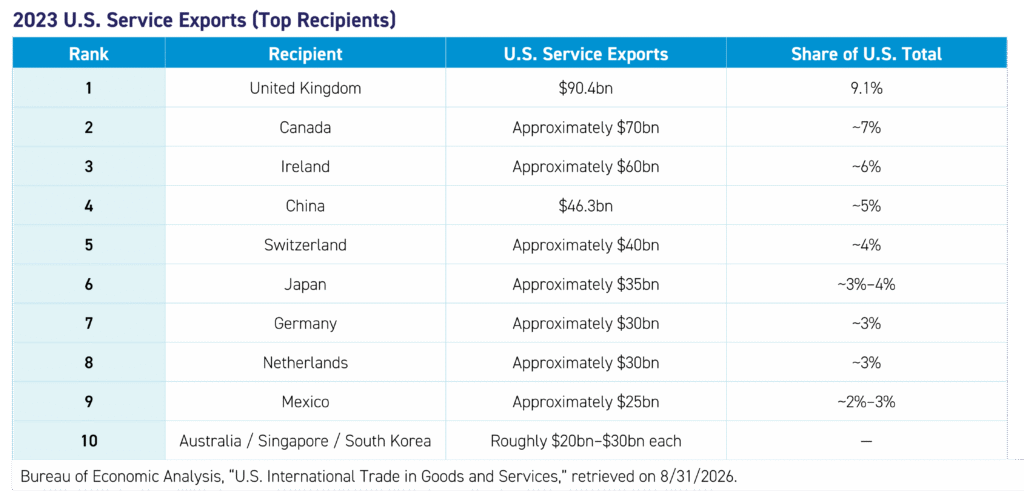
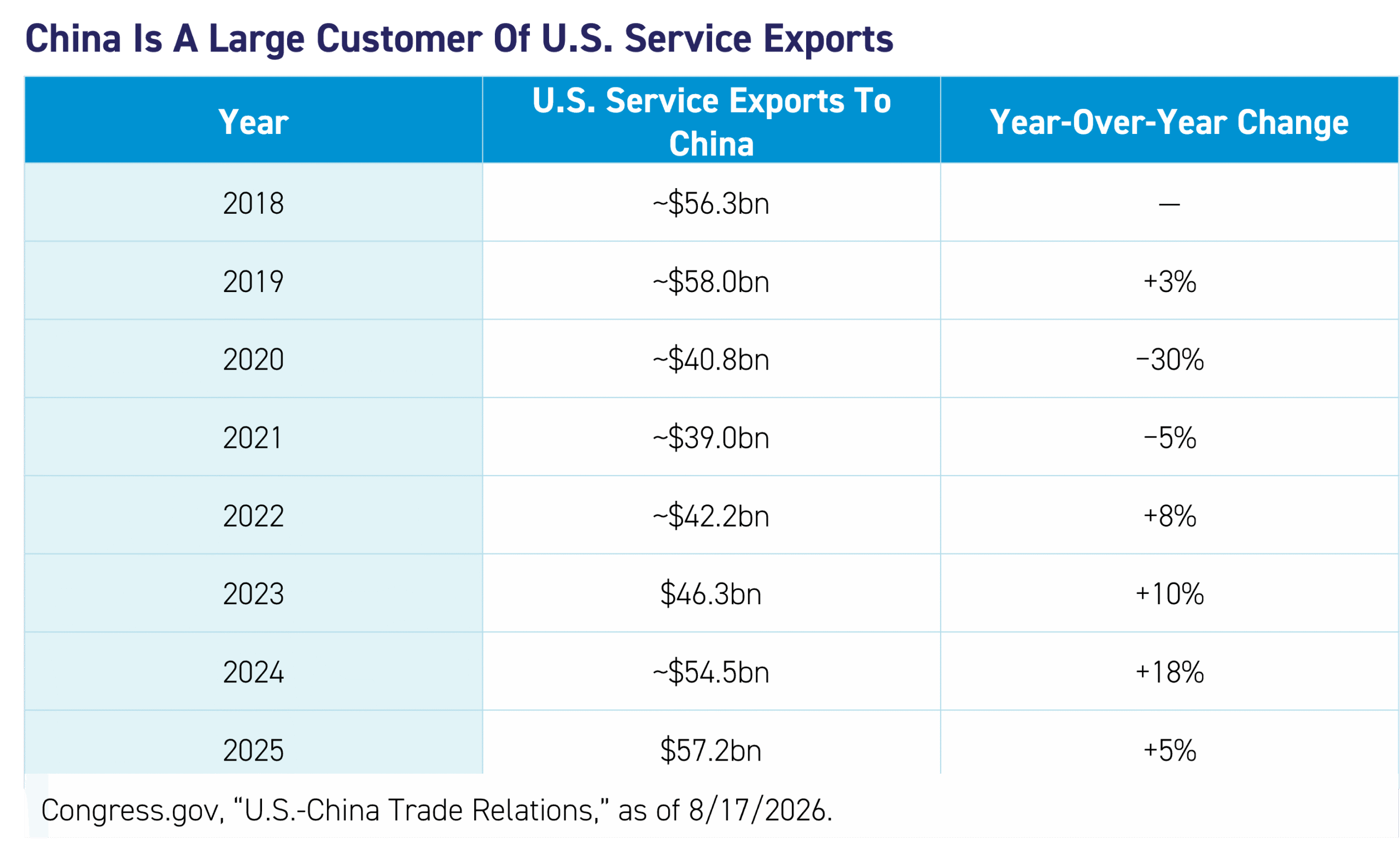
While Trump has historically focused on the physical goods trade deficit with China, as illustrated by his strong focus on tariffs, the Trump-Xi summit could extend to services. In 2025, China accounted for 4.6% ($57.2 billion) of U.S. service exports, a 5% increase from 2024.4 When goods and services are considered together, we think the "trade imbalance" disappears. Services could also be a secondary bargaining chip for China, since it is such a large customer of US services. We believe it would be in the best interests of both countries to preserve commercial access, reduce disruption to supply chains, and maintain links between their business communities.
Trade statistics can also obscure the economics of global supply chains: products assembled in China for US multinationals may be treated as Chinese exports even when intellectual-property income, brand value, and a significant share of profits accrue to US companies. Additionally, trade war discussions often overlook the significant exposure of US firms that make money directly in China.
When the first trade war was heating up, the official research and analysis blog published by the Federal Reserve Bank of New York, "Liberty Street Economics," released a report arguing that total sales (exports plus multinational sales) in China by majority U.S.-owned affiliate firms are overlooked. We believe the report's observation still holds true today, even if the underlying trade and affiliate-sales figures have changed.

During the first trade war, U.S. total sales were only 11 percent lower than those of Chinese firms in the U.S. market ($570 billion).4 More recently, in 2023, sales in China by majority U.S.-owned affiliate firms were $475.2 billion.5
Recent engagement between senior officials, policy groups, legislators, and business leaders suggests that dialogue remains active. That does not guarantee a breakthrough, but it creates scope for more constructive rhetoric, specific commercial announcements, or incremental progress on bilateral issues.
The Market Setup
The "cannonball"?
The Trump-Xi summit may be an underappreciated catalyst. It could produce improved dialogue, commercial cooperation, or progress toward easing trade and geopolitical tensions. Its timing also matters because it occurs shortly before the late-September Politburo meeting, when Beijing may provide greater clarity on measures to support consumption, housing, and growth. The precedent is notable: at the September 2024 Politburo meeting, Chinese leaders coupled a pledge to support growth with property-sector measures, including lower mortgage rates and relaxed housing-purchase restrictions.
The "cavalry"?
Domestic demand support could be the more direct economic catalyst. The Zhong Caiwen commentaries, Politburo guidance, State Council messaging, and Ministry of Finance actions all emphasize household spending, small-business support, housing stabilization, and fiscal-monetary coordination. There are significant fiscal and financial measures currently under review. If they are approved, they could support consumption-oriented sectors and reduce China’s reliance on exports to drive growth.
"Complacency"?
China equities may be positioned for a convergence of positive developments: more consequential consumption support, signs of property-market stabilization, stronger corporate activity, and lower US-China tensions. Investor sentiment remains constrained by macroeconomic uncertainty, property weakness, regulatory concerns, and geopolitics. In our view, relatively light positioning could make the market more sensitive to positive surprises in policy implementation or diplomatic outcomes.
Positioning for China's Priorities
The policy message highlights two potential themes for Chinese equity investors: domestic consumption recovery and innovation-led industrial development. The KraneShares CSI China Internet ETF (KWEB), KraneShares China Technology & Semiconductor STAR 50 Index ETF (KSTR), and KraneShares Bosera MSCI China A 50 Connect Index ETF (KBA) provide differentiated ways to gain exposure to these themes.
KWEB: Consumption and China AI
China Internet ETF KWEB provides exposure to China's digital economy, including E-Commerce, online services, digital entertainment, travel, advertising, cloud computing, and AI, through holdings such as Alibaba, Tencent, PDD Holdings, JD.com, Baidu, and Meituan.
A more forceful effort to lift domestic demand could be constructive for businesses tied to online retail, local services, travel, advertising, entertainment, and consumer platforms. Potential support for consumer credit, auto- and home-related spending, and services consumption could be particularly relevant to China's digital consumer ecosystem.
KWEB also provides exposure to companies seeking to monetize AI through cloud services, search, advertising, logistics, enterprise software, and consumer applications.
KSTR: Technology Hardware and AI Infrastructure
China Semiconductor ETF KSTR seeks to track the SSE Science and Technology Innovation Board 50 Index, known as the STAR 50 Index. Shanghai's STAR Market is designed for next-generation technology and strategic emerging-industry companies.
KSTR may be relevant to China's export and innovation themes. China remains a key supplier of electronic components, communications equipment, semiconductors, and semiconductor materials, areas that could benefit if global spending on AI infrastructure, data centers, and communications networks remains robust. KSTR's portfolio includes humanoid manufacturer Unitree, and semiconductor makers CXMT and Cambricon. Additionally, frontier model company DeepSeek has filed for an IPO on China's STAR Market.
KSTR may also benefit from China's domestic support for technological self-sufficiency, AI, robotics, advanced manufacturing, and emerging "pillar industries."
KBA: Large-Cap China A-Shares
China A-Share ETF KBA is designed to provide exposure to some of China's largest and most liquid Mainland companies, an area of the market that may be particularly relevant if global investors increase allocations to China's onshore equity market.
KBA offers broader exposure to China's domestic economy than the more sector-specific KWEB and KSTR strategies. Its portfolio spans financials, information technology, industrials, consumer staples, consumer discretionary, materials, health care, utilities, and energy. Its holdings have included companies linked to domestic consumption, financial-system activity, manufacturing, clean technology, and AI-related infrastructure, such as Kweichow Moutai, China Merchants Bank, Contemporary Amperex Technology, BYD, Foxconn Industrial Internet, and Cambricon Technologies.
A more meaningful policy response focused on consumption, housing stabilization, credit transmission, and small-business support could have implications across this broader A-share universe.
For KWEB standard performance, top 10 holdings, risks, and other fund information, please click here.
For KSTR standard performance, top 10 holdings, risks, and other fund information, please click here.
For KBA standard performance, top 10 holdings, risks, and other fund information, please click here.
Citations:
- People's Daily, "What does China's 4.7 percent growth in the first half of 2026 tell us," as of 8/25/2026.
- Data from Bloomberg as of 9/10/2026.
- Bureau of Economic Analysis, "U.S. International Trade in Goods and Services," retrieved on 8/31/2026.
- Liberty Street Economics, "The Investment Cost of the U.S.-China Trade War," as of 5/28/2020.
- Congress.gov, "U.S.-China Trade Relations," as of 8/17/2026.