Physical AI ETF KOID: NVIDIA, Unitree, Sharpa, and the Next Leg of the Humanoid Trade
By  Cole Wenner
NVIDIA just made a major move into humanoid robotics, and it chose Unitree as its launch partner.
On May 31st, 2026, NVIDIA announced the launch of its NVIDIA Isaac™ GR00T Reference Humanoid Robot, described as “the first open humanoid robot reference design” built on its Jetson Thor™ chip and Isaac GR00T development platform.1
Put simply, this will be a humanoid robot integrated with a software stack that labs can buy off the shelf to train and test applications on, rather than building everything from scratch.
For investors interested in the humanoid robotics opportunity, KraneShares’ physical AI ETF, KOID, provides exposure to the “brain” of the humanoid (semiconductors & technology), the “body” (actuation systems, mechanical systems, sensing & perception, and critical materials), and the “builders” (the companies that actually manufacture humanoids).
A Global Supply Chain for Physical AI
An important angle to this story is who is involved. This reference platform is not just a U.S. project. It is a cross‑border effort that mirrors the global nature of the semiconductor and AI supply chains.
NVIDIA is a U.S. company, Unitree is based in China, and Sharpa is in Singapore. Together, they are stitching together a humanoid “supply chain” that looks a lot like the semiconductor stack investors already know: NVIDIA designs chips, a partner like Taiwan Semiconductor manufactures them, and a global network of system makers and original equipment manufacturers (OEMs) builds on top.
The pattern is the same here.
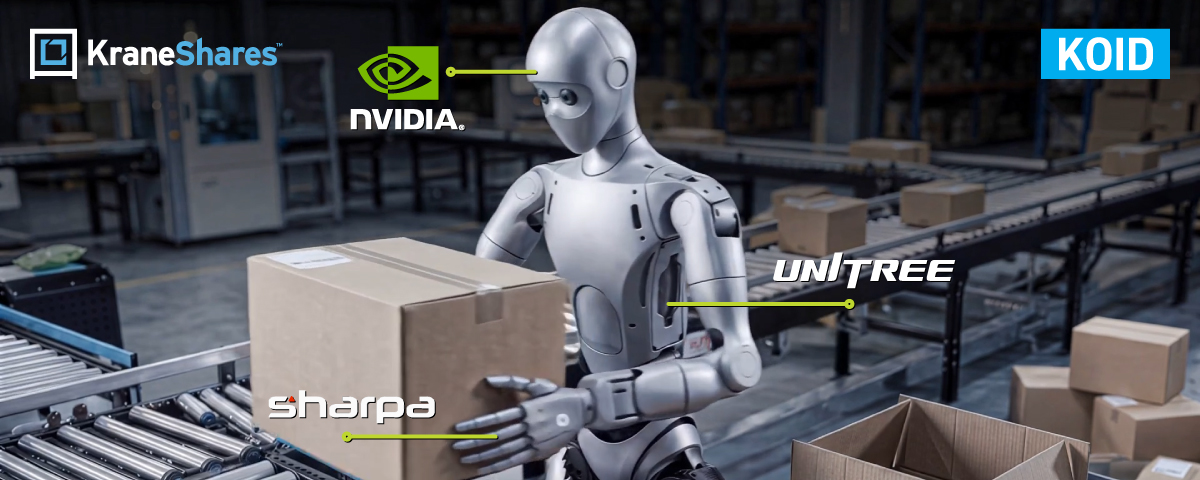
NVIDIA provides the compute and software stack, Unitree delivers the humanoid body, Sharpa supplies dexterous hands, and research institutions around the world build applications on top. No single country or company owns the entire stack. Instead, value is created at each layer of a tightly integrated, global ecosystem.
Global collaboration has historically unlocked scale and sustained innovation in semiconductors and cloud AI. Humanoid robotics is now following that playbook, and physical AI ETF KOID is designed to provide exposure to this emerging, cross‑border value chain.
What NVIDIA, Unitree, and Sharpa Actually Launched
NVIDIA's announcement calls its new system “a state-of-the-art platform that brings the key building blocks for frontier humanoid research into one system.”
The design combines:
- Unitree H2 Plus humanoid – A nearly 6‑foot, ~150‑pound robot body with 31 joints (“degrees of freedom”) across the torso and limbs.1 Translation: a human‑scale frame that can walk, bend, and reach in complex ways, not just roll around like a cart.
- Sharpa Wave five‑finger hands – Dual tactile hands with 22 additional joints, bringing the robot to 75 degrees of freedom total.1 Translation: individual fingers with precise control, designed for turning knobs, opening doors, and handling objects (not just lifting boxes).
- Jetson AGX Thor™ onboard compute – A Blackwell‑based AI computer with over 2,000 FP4 teraflops of performance and 128GB of memory.1 Translation: a supercomputer in the robot’s torso, powerful enough to run advanced AI models locally, so the robot can react in real time without waiting to connect to the cloud.
- NVIDIA Isaac™ GR00T software and models – A full software stack for simulation, training, and deployment, including Isaac Sim, Isaac Lab, teleoperation tools, and open humanoid foundation models. Translation: virtual environments to practice in, plus prebuilt AI “brains” and tooling to move those skills onto the real robot.
NVIDIA’s founder and CEO, Jensen Huang, has a clear goal: “a single, open platform to make breakthrough discoveries toward general-purpose physical intelligence.” Essentially, NVIDIA wants this platform to be the default hardware and software starting point for advanced humanoid research.
Why Unitree’s Role Matters
NVIDIA could have gone fully in‑house, but instead anchored the first design on Unitree’s H2 Plus. For Unitree, it is a powerful endorsement.
Unitree is already a go‑to supplier of research‑friendly humanoid robots, and for NVIDIA, this accelerates time‑to‑market. Unitree knows how to build and ship robots, while NVIDIA focuses on chips and software.
Not only this, but the design is deliberate. Unitree for the body, Sharpa for hands, NVIDIA for compute and software. These companies are defining how the pieces fit together, not trying to own every piece.
We believe that’s how durable tech ecosystems form.
How NVIDIA’s Founder & CEO, Jensen Huang, Frames the Opportunity
Jensen Huang has been extremely straightforward about the physical AI opportunity.
Huang said in NVIDIA’s announcement of the Unitree partnership that “humanoid robots will bring physical AI to the world’s largest industries, opening a multitrillion‑dollar economic opportunity.”
Huang views humanoids as a long‑duration, multi‑trillion‑dollar theme, not a side project.
Why Investors Should Care
Standardization speeds up progress.
Today, humanoid development is fragmented. Each company typically builds its own hardware, integrations, and training stack. NVIDIA’s platform design “unifies development” by bundling the Unitree H2 Plus body and Sharpa hands (the “body”) with Jetson Thor™ and Isaac™ GR00T (the “brain”) into a single, integrated system.
If successful, more teams and companies can start at a higher baseline rather than having to reinvent basic motion and control, potentially shortening the path to commercial deployment.
Lower barriers mean more players.
The release explicitly states that the platform is meant to “democratize” humanoid research and enable more institutions to skip the building of humanoids and instead focus on skill development and real-world applications. In theory, this would speed up the race to general-purpose humanoids.
Instead of designing a robot from scratch, a lab can buy this system and focus on the next critical phase: data, algorithms, and applications. Additionally, a broader set of participants usually means more experimentation, more use cases discovered, and a larger eventual market.
Why This Matters for Physical AI ETF KOID
NVIDIA’s partnership with Unitree is exactly the kind of catalyst physical AI ETF KOID is designed for. It pushes the humanoid story into a concrete, standardized platform that top labs can buy, deploy, and build on.
Physical AI is still early, but the market direction is increasingly clear: more standardized platforms, more participants, and more pathways from research to real deployments. KOID aims to give investors a global, differentiated way to capture that opportunity across the United States, China, Japan, and other key markets.
Holdings are subject to change.
For KOID standard performance, top 10 holdings, risks, and other fund information, please click here.
Citations:
1, Data from "NVIDIA Announces NVIDIA Isaac GR00T Reference Humanoid Robot for Academic Research," NVIDIA, as of 5/31/2026.