Photonic ETF LUMA: Designed To Capitalize On One of AI’s Biggest Bottlenecks
AI's newest bottleneck is not the processor; it is the connections running between them.
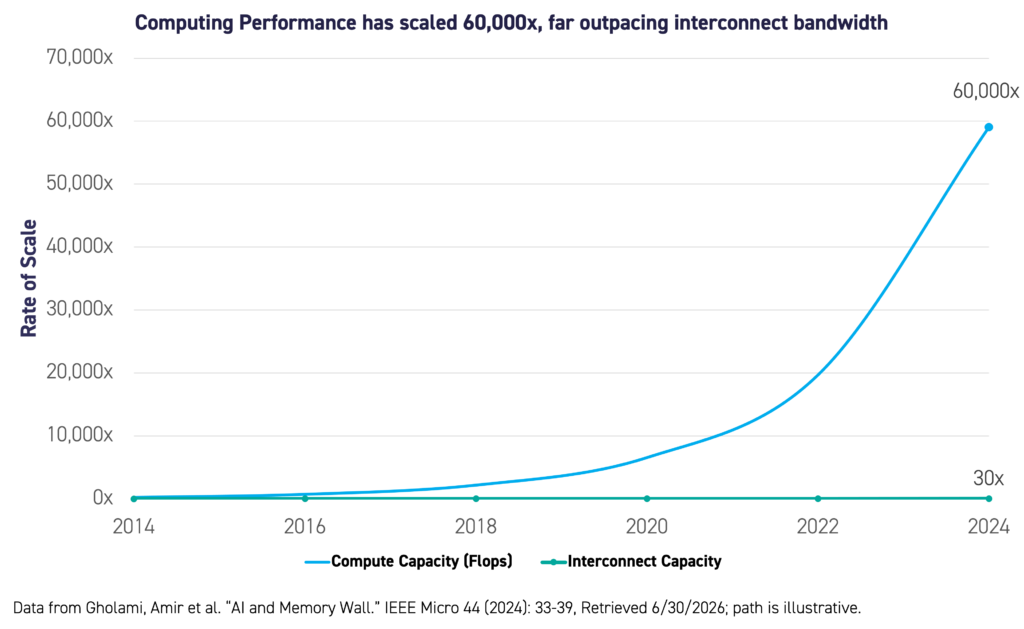
Computing power has increased more than 60,000 times over the last two decades, while interconnect bandwidth has only increased 30 times.1 Computers cannot talk to each other fast enough to keep up with the massive increase in data transfer demand.
As AI models and computing clusters scale, data movement is emerging as one of the industry's most significant bottlenecks. Traditional copper-based connections are likely approaching their physical and economic limits, accelerating the transition toward optical data transmission across chips, servers, and data centers.
LUMA, KraneShares' Photonics and Optical ETF, is designed to capture the long-term growth opportunity created by this structural shift from electrons to photons.
Today, data centers consume and produce more data than ever before. AI Models, or Large Language Models (LLMs), use thousands of special computer chips called accelerators that perform a huge number of immensely complicated calculations. These chips must continually exchange information at extremely high speeds to train and run these AI models.
The metric that matters here is bandwidth: the amount of data that can be transmitted at once. The higher the bandwidth, the quicker AI can train and compute user queries. Faster training means companies can improve their models quicker than the competition. Therefore, whoever can build the connection with the most bandwidth will gain an edge over their competition.
Copper: The Technology Slowing the AI Buildout.
The connections between these chips are called interconnects. Current interconnects are almost all made from copper. To transmit data via copper, information is converted into electrical pulses. These pulses travel along copper as an electrical signal until they reach the receiver, which interprets the variations in the signal back into usable information. The problem is that these electrical signals dissipate as they travel along the copper. Think of it like sound getting fainter the further it gets from its source.
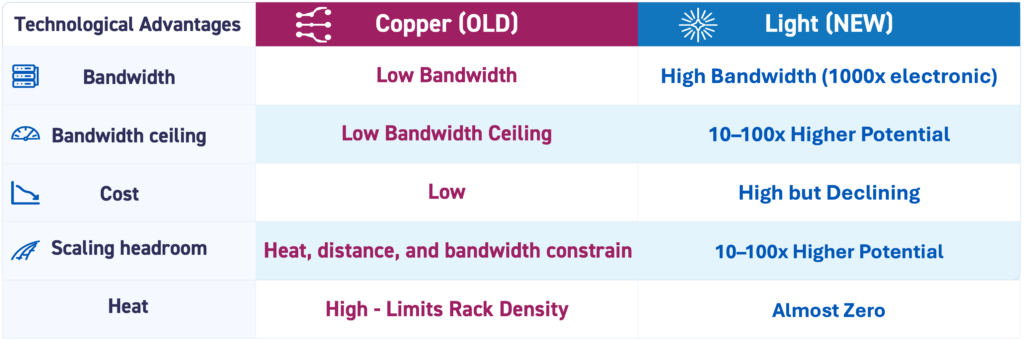
These signals also generate heat because the electrons transmitting the information smash into atoms inside the copper interconnect. Heat means that electricity is being wasted and components must be designed at additional cost to handle the heat.
For most applications, this can be solved by increasing the size, power, and shielding of a copper interconnect or by using other advanced technologies to compensate for data loss over distance. However, this is costly and not always suitable for the AI accelerators. Bandwidth requirements or size constraints associated with these chips mean copper is limiting how much data can be transmitted at once.
The Solution: Photonics and Optical Interconnects.
Photonics uses light to generate, transmit, and detect information. An optical transceiver acts as a translator: it converts electrical data produced by a chip into light, sends that light through glass fibers, and converts it back into an electrical signal at the other end. Optical links can carry large amounts of data with less signal loss and, in many configurations, lower energy use than electrical links.
In the past, this has only been economical over long distances. Undersea data cables and optical fiber networks have long been the backbone of global telecommunications. These faster, higher-capacity optical interconnects have proven capable of moving immense amounts of data over very long distances. More recently, optics have been used to connect data centers and large groups of computers within them called racks. These use cases will continue to be incredibly useful and should grow alongside the rest of the industry. The exciting part is that this same technology has finally matured enough to be applied to physically smaller applications. The goal is straightforward: move more information while using less energy.
Pluggable Optics
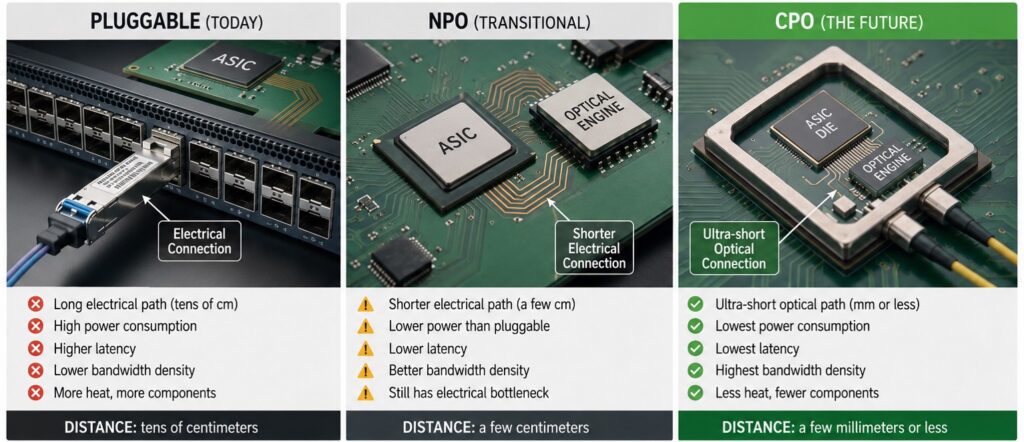
Today, many optical connections use pluggable transceivers located at the “edge” of networking equipment. Think of the current pluggable optics as the cable you plug into the back of your computer. These systems offer all of the benefits of optical interconnects while remaining flexible. They can be used in most systems just by plugging them into the server module or rack. Hence the name: pluggable. However, before data reaches the cable you just plugged in, it must travel through your computer. This means that power is wasted and capacity is limited.
Near Packaged Optics (NPOs)
NPOs begin to solve this problem by bringing the optical modules, the devices turning data into light, closer to the chips sending the data. In practice, this means cutting the distance from tens of centimeters of copper interconnects to just centimeters, leading to lower power usage, lower latency, and more bandwidth.
A New Trend in Photonics: Co-Packaged Optics.
Co-packaged optics (CPOs) integrate optics directly with the chips sending the data. This further shortens the difficult electrical part of the journey to only a few millimeters or less, and allows more data to move through the same space while using less power. Think of this as taking that cable and installing it directly onto the part of your computer that needs it, supercharging its ability to transfer data. Again, this enables the whole AI system to work faster and more efficiently. As this industry matures, pluggable modules, NPOs and CPOs may likely coexist for years, serving different needs.
Optical systems are not energy-free, and they still depend on electronics. The opportunity lies in using each medium where it is strongest and shortening the most difficult electrical portions of the connection.
The AI Industry Is Betting Big on Photonics.
Modern AI systems rely on accelerators constantly exchanging information. If the network cannot keep pace, expensive chips spend more time waiting, while the data center continues to use power. Photonics does not make an individual accelerator calculate faster. It helps many accelerators communicate more efficiently so the cluster can operate more like one large computer.
That need supports a significant market. Goldman Sachs Research estimates that the market for AI optical networking could reach more than $150 billion by 2028, approximately nine times its current size.2 This projection shows how much more important connectivity is becoming within AI infrastructure.
Industry spending is already following the theme. On March 2, 2026, NVIDIA announced a $2 billion investment in US optical component leader Lumentum, who builds advanced lasers and optical components for leading chip manufacturers. NVIDIA also invested $2 billion in the leading US photonics company Coherent. Coherent builds advanced photonics components, lasers, and optical transceivers. Both companies are leading the charge in co-packaged optics. The agreements also included multiyear purchase commitments and access to future capacity for advanced laser and optical-networking products.3,4 These commitments do not guarantee which optical design will win. Still, they show that NVIDIA, one of the most influential AI platform companies, views optics as a strategic part of future systems.
Luma Is Investing in the Entire Photonics Supply Chain.
An optical connection depends on much more than one laser or cable. The supply chain includes lasers, optical chips (CPOs), transceivers, fiber and cables, networking equipment, specialized materials, and the tools used to manufacture them.
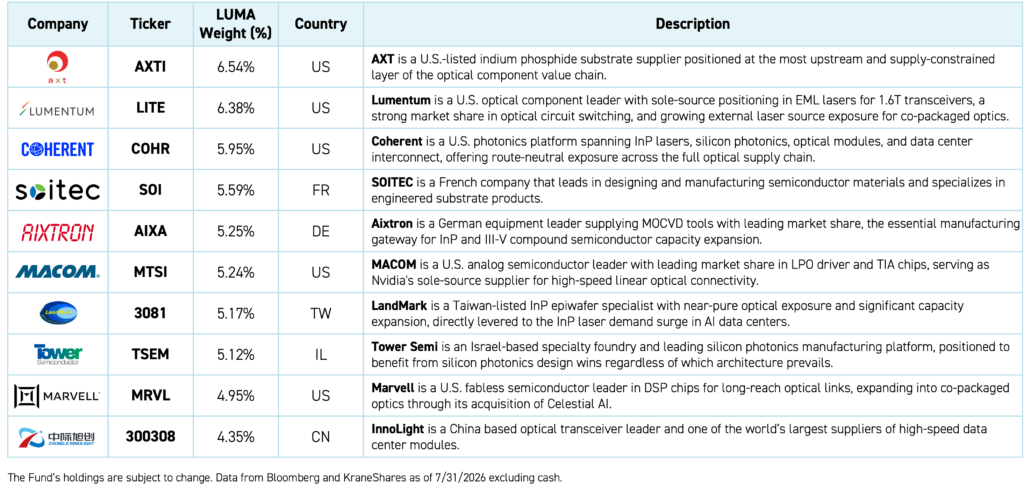
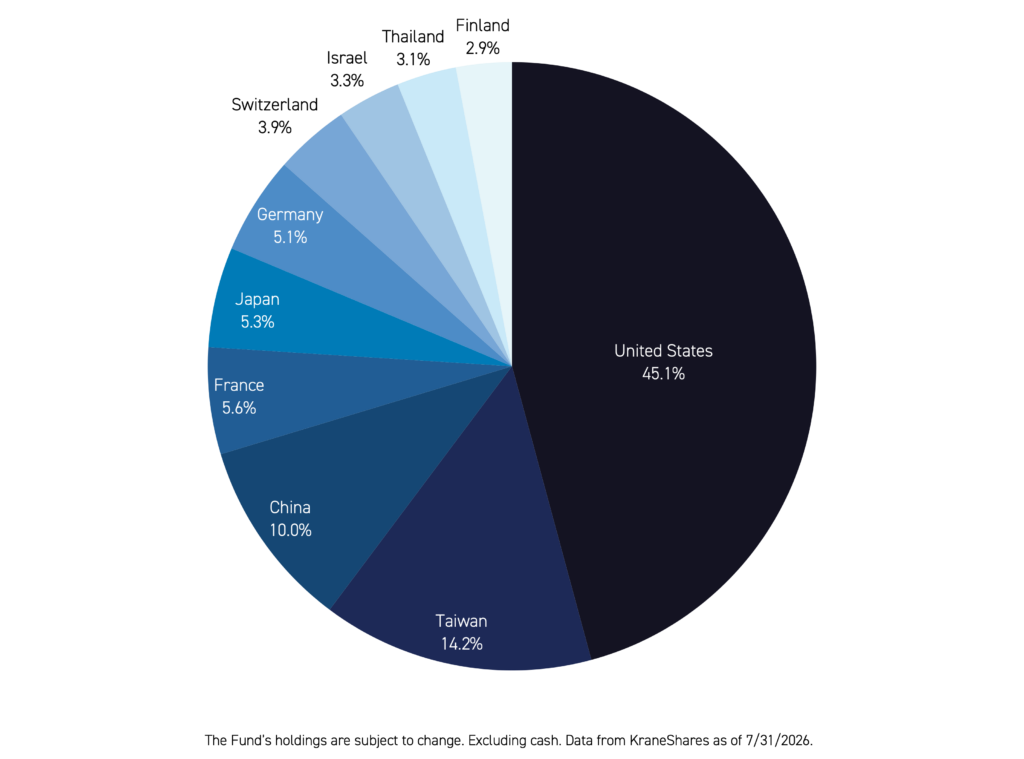
Representative holdings in the KraneShares Photonic and Optical ETF (Ticker: LUMA) show that breadth. Lumentum and Coherent supply lasers and optical components. InnoLight and Eoptolink make transceivers. Sumitomo Electric and Furukawa Electric provide fiber and cable, while AIXTRON supplies manufacturing equipment and Tower Semiconductor provides specialty chip manufacturing. Geographically, US companies make up the largest share of this portfolio, reflecting the country's massive investment in AI.5 All of these companies are at the forefront of the industry and are ready to capitalize on the AI buildout.
LUMA Top 10 Holdings
LUMA's Geographical Exposure
LUMA's Strategy
LUMA is actively managed and seeks capital growth through exposure to public and private companies worldwide that develop optical interconnects, transceivers, fiber-optic cables, and other light-based infrastructure.
The portfolio uses a structured, research-driven process that considers factors including thematic exposure, relevance to emerging bottlenecks, liquidity, and market capitalization. The objective is not simply to own the largest networking companies. It is to identify businesses whose products may become more important as the constraint moves across the optical value chain. This approach also gives LUMA flexibility to respond as architectures evolve and to consider select private companies.
Conclusion
We believe AI is increasingly becoming a system-level infrastructure challenge. Faster accelerators still matter, but their value depends on how efficiently they are supplied with data and connected to one another. As computing capability outpaces interconnect bandwidth, networking may move from a supporting role to a defining factor in system performance and economics.
Photonics offers a path forward by replacing the most demanding electrical links with light and bringing optical connectivity progressively closer to the computing package. We believe the transition is unlikely to be linear: copper will remain important, pluggable optics will continue to serve many applications, and new architectures such as CPOs still face commercialization risks. Even so, the direction of industry capital and the widening gap between compute and connectivity suggest that optical infrastructure may capture a growing share of the $7.2 trillion expected to be spent on the entire AI ecosystem through 2031.6 LUMA is designed to give investors targeted exposure to companies building the components, modules, semiconductors, materials, manufacturing equipment, and fiber behind that transition.
Holdings are subject to change.
For LUMA standard performance, top 10 holdings, risks, and other fund information, please click here.
Citations:
- Gholami, Amir, et al. "AI and Memory Wall." IEEE Micro, vol. 44, no. 3, 2024, pp. 33-39
- Goldman Sachs Research. "Optical Networking: The Next Mega Trend in AI Infrastructure." 12 May 2026.
- NVIDIA. "NVIDIA Announces Strategic Partnership With Lumentum to Develop State-of-the-Art Optics Technology."2 Mar. 2026.
- NVIDIA. "NVIDIA and Coherent Announce Strategic Partnership to Develop Optics Technology to Scale Next-Generation Data Center Architecture."2 Mar. 2026.
- KraneShares. "KraneShares Photonic and Optical ETF (LUMA)." Holdings and fund data as of 31 July 2026.
- Goldman Sachs Global Institute and Goldman Sachs Global Investment Research, “Tracking Trillions: The Assumptions Shaping the Scale of the AI Build-Out,” May 1, 2026. Estimates based on Goldman Sachs' baseline infrastructure model and NVIDIA projections as of March 3, 2026.
Term Definitions:
Accelerator: A specialized processor designed to perform compute-intensive tasks, including training and running AI models, more efficiently than a general-purpose processor.
Active management: An investment approach in which a portfolio manager selects and adjusts holdings using research and judgment rather than simply tracking an index.
Artificial intelligence (AI): Computer systems designed to perform tasks commonly associated with human intelligence, such as learning, reasoning, recognizing patterns, and understanding language.
Bandwidth: The amount of data a connection can transmit in a given period of time, typically measured in bits per second.
Co-packaged optics (CPO): An architecture that places optical components beside a computing or networking chip, shortening the electrical path that data must travel.
Computing cluster: A group of connected computers or processors that work together as one system to complete large or complex tasks.
Fiber-optic cable: A cable containing thin strands of glass or plastic that transmit data as pulses of light.
Interconnect: A connection that transfers data between chips, servers, or systems using electrical signals over copper or optical signals over fiber.
Large language model (LLM): A type of AI trained on large amounts of text to understand and generate human language.
Liquidity: The ability to buy or sell an investment without causing a significant change in its market price.
Market capitalization: The total market value of a company's outstanding shares, calculated by multiplying its share price by the number of shares outstanding.
Optical transceiver: A device that converts electrical data into light for transmission and converts received light back into an electrical signal.
Photonics: The science and technology of generating, controlling, transmitting, and detecting light, including its use to carry digital information.
Pluggable transceiver: A removable optical module installed at the edge of networking equipment that converts data between electrical and optical signals.
Semiconductor: A material that can control the flow of electricity and is used to make computer chips and other electronic components.