
First Came Personal AI, Now The “Intent Agent”
By Max Chen &  Derek Yan, CFA
The internet offers an instructive precedent.
In 1997 and 1998, when everyone marveled that the web would let countless ordinary people build their own pages, the plain, homespun sites of the early geeks captured the rough but luminous optimism of the era. And the market, for a time, priced that optimism eagerly (aka the "dot-com boom"). It priced a future in which everyone would code a personal HyperText Markup Language (HTML) homepage.
They were half right. In the decades that followed, most people did not rush to build their own websites. They built their own social media profiles, their own blogs, their own online shops, their own social channels on platforms like YouTube and TikTok. The majority of encounters with the internet's underlying protocol (TCP/IP, the plumbing that moves data between machines) occurred through a simplified, abstracted layer of tools, and those tools, in turn, became "platforms." The story repeated itself, from the web to mobile. What most ordinary users wanted was never complicated: to connect and to be seen. Being seen is one of the internet's central storylines because the internet created expanded opportunities for connection.
Now, in the era of large language models (LLMs), we believe the same optimism may be sweeping in again. In Silicon Valley coffee shops, people imagine that everyone will build their own app and their own one-person company, and that new scientific discoveries and breakthrough drugs will usher in a new age of exploration. But in the end, will everyone really build their own app?
The Democratization Of Intelligence, The Capacity To Act, and The Proxy
We believe artificial intelligence (AI) represents the end of intelligence as a privilege. Much as the spread of printing in the late Middle Ages narrowed the absolute gap between ordinary people and the elite, thereby becoming the infrastructure that lifted an entire civilization, AI supplies not only intelligence itself but also labor, in the form of agents. Together, they give ordinary people a capacity for action and execution that was once out of reach. We think this lies at the heart of AI's central story: it enables more people to fulfill their potential.
We think that capacity requires a proxy. The medium through which ordinary people may truly connect with AI is not the dazzling array of coding agents but an intent agent: one that continuously advances a user's goals on their behalf. Such an agent should understand a user's long-term context well enough to read intent precisely; hold enough permissions, tools, and system connections to act; and take responsibility for outcomes, which is the basis for trust and sustained use.
In personal life, this is simply a personal assistant. It also explains the undercurrent that has been building with industry announcements this week around Instinct, an invite-only personal agent from Spear Street Technology that users text or call1; Town, an a16z-backed San Francisco startup whose assistants learn how you work across the tools you already use2; and Meta's newly released Muse, a personal agent app that connects to a user's other apps to send emails, make payments, and carry out tasks3. These are the stirrings of what we believe to be the next big wave.
What Separates Intent Agents From Chatbots & Conventional AI Agents?
Consider how Instinct and Muse actually differ from the chatbots we have used for more than two years, and from OpenClaw, the open-source, self-hosted agent framework that caught fire among developers earlier this year.
First, they are more proactive. A chatbot waits for you to speak; a conventional agent typically waits for a command or a configured automation. An intent agent, by contrast, should continuously perceive events, goals, and changes within its authorized scope, and judge when intervention is worthwhile. It can act the moment an email lands: a legal document arrives, and the agent reviews it and offers recommendations unprompted. A data room opens, and the agent logs in, reviews the contents, and surfaces the questions you would want answered next. Agents may even hold your position, knowing how to think from your interests and your vantage point when a competitor raises money, a regulation shifts, or a core customer changes, doing part of your thinking as a stand-in and then acting on that delegated stance. And the stance is long-lived. Once a user sets a goal, Muse is designed to create a personalized plan, coordinate time and resources, and continue working after the user leaves the app, returning only when the task changes or a sensitive action requires approval.
Second, they may prove to be more reliable. Models with ever-stronger computer-use capabilities, chief among them Astra (OpenAI's new GPT-6 flagship, built to operate browsers, spreadsheets, and desktop software the way a person does), along with the gains in capability and reliability from multi-agent "swarms," have made intent agents materially more dependable when they actually execute.4 They can also handle work that requires a graphical interface, which is indispensable for the many long-horizon "wishes" that depend on operating specific software.
Finally, they may amplify the internet era's connective power. AI "superconnector" platform Boardy says it has brokered more than 200,000 introductions, roams the maze of professional networks, finding paths through complex, weak-tie, and implicit-trust relationships to the collaborators, investors, and partners who fit your requirements.5 Instinct can communicate with other people's Instinct agents to coordinate plans. Each of our intent agents may well become the mutual friend among all strangers, and we believe that connective power is likely to reshape, once again, how we are connected and how we are seen.
What Companies May Benefit From The Intent-Agent Era?
Intent agents are already fundamentally different from first-generation productivity products like ChatGPT and Claude Code. But this round may be more of a game for the giants that already command formidable network effects and installed bases. In the productivity-tool era, the core question was who had the best brain. In the intent-agent era, the question might become which company is closest to the user, understands the user best, is most entitled to act on the user's behalf, and can most easily interoperate with everyone else's agents?
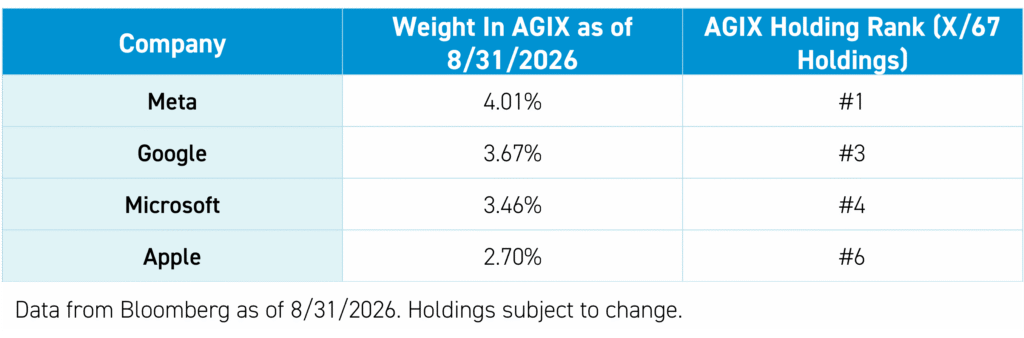
Companies with "default permissions" may hold the edge. Google already has Gmail, Calendar, Search, Chrome, Android, Maps, and a payments entry point. Microsoft has Windows, Office, Outlook, Teams, GitHub, and the enterprise identity stack. Apple owns the devices, the operating system, contacts, location, payments, and an unusually deep reservoir of privacy trust. Meta owns the social graph and the high-frequency messaging networks of WhatsApp, Instagram, and Facebook. None of them needs to persuade users from scratch to "hand their lives to a new agent." They can embed agency gradually into the identities, devices, relationships, and workflows people already use.
These potential winners of the intent-agent era are all overweight positions in our AI ETF AGIX, the KraneShares Public-Private AI & Technology ETF.
Do Models Still Matter In Such A Contest?
Large language models (LLMs) are still important, but we believe what matters now is cost, not absolute capability. Brian Wansink, a former Cornell University food psychologist, once found that people make more than 200 food-related decisions a day, a finding he became famous for and one that later mutated into the popular claim that we make 35,000 decisions daily.6 Suppose, for argument's sake, that the order of magnitude is right.
If every one of those decisions were assisted or processed by an intent agent, the consumption of tokens (the units of text that models read and generate, and the basis on which they are priced) would be astronomical. At today's frontier-model prices, such high-concurrency, high-volume usage is simply unaffordable. Hence, the timely arrival of DeepSeek V4.1 Flash. For browser-use tasks, the company said it delivered frontier-level capability, on par with GPT 5.6-Sol and Claude Opus 5, but at a fraction of the cost.7 Even compared to the company's previous top model, DeepSeek V4-Pro, off-peak rates are 60% lower.7
Just as important, in our view, its architecture is genuinely optimized for high concurrency: the ability of a computing system to serve many users, requests, or AI agent tasks simultaneously. It has an asymmetric design (a Causal Encoder-Decoder that activates 8 billion parameters per token while reading input and 16 billion while generating8), which is a model design that uses different amounts of computation, different components, or different methods for reading input versus generating output. It also has aggressive Key-value cache (KV cache) compression (the working memory a model keeps for every token in its context, which we believe is one of the main constraints on serving many users at once).
It reads as a serious attempt to answer how today's supply-constrained compute might support an explosion in global token demand, or, put differently, ordinary people's demand for AI.
Conclusion
Return to where we began. If being seen was the internet's central storyline, then being realized, being fulfilled, is AI's, and it is a right that belongs to every ordinary person. We believe AI also represents the end of intelligence as a privilege: it may be turning intelligence from a scarce endowment internalized in a few into an accessible, callable, orchestratable public factor of production.
Just as the Industrial Revolution externalized physical strength from human and animal bodies into machines, and the internet freed information from institutional and geographic boundaries, AI is attempting to externalize part of cognition from individual minds into infrastructure, and in doing so, it may lay a cornerstone for a new civilization.
Holdings are subject to change.
For AGIX standard performance, top 10 holdings, risks, and other fund information, please click here.
Citations:
- TechCrunch, "Instinct's powerful AI assistant is raising privacy and security concerns," as of 8/24/2026.
- Fortune, "Town's AI assistants learn your life—Andreessen Horowitz and Forerunner just backed the vision with $55 million," as of 6/3/2026.
- Reuters, "Meta launches AI agent that can access other apps to send emails, make payments," as of 9/8/2026.
- OpenAI, "A new generation of intelligence," retrieved on 9/15/2026.
- Boardy, "I can introduce you to anyone, try me," retrieved on 9/15/2026.
- Wansink, B., & Sobal, J. (2007). Mindless Eating: The 200 Daily Food Decisions We Overlook: The 200 Daily Food Decisions We Overlook. Environment and Behavior, 39(1), 106-123.
- DeepSeek, "Introducing DeepSeek-V4.1-Flash: smarter, faster, more efficient," as of 9/9/2026.
- HuggingFace, "DeepSeek-V4.1-Flash: Pushing the Limits of KV Cache Compression," retrieved on 9/15/2026.
Definitions:
Dot-com boom: The late-1990s surge in internet-company valuations, fueled by expectations for online businesses that often outpaced their revenues, profits, and proven business models.
Interoperability: The ability of different software systems, platforms, or AI agents to exchange information and work together.
Factor of production: An input used to produce goods and services—traditionally labor, capital, land, and entrepreneurship; the article argues AI could become a broadly accessible productive input.
HyperText Markup Language (HTML): The standard markup language used to structure the content of webpages, including text, links, images, and page sections.
Transmission Control Protocol/Internet Protocol (TCP/IP): The foundational set of networking rules that allows devices to send, route, receive, and reliably organize data across the internet.
Artificial intelligence (AI): Computer systems that perform tasks associated with human intelligence, such as understanding language, recognizing patterns, reasoning, generating content, and making recommendations.
Large language model (LLM): A type of AI trained on vast amounts of text and other data to understand and generate language, answer questions, summarize information, write code, and perform related tasks.
AI agent: Software that uses AI to pursue a task or goal by reasoning, using tools, retrieving information, and sometimes taking actions across digital systems.
Intent agent: A proposed type of AI agent designed to understand a user's longer-term objectives and proactively take authorized actions toward those goals rather than waiting for individual commands.
Graphical user interface (GUI): A visual software interface that lets users interact through windows, buttons, menus, icons, and similar on-screen elements rather than text-only commands.
Multi-agent swarm: A group of AI agents that divide tasks, share information, or check one another's work in an attempt to solve complex problems more effectively than a single agent.
Open source: Software whose underlying code is publicly available for people to inspect, modify, and redistribute under its applicable license.
Token: A small unit of text or code processed by an AI model—often a word, part of a word, punctuation mark, or symbol—and commonly used as the basis for model pricing.
Frontier model: A leading-edge AI model regarded as among the most capable available at a particular time, typically developed using substantial computing power, data, and research resources.
Causal Encoder-Decoder: An AI-model architecture that encodes incoming information for understanding while generating outputs sequentially, with each generated token conditioned on prior tokens.
Order of magnitude: A rough scale of size, usually expressed in powers of ten; a difference of one order of magnitude means something is roughly 10 times larger or smaller.