Anthropic Isn’t Overthrowing Software, It Might Just Be Rewiring It
By Max Chen, Etna Capital Management, Derek Yan, CFA & Cole Wenner
Anthropic isn't overthrowing software; it could be rewiring how we look at it. Investors can get exposure to Anthropic through KraneShares' public-private AI ETF (Ticker: AGIX).
One of Wall Street's favorite sectors just hit the reset button after a significant update to Anthropic's "CoWork" platform. In recent weeks, according to Fortune, the U.S. software sector experienced a widespread sell-off, losing over $1 trillion in market value, after news broke about Anthropic's new agentic artificial intelligence (AI) capabilities.1
Now, investors are grappling with an important question: Could advances in AI, including those from Anthropic, fundamentally reshape how businesses use software?
We believe the concern is not purely theoretical. Anthropic’s recent advancements in its AI systems and agentic workflow automation seem to have captured the attention of both enterprise leaders and Wall Street, fueling speculation that companies may one day rely less on traditional software subscriptions and more on intelligent agents capable of executing tasks autonomously.
How Does Anthropic’s AI Work?
Anthropic’s vision centers on AI agents that function less like tools and more like digital colleagues. Rather than navigating multiple applications, users can delegate complex workflows to an AI system that operates across various platforms.
The concept behind systems sometimes described as “co‑worker” agents or autonomous task bots is straightforward but powerful: combine large language models (LLMs) with memory, reasoning capabilities, and secure integrations into enterprise environments.
LLM function calling plays a key role here. It allows the model to trigger application programming interfaces (APIs), software interfaces, or internal tools on the user’s behalf, which is what makes this kind of AI feel more like a coworker than an advisor. The agent can interpret goals, break them into steps, use these software interfaces or APIs to actually execute tasks, and adapt as conditions change.
Will Human User Interface Transition To Agent Interface?
The idea that AI, like Anthropic-style “co‑workers” and agentic workflows, will kill software is overstated. We believe AI is changing who operates software, not whether software is needed at all.
Generative and agentic AI could shift the primary operator of software from people to digital agents. Instead of users clicking through applications, they describe goals to AI agents, which execute workflows across tools, APIs, and data sources. Anthropic’s “AI co‑worker” model illustrates this: an agent can pull customer relationship management (CRM) data, analyze trends, draft slides, and route approvals in minutes, compressing multi-hour workflows into a single instruction.
In this example, software does not disappear. It becomes the execution substrate that agents orchestrate in the background, like the systems of record (the authoritative systems where core business data lives), permissions, and processes that AI relies on to act safely and accurately.
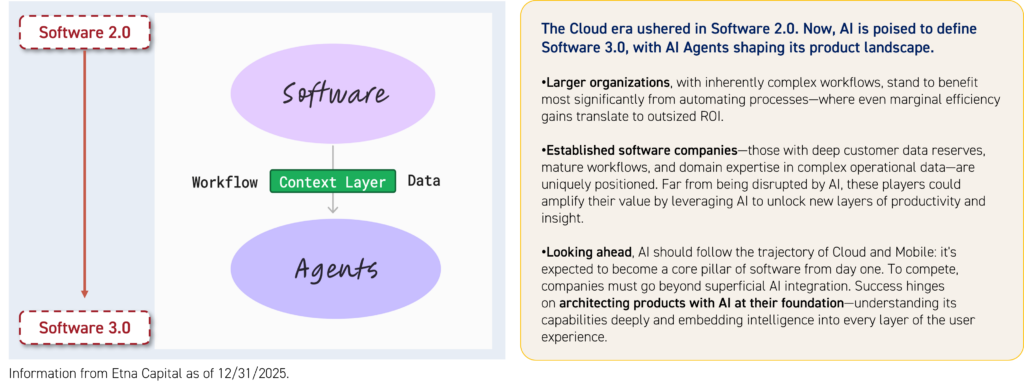
Systems Of Record: AI’s Critical Context Layer
Enterprise software’s real moat was never the user interface (UI). It is the central data model, workflow engine, permission boundary, and audit trail that keep organizations aligned and compliant.
Examples include how Microsoft positions Copilot as useful because it plugs into Microsoft 365 data and Microsoft Graph while preserving security and compliance boundaries. Salesforce’s agent capabilities ground outputs in structured CRM objects like Accounts, Contacts, and Cases. Palantir’s Ontology organizes an enterprise’s digital and physical assets into a graph that agents can understand and act on.
When people say “we do not need software anymore,” they usually mean we do not need so many UIs. AI does not eliminate systems of record; it increases the premium on accurate, governed, well-structured ones.
Why Software As A Service Isn’t Going Away
AI-native workflows have contributed to heightened investor uncertainty around Software as a Service (SaaS) stocks. Valuations that once assumed AI would simply lift productivity are being reassessed by some investors as enterprises experiment with custom agents and automation. Some narrow, tool-like applications that only provide a thin UI over simple tasks could be at risk if an agent can produce the same outcome without a separate interface.
But core platforms, like CRM, enterprise resource planning (ERP), human resources information systems (HRIS), information technology service management (ITSM), and collaboration hubs, are deeply embedded in how organizations operate. Replacing them is constrained by integration dependencies, process redesign, training, and change management, often on multi-year timelines.
Panorama Consulting Group’s 2024 ERP report stresses that AI projects succeed only when tightly integrated into existing systems and supported by robust business process management (BPM) guidance. Research from Gartner, cited by multiple industry outlets, forecasts that more than 40% of agentic AI projects will be canceled by 2027 due to rising costs and unclear business value, underscoring how hard it is to get production deployments right.2
The bottleneck is not better technology in the abstract; it is production reliability, governance, and organizational change. Those are the domains where established SaaS systems have tended to be more difficult to displace.
Production Reality: “API Works” Does Not Mean “Production Works”
Most impressive AI demos ignore real-world enterprise constraints: role-based access, data privacy, auditability, uptime, latency, and cost controls. Once those requirements appear, complexity multiplies, and off-the-shelf models are not enough. Vendors like Anthropic still need engineering teams embedded with customers to wire AI into existing systems, workflows, and compliance regimes.
Industry research shows that AI and ERP initiatives only deliver value when they are tightly integrated with current applications and guided by explicit process design. Gartner’s projection that over 40% of agentic AI efforts may be scrapped by 2027 is a warning: ungoverned AI pilots are easy; durable, return-on-investment (ROI) positive production systems are hard.2 That reality favors platforms with mature integration surfaces, security models, and ecosystems.
SaaS Moats Are Socio-Technical
SaaS is “sticky” not just because of its features, but because of the people around it. The admins, consultants, training programs, certificates, and online communities all build a powerful moat around these core platforms. Salesforce’s Trailhead learning platform, for example, has millions of “Trailblazers” earning badges and building careers that are directly tied to Salesforce. When someone’s job, reputation, and pay are built on a system, they will fight to keep that system in place.
AI may change what these jobs look like, moving work from manual setup and report writing to overseeing AI agents, cleaning data, and enforcing rules. But those changes may make the core systems of record (the main, trusted source of key data) even more important, not less.
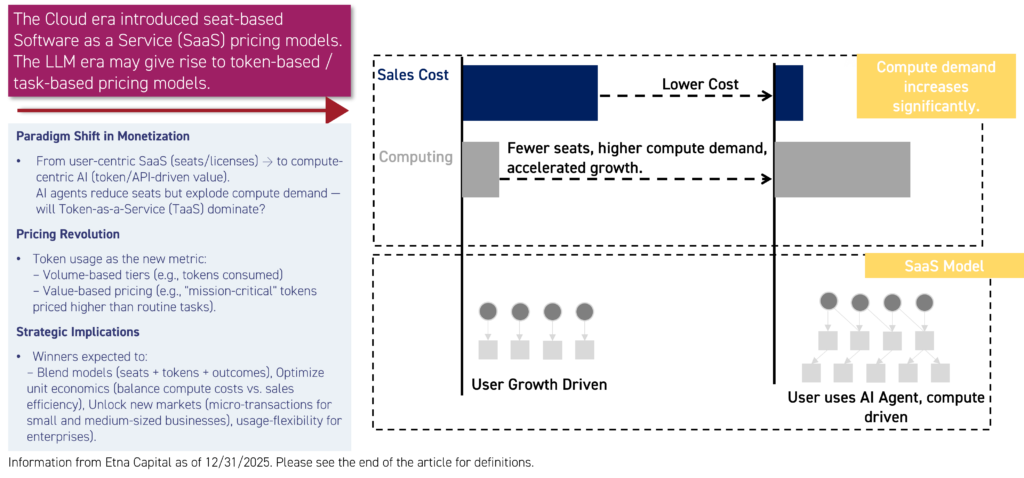
The Real Shift: From Seats To Digital Labor
The popular story is that SaaS apps will just turn into chat windows, where you “talk” to your CRM or ERP, and it does the work for you. The more realistic transformation is not “SaaS to chat” but “seats to metered digital labor,” where you pay less for human users and more for work done by software agents, billed based on usage. Instead of only selling per-user licenses, vendors are starting to price the actual work: actions taken, events processed, or conversations handled by AI agents. Salesforce’s Agentforce, for example, already blends traditional user licenses with consumption-based Flex Credits, so customers pay per agent action and can match spend more directly to measurable outcomes. ServiceNow and other workflow platforms are moving the same way, defining and monetizing discrete AI “assists” rather than just selling more seats.
In this world, we believe the winners will be platforms that:
- Expose clean, secure APIs and event streams for agents.
- Treat agents as first-class users of their systems of record.
- Monetize agent traffic with transparent, outcome-linked pricing.
Horizontal workflow platforms that own core data and governance, and that embrace an agent-first model, may be positioned to succeed.
Implications For Investors: Disruption, Not Extinction?
For public markets, AI introduces genuine volatility. Large, deeply integrated platforms must invest heavily to become agent-native and shift pricing toward digital labor. However, history suggests that innovations and platform shifts may change industry leadership rather than erase entire sectors.
Additionally, some investors may be looking beyond public equities to capture innovation in the AI value chain. That is why we launched a public-private AI ETF, the KraneShares Artificial Intelligence & Technology ETF (Ticker: AGIX), a fund primarily focused on U.S. markets that provides exposure to public companies with select private innovators such as Anthropic and SpaceX (through the xAI-SpaceX merger). This kind of public–private lens can help capture both incumbents adapting software to agent substrates and frontier labs building the agents themselves.
For investors interested in China's technology industry, we launched a China AI ETF, the KraneShares CSI China Internet ETF (Ticker: KWEB). KWEB provides exposure to publicly listed companies that are influencing China’s LLM, video generation, and applied AI stack, from models like Alibaba’s Qwen and Baidu’s ERNIE to Tencent’s Hunyuan.
Similarly, we launched an Emerging Market Technology ETF, the KraneShares Emerging Markets Consumer Technology ETF (Ticker: KEMQ). KEMQ extends this AI and technology theme beyond China, targeting global companies that are building the digital infrastructure and AI solutions serving billions of emerging‑market consumers, such as Taiwan Semiconductor Manufacturing Company (TSMC) and South Korea's SK Hynix.
For AGIX standard performance, top 10 holdings, risks, and other fund information, please click here.
For KWEB standard performance, top 10 holdings, risks, and other fund information, please click here.
For KEMQ standard performance, top 10 holdings, risks, and other fund information, please click here.
Holdings are subject to change.
Citations:
- Data from "Anthropic’s Claude triggered a trillion-dollar selloff. A new upgrade could make things worse," Fortune, 2/6/2026.
- Data from “Over 40% of agentic AI projects will be scrapped by 2027, Gartner says,” Reuters, 6/25/2025.
Definitions:
Large language models (LLMs): An artificial intelligence system trained on vast amounts of text to learn patterns in human language so it can understand prompts and generate human-like responses.
User interface (UI): The screens, buttons, and menus that people interact with when they use software.
Application programming interface (API): A set of rules that allows different software programs to communicate and share data or functions with each other.
Customer relationship management (CRM): Software that helps companies track and manage interactions with customers and sales prospects.
Enterprise resource planning (ERP): Software that integrates key business functions such as finance, supply chain, manufacturing, and procurement into one system.
Human resources information system (HRIS): Software that manages employee-related data, including payroll, benefits, performance, and hiring.
Information technology service management (ITSM): Software and processes that help IT teams deliver, manage, and support technology services across an organization.
Software as a Service (SaaS): A software delivery model where customers access applications over the internet and pay a recurring subscription rather than buying and installing the software themselves.
Business process management (BPM): The practice of analyzing, designing, and improving business workflows to make them more efficient and effective.
Return on investment (ROI): A measure of how much financial benefit a project or product generates compared with its cost.
Salesforce Trailblazers: In Salesforce’s ecosystem, “Trailblazers” are the pioneers and lifelong learners who use Salesforce to innovate, build their careers, companies, and communities, and help others succeed with the platform.
Token as a Service (TaaS): A service model where a provider manages the creation, issuance, and lifecycle of digital tokens (often for blockchain, access, or usage-based billing) so clients can use tokens without building their own infrastructure.
Small and medium‑sized businesses (SMBs): Commercial organizations that fall below a country or industry’s thresholds for large enterprises, typically defined by employee count and/or annual revenue.