A Complete Guide To Unitree Robotics’ 2026 IPO, Why It Matters For STAR Market ETF KSTR & Humanoid Robotics ETF KOID
By  Cole Wenner
Unitree Robotics’ initial public offering (IPO) application has just been accepted for Shanghai’s STAR Market.
The STAR Market is a natural fit. China’s Nasdaq-style exchange was built for high-growth innovators, and Unitree fits the mold. The company is delivering a rare combination in robotics manufacturing today: hyper-growth, profitability, and meaningful cash generation.
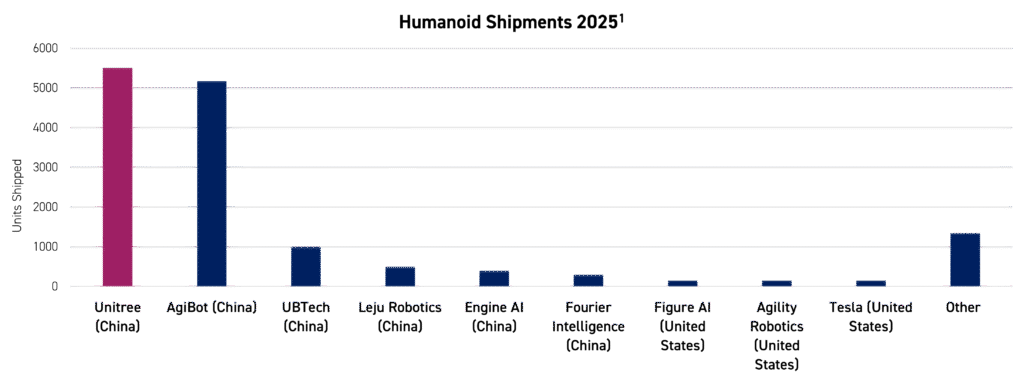
As China’s leading humanoid robotics manufacturer, Unitree will join UBTech as a public-market benchmark for valuing a pure-play humanoid robotics company.
Unitree IPO status, size, and timeline
On March 20th, 2026, the Shanghai Stock Exchange formally accepted Unitree Robotics’ IPO application for the STAR Market.2
Unitree IPO Highlights:
- Unitree intends to raise about CNY 4.2 billion (approximately USD 608 million) by issuing at least 40.45 million shares (This is the cash Unitree aims to raise by issuing new shares to public investors in its STAR Market IPO and is not the total value of the company).2
- Unitree plans to allocate the proceeds to R&D, the design of new intelligent robots, and the construction of a smart manufacturing facility.3
If successful, Unitree would join the ranks of UBTech in the second half of 2026 as a dedicated humanoid robotics company listed on the A-share market.
Unitree business profile and strategic positioning
Founded in 2016 in Hangzhou by CEO Wang Xingxing, who controls roughly one third of the company through direct and indirect holdings2, Unitree has evolved from a quadruped robotics pioneer into a broader humanoid robotics platform. The firm is widely recognized as a global leader in quadruped robots, with over 60% market share2, and has become highly competitive in China’s humanoid robot market.
Unitree’s products span:
- Quadruped robots (4-legged dog-like robots) used across research, education, and consumer applications, with growing industrial use cases such as inspection and firefighting. Models include it’s Go2, B2, and A2 quadrupeds.
- Humanoid robots that are currently deployed mainly in research, education, and consumer environments. Models include it’s G1, H1, R1, and H2 humanoids.
- Core components, including proprietary high torque motors, actuators, precision reducers, intelligent controllers, and high precision sensors, supporting a highly integrated hardware stack.
The company has also built impressive brand awareness through high-profile demonstrations, including performances at the CCTV Spring Festival Gala, which showcased the Unitree G1 EDU Ultimate Robotic Humanoid’s advanced mobility and coordination to mass audiences.
Additionally, KraneShares sparked its own wave of media buzz for Unitree. A Unitree G1 EDU Ultimate humanoid robot, nicknamed “KOID-bot,” rang the Nasdaq opening bell to celebrate the launch of the KraneShares Global Humanoid & Embodied Intelligence Index ETF (Ticker: KOID).
KOID-bot, which KraneShares acquired from Unitree’s official North American partner RoboStore, trended on social media platforms like TikTok and Instagram, appeared on live segments from FOX Business, Yahoo Finance, and Cheddar, and was featured in print in Barron's, the New York Post, and The Times in the UK.
In London, Autodiscovery, one of the UK's fastest-growing robotics companies, hosted a live demonstration of the Unitree G1 Ultimate humanoid robot in partnership with KraneShares.
Financial trajectory and growth drivers
Unitree’s financials underscore the scalability of its model relative to many early-stage robotics peers.
In 2025, the company generated approximately CNY 1.71 billion (USD 235 million) in revenue, representing 335% year-over-year growth.2
Humanoid robots became Unitree’s main revenue driver in 2025, contributing about 52% of total revenue in the first three quarters, while quadrupeds accounted for roughly 65% of 2024 revenue and humanoids about 30%, with components making up the balance.2
Gross margins have expanded from the mid-40% range in 2022–2023 to nearly 60% by 2025, as the product mix shifted towards higher-value humanoid systems.2 Net profit margin improved to the mid-teens by 2025, supported by strong operating cash flow and a conservative balance sheet characterized by low leverage and high liquidity.2
What companies have invested in Unitree?
Investors in Unitree span major internet platforms, venture capital firms, and industrial leaders.
Largest outside shareholders3:
- Meituan: 9.6%
- HongShan China (formerly Sequoia China): 7.1%
- Matrix Partners China: 5.5%
In addition, several prominent technology firms, including Tencent Holdings, Alibaba Group Holding, Ant Group, Xiaomi, and ByteDance, have participated either directly or through affiliated entities, alongside manufacturing groups such as BYD and Geely.3
Supply chain strategy and vertical integration
A key differentiator for Unitree is its vertically integrated manufacturing and supply chain strategy. Unitree reports a domestic component sourcing rate above 90%4, reflecting deep reliance on Chinese suppliers for motors, reducers, controllers, and sensors. This approach offers several advantages:
- Supply chain resilience and shorter lead times.
- Cost benefits relative to imported components.
- Tighter quality control.
- Alignment with China’s goal of technological self-reliance.
Unitree plans to deploy a significant portion of IPO proceeds into a smart manufacturing base, further deepening vertical integration and enabling modular, flexible production across multiple humanoid and quadruped platforms.
Recent partnerships, such as a strategic technology collaboration with Japan-based Omakase Robotics and US-based IntBot for human-robot interaction software, also signal a “global” strategy that could accelerate commercialization in Japan, the United States, and other developed markets.
Market context and competitive landscape
The IPO lands at a time when humanoid and embodied intelligence are shifting from concept to commercialization.
The Morgan Stanley Global Humanoid Model projects there could be 1 billion humanoids and $5 trillion in annual revenue by 2050.5 Additionally, Morgan Stanley is forecasting global humanoid industry revenue to grow at a compound annual growth rate (CAGR) of 54% over the next decade.6
Unitree competes with both global and domestic players:
- Global peers: Boston Dynamics (Atlas), Tesla (Optimus), Agility Robotics (Digit), Figure AI, and others working on general-purpose humanoids.
- Chinese peers: AgiBot, Ubtech, Fourier Intelligence, Xiaomi’s CyberOne platform, and several listed industrial robotics firms that are expanding into service and humanoid formats.
Recent robotics and AI-adjacent IPOs in China’s A-share market have shown wide dispersion in post-listing performance, with some embodied intelligence companies delivering strong returns, while others have experienced steep drawdowns and volatility.
Against this backdrop, Unitree’s scale, profitability, and supply chain control position it as a candidate for a premium valuation, though investor selectivity and high turnover in the segment suggest that it will not be immune to volatility after going public.
Valuation framing and IPO expectations
Unitree was valued at roughly USD $1.7 billion in a mid-2025 funding round and is now targeting an IPO valuation of USD $3–7 billion (i.e., the total value of all Unitree shares after pricing the IPO, share price × total shares outstanding).2 Based on 2025 revenue, this would imply a forward price-to-sales (P/S) multiple in the low to mid 20s at the lower end of that range, rising substantially if the final valuation settles near current estimates.2
Comparable robotics names on China’s STAR and ChiNext boards trade across a wide spectrum, with many clustered around mid-teens revenue multiples, but select high-growth leaders commanding significantly higher valuations.2
Given Unitree’s rapid top-line expansion, rising margins, and status as a humanoid robot “pure play,” a valuation premium over the broader robotics cohort appears possible, though with heightened sensitivity to broader technology-sector sentiment.
Why Unitree’s IPO matters for STAR Market 50 ETF KSTR & Humanoid Robotics ETF KOID
For Unitree to be included in US-listed ETFs immediately after listing on the STAR Market, the ETF manager must have a Qualified Foreign Institutional Investor (QFII) designation. A QFII designation allows foreign institutions to directly invest in Mainland China’s domestic markets, including Shanghai and Shenzhen A-shares and the STAR Market.
Without a QFII designation, a US‑listed ETF generally has to wait until Unitree becomes accessible via Stock Connect and then is added to its benchmark universe. That creates a lag between IPO and when the ETF can own it.
KraneShares has its own STAR Market ETF, the KraneShares SSE STAR Market 50 Index ETF (Ticker: KSTR), which tracks the SSE STAR 50 Index, a benchmark of the 50 largest and most liquid companies on the STAR Market.
Whether Unitree would earn a place in the STAR 50 at IPO depends heavily on where its final listing valuation lands (and subsequent trading). Unitree is targeting a valuation of USD $3–7 billion.2 At the upper end of that range, Unitree could plausibly rank among the STAR Market's top 50 companies by market cap, but would likely sit at the lower end of the STAR 50, where competition is stiff from established semiconductor, biotech, and industrial technology companies.
For KraneShares Humanoid Robotics ETF, KOID, we view the planned IPO as another data point supporting KOID’s already investable ecosystem, and Unitree may be eligible for inclusion in KOID's Index, the Merqube Global Humanoid and Embodied Intelligence Index.
KraneShares launched an equal-weighted Humanoid Robotics ETF, KOID, on 6/4/2025. With KOID, investors gain exposure to the humanoid robotics ecosystem, including the “brain” of the humanoid (semiconductors & technology), the “body” (actuation systems, mechanical systems, sensing & perception, critical materials), and humanoid “integrators” (the companies actually manufacturing humanoids).
While the “integrators” bucket in KOID is the smallest exposure right now, Unitree’s IPO is a clear signal that the companies actually manufacturing humanoid robots may be more relevant in public markets sooner than later.
Unitree’s IPO is important to KOID’s opportunity set in several ways:
- It expands the investable universe of “integrator” companies, particularly within China’s onshore market, complementing existing exposures to global humanoid and embodied intelligence leaders.
- It provides an additional public market benchmark for valuing high-growth humanoid robotics firms, which can influence sentiment and pricing across the ecosystem KOID targets.
- Unitree’s heavy domestic sourcing and vertical integration spotlight the importance of core component suppliers, motors, reducers, sensors, and controllers, that already represent a meaningful weight in the KOID portfolio (~74%7).

Conclusion
The acceptance of Unitree’s STAR Market application reinforces our view that humanoid robotics is becoming an increasingly important pillar within China’s innovation agenda and a growing component of the global embodied intelligence opportunity that KOID aims to capture.
Investors seeking broader exposure to AI, robotics, and technology, KOID sits within KraneShares’ AI, Robotics & Emerging Technology ETF suite, which holds complementary strategies that focus on global AI and technology.
For KOID standard performance, top 10 holdings, risks, and other fund information, please click here.
For KSTR standard performance, top 10 holdings, risks, and other fund information, please click here.
Citations:
- Data from Unitree and Omdia as of 2/5/2026.
- Data from Wind as of 3/23/2026.
- Data from “Inside Unitree’s landmark IPO: what to know about China’s humanoid giant,” South China Morning Post, as of 3/23/2026.
- Data from the Unitree Company Website as of 3/23/2026.
- Data from “Humanoids: 1bn Robots and $5tn Revenues by 2050, China is in Pole Position,” Morgan Stanley Research, as of 4/28/2025. Third-party projections do not guarantee future results.
- Data from "A $5 Trillion Global Market," Morgan Stanley, as of 4/29/2025.
- Data from Bloomberg as of 2/28/2026.
Definitions:
Compound Annual Growth Rate (CAGR): Mean annual growth rate of an investment over a period longer than one year.
Adjusted net profit: Adjusted net profit is a company’s profit after removing certain one-time or non-cash items to better show its underlying earnings.
Gross margin: Gross margin is the percentage of revenue left after subtracting the direct costs of producing goods or services, showing how much a company keeps from each sale before overhead.
Net profit margin: Net profit margin is the percentage of revenue that remains as profit after all expenses, interest, and taxes are paid.
Operating cash flow: Operating cash flow is the cash a company generates from its core business operations, excluding investing and financing activities.
Price-to-sales (P/S) multiple: The P/S multiple compares a company’s market value to its annual revenue to show how much investors are paying for each dollar of sales.
Index Definitions:
Shanghai Stock Exchange STAR Market (STAR Market): The STAR Market is a technology-focused segment of the Shanghai Stock Exchange, often compared to Nasdaq, designed to help high-growth science and tech companies raise capital.
China’s A-share market / A shares: A shares are stocks of mainland China-based companies that trade in Chinese renminbi on the Shanghai or Shenzhen stock exchanges.
Merqube Global Humanoid and Embodied Intelligence Index: The MerQube Global Humanoid and Embodied Intelligence Index measures the performance of Developed and Emerging Market companies that are making significant advancements in the development or utilization of humanoid and embodied intelligence technology across various sectors.