KWEB China ETF: Navigating Volatility As Positive Catalysts Mount
By Henry Greene
China’s internet sector has been volatile so far this year. As global markets contend with the turmoil from the current conflict in Iran, current market volatility has renewed attention on China internet equities, including those represented by the KraneShares CSI China Internet ETF (Ticker: KWEB). We are constructive on China’s offshore-listed internet companies because their Mainland counterparts have been relatively resilient so far into the conflict, there are potential geopolitical and policy tailwinds for China’s equities that we do not believe are priced in, and many developed markets remain expensive relative to China.
Mainland Markets Appear Optimistic
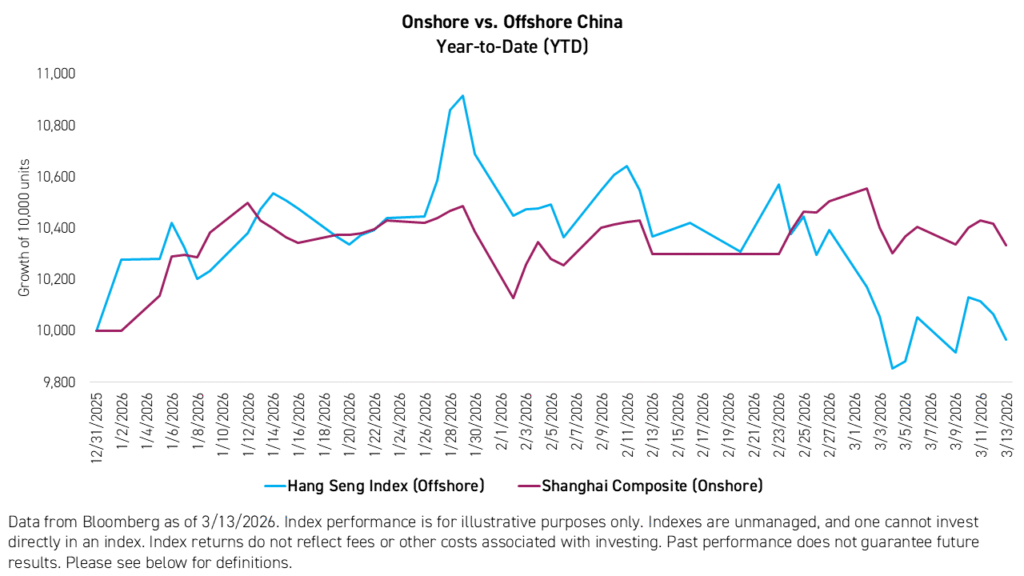
Mainland equity markets have taken the conflict in stride. The Shanghai Composite Index is up 5% year-to-date (YTD) as of March 13, 2026.3 This can be contrasted with offshore China, represented by the Hang Seng Index, which has experienced greater volatility and is nearly flat YTD, likely driven by skittish foreign investors.
Although it has not stemmed losses in the offshore market, Mainland investors have also been expressing their positive views in Hong Kong. They have been highly active in buying Hong Kong-listed stocks and ETFs via the Southbound Stock Connect channel this year, netting $25 billion since the start of 2026.3
What could local investors be picking up on? Perhaps this reflects several macroeconomic and policy developments affecting offshore China equities, including the segments represented in KWEB. On the other hand, tactical trades based on technical factors may also be at play.
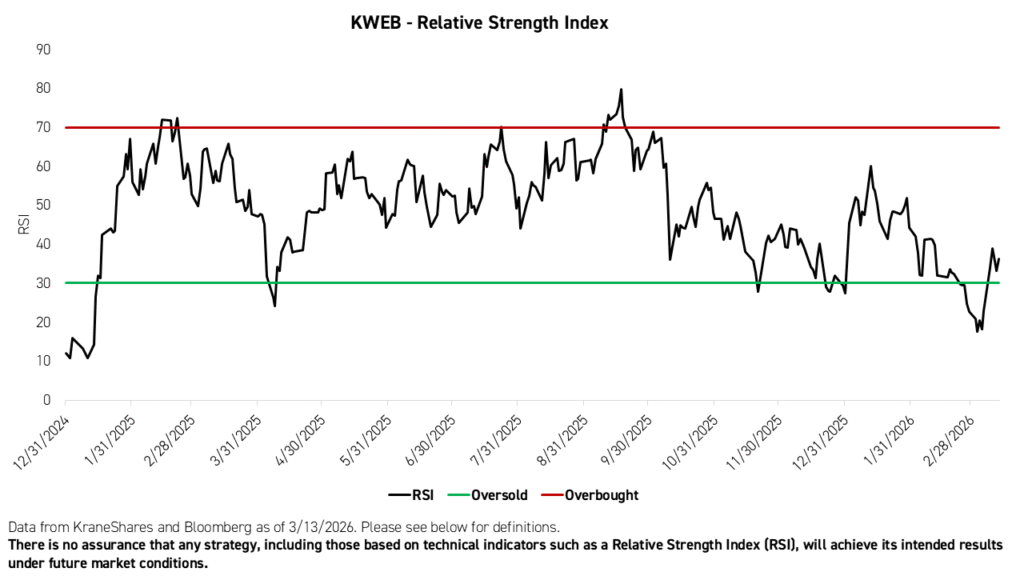
KWEB’s relative strength index (RSI), which is a technical measure of the extent to which an asset could be oversold or overbought based on historical returns, reached the second-lowest level in its history on March 3, 2026, and remains near 30, a level typically described as 'oversold'.
To illustrate the divergence between local investor behavior and that of foreign investors, we examined net Southbound flows into Hong Kong alongside the performance of the Hang Seng Index.
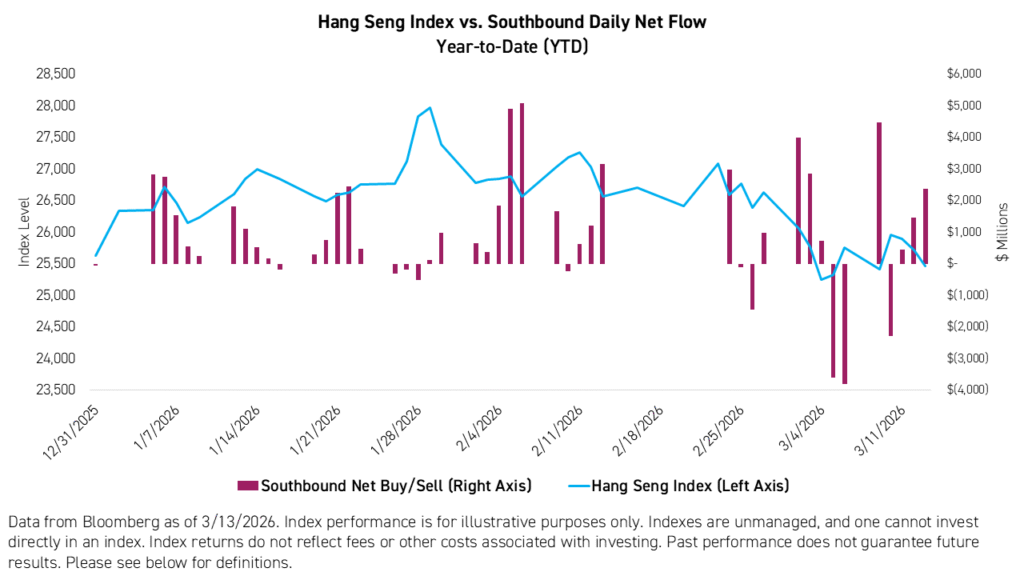
In multiple cases, as illustrated above, Mainland investors have bought Hong Kong-listed stocks and ETFs as the Hang Seng Index fell. Local investors appear optimistic during these downdrafts, based on Southbound flow data.
Catalysts For China’s Equity Market
Below are three key potential near-term catalysts for KWEB and China’s equity market in general.
- Improving US-China Relations: Trump and Xi are still scheduled to meet in the coming months. Higher energy prices may push both leaders to work faster towards a deal on tariffs, export controls, rare earths, and more. We also believe neutralizing threats from both Iran and Venezuela may help clear the way for Washington and Beijing to come to a renewed understanding.
- Consumer Spending Growth: China recorded a 1% year-over-year (YoY) change in its consumer price index (CPI) in February.1 CPI readings have been consistently below 1% YoY every month since February of 20241 due to deflationary pressures that have weighed on consumption. The improving inflation rate, coupled with resolute, long-term measures to restore consumer confidence, to be announced in the 15th Five-Year Plan later this month, could benefit consumer-oriented stocks.
- Improving Profitability: JD.com, which set off a race-to-the-bottom price war when it launched its "instant commerce" retail offering in 2024, was more profitable than expected in the fourth quarter of 2025.2 We believe this could be a sign that JD and other E-Commerce firms are no longer offering 30-minute delivery at a loss, as had been the case throughout 2025.
Volatility Amid High Valuations in US & Developed Markets
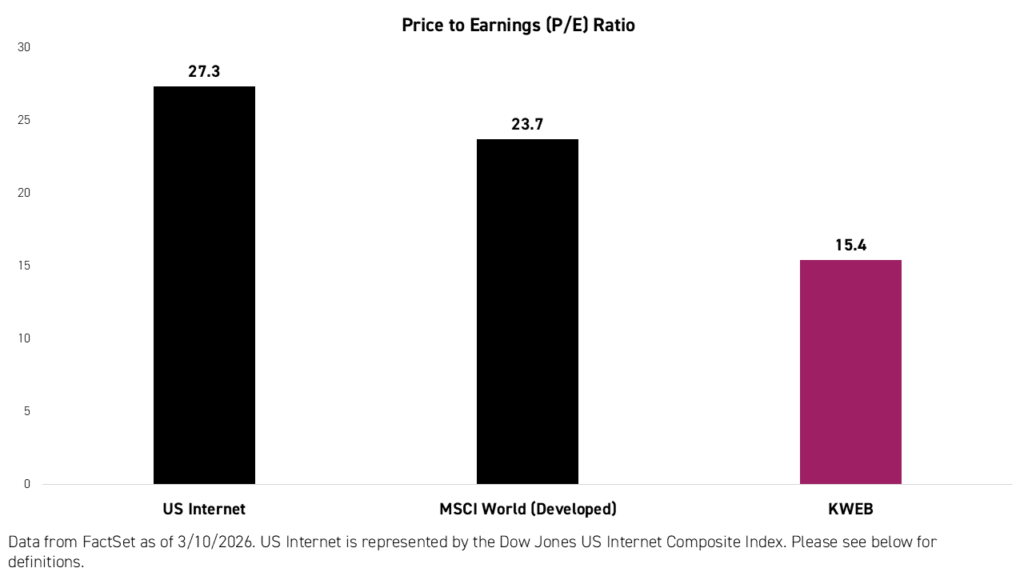
Despite recent volatility, average earnings multiples across US and Developed Markets remain significantly higher than companies in KWEB.
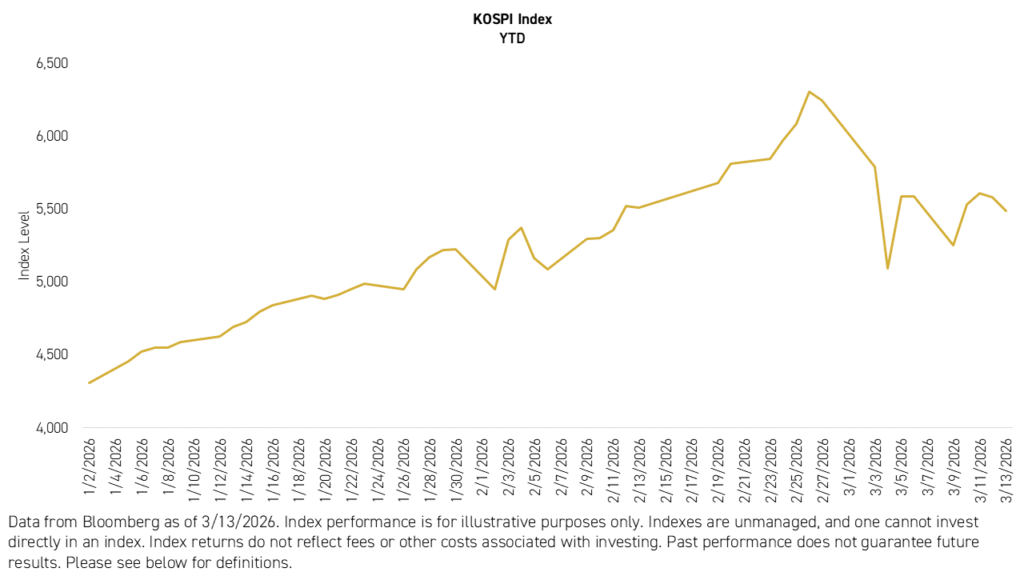
Korea’s Korea Composite Stock Price Index (KOSPI), which is heavily dominated by chipmakers, has experienced volatility so far this year, driven partly by anxiety over oil supplies coming through the Strait of Hormuz.
China, by contrast, has done a better job of diversifying its oil import sources.
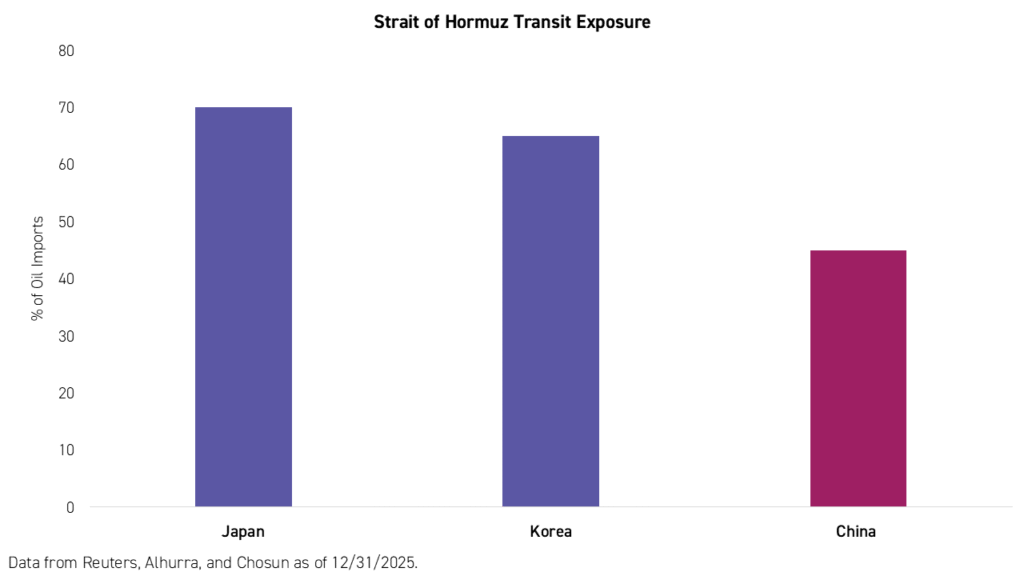
Some market participants have noted relatively lower valuations in emerging markets, including China, and lower exposure to potential Persian Gulf disruption.
Conclusion
We believe offshore China equities continue to offer a compelling value proposition despite recent market volatility. We are constructive on China’s offshore-listed internet companies because their Mainland counterparts have been relatively resilient so far into the conflict, there are potential geopolitical and policy tailwinds for China’s equities that we do not believe are priced in, and many developed markets remain expensive relative to China.
The preceding discussion reflects current market views and assessments, which are subject to change without notice. Forward‑looking statements are inherently uncertain and may not be realized.
Holdings are subject to change. For KWEB standard performance, top 10 holdings, risks, and other fund information, please click here.
Citations:
- Data from China’s National Bureau of Statistics as of 2/28/2026.
- Data from Bloomberg and Company Reports as of 3/11/2026.
- Data from Bloomberg as of 3/13/2026.
Definitions:
Relative Strength Index (RSI): The relative strength index (RSI) is a momentum oscillator that measures the speed and magnitude of recent price changes, scaled to move between 0 and 100. It is typically used to identify overbought conditions (high RSI) and oversold conditions (low RSI). The Relative Strength Index (RSI) formula is: 100 - (100/1+RS), where RS = (Average Gain over N periods)/(Average Loss over N periods). In this case, N = 14 days.
Hang Seng Index: The Hang Seng Index is a free-float, market-capitalization-weighted index that tracks large, liquid companies listed on the Hong Kong Stock Exchange and serves as the primary barometer of the Hong Kong equity market. It was first launched on November 24, 1969, with a base value calculated retroactively to July 31, 1964.
Shanghai Composite Index: The Shanghai Composite Index is a broad market-capitalization-weighted index comprising all A- and B-shares listed on the Shanghai Stock Exchange, used as the main gauge of the mainland Chinese equity market. It was launched in July 1991, with a base date of December 19, 1990 (base value 100).
Dow Jones US Internet Index: The Dow Jones US Internet Index is a modified market-capitalization-weighted index designed to track U.S.-listed companies that derive a majority of their revenue from internet-related businesses (both internet services and internet commerce). It was introduced by Dow Jones Indexes in February 1999, with a base date in late 1998 (commonly referenced with a base value of 100).
MSCI World Index: The MSCI World Index is a free-float-adjusted, market-capitalization-weighted index covering large- and mid-cap stocks across developed markets worldwide, often used as a global equity benchmark. It was launched by MSCI in 1969, with its standard base date in 1969 as well.
Korea Composite Stock Price Index (KOSPI): The KOSPI is the main market-capitalization-weighted index of the Korea Exchange, tracking all common stocks listed on the KRX main board and serving as the primary indicator of South Korea’s equity market. It was introduced in 1983, with a base date of January 4, 1980, and a base value of 100.
P/E Ratio: The price-to-earnings (P/E) ratio is a valuation metric that compares a company’s share price to its earnings per share (EPS). It shows how much investors are willing to pay today for one unit of the company’s current earnings.
Southbound Net Buy/Sell: The net flow into Hong Kong-listed stocks and ETFs from Mainland China through the Stock Connect channel, which is a mutual market access program developed by the Hong Kong Stock Exchange and the Mainland exchanges. It is calculated as buys minus sells, meaning that negative numbers represent net sells and positive numbers represent net buys.
Consumer Price Index (CPI): The consumer price index is a measure of the average change over time in the prices paid by consumers for a fixed basket of goods and services.