
How This Hedged Equity ETF (KSPY) Turns Volatility Into A Tool For Choppy US Markets
By  Cole Wenner
Recently, markets have been whipsawed by a steady stream of macroeconomic shocks and geopolitical surprises.
From escalation one day to de-escalation the next, the US-Israel-Iran conflict has injected a persistent risk premium into oil prices. This has complicated the inflation outlook just as investors hoped for an improving narrative on that front. Every monthly jobs report and manufacturing release now carries outsized importance. Upside surprises have revived concerns of “higher for longer” rates, and downside surprises stoke recession anxiety.
In this environment, realized volatility (backward-looking versus the market’s expectation of future movement derived from options prices) in US equities has become a data-driven expression of macroeconomic uncertainty, not just noise around a benign trend.
For long‑only US equity investors, that concern is showing up in two ways at once: the risk of missing upside if they de‑risk too early, and the risk of absorbing large drawdowns if they stay fully exposed.
Option markets, cross‑asset correlations, and factor reversals (i.e., sharp swing from growth to value stocks) have all reinforced a simple message: the regime has shifted from “buy the dip” to “manage the range.”
Why Traditional Hedging Is Falling Short
Investors are increasingly asking how to stay invested in US equities while acknowledging that macro and geopolitical risks are now a structural feature of the landscape.
Many allocators have tried to respond with tools that were not designed for an environment of fast‑moving data and frequent narrative shifts. Static put option overlays can provide protection, but they are often expensive, require ongoing implementation, and can materially drag performance when markets grind higher.
Structured products or tailored option strategies may offer downside buffers, but they are typically complex and operationally difficult for most portfolios. Even simple shifts into cash or short‑duration fixed income can create painful opportunity costs when equity markets rebound rapidly after a scare.
What is missing in many portfolios is an instrument that can do three things dynamically:
- Maintain core exposure to US large‑cap equities.
- Systematically seek to reduce volatility and manage downside risk.
- Dynamically adapt hedges as the risk environment changes, without requiring investors to constantly trade options themselves.
This is precisely the role a US hedged equity ETF can play when it is built on a repeatable risk model and implemented through a liquid, transparent index.
Introducing KSPY: A Dynamic US Hedged Equity Solution
The KraneShares Hedgeye Hedged Equity Index ETF (Ticker: KSPY), which is sub-advised by Hedgeye Asset Management, a firm that aims to bring hedge fund-level strategies and insights to everyday investors, seeks to provide exposure to the S&P 500 while actively reducing volatility and managing downside risk. KSPY tracks the Hedgeye Hedged Equity Index, an index created by Hedgeye and powered by Hedgeye’s proprietary Risk Range™ Signals. Hedgeye’s Signals analyze the daily trading range of the S&P 500 using price, volume, and volatility. Rather than relying on static hedges, the index can adjust its positioning as frequently as daily, allowing the strategy to respond to changing market conditions in real time.
At its core, KSPY combines:
- Passive exposure to the S&P 500 via underlying ETFs.
- A systematic options overlay using puts and calls on the S&P 500 designed to hedge downside and generate option income to compensate for the potential loss of upside.
- A rules‑based process guided by Hedgeye’s Risk Range SignalsTM, which determine which of three options strategies the index should deploy based on where the S&P 500 sits within its modeled range.
The result is a transparent, index‑based approach that seeks to keep investors anchored in the US equity market, while attempting to smooth the ride when volatility spikes.
How KSPY’s Dynamic Options Framework Works
KSPY’s index does not treat options as a static insurance policy; instead, options are an active risk‑management tool that can shift between offense and defense as the risk backdrop evolves.
Using Hedgeye’s Risk Range SignalsTM, the index evaluates the S&P 500’s daily trading range and determines which of three options strategies to deploy, with the goal of either maximizing upside capture or minimizing downside capture depending on where the market is trading.
While the exact implementation is proprietary, the framework can be understood in three broad regimes:
- When the S&P 500 trades toward the lower end of its modeled range, the strategy can emphasize upside participation, seeking to capture potential rebounds while still maintaining risk controls through option structures.
- When the market trades toward the upper end of the range, the strategy can tilt more defensively, using options to hedge against a potential pullback and to generate income that can help offset volatility.
- When the S&P 500 sits near the middle of the range, the index can adopt a more balanced stance, combining upside participation with measured downside protection.
Because options positions are rolled on a regular basis (at a minimum, every three weeks), and the specific strategy can change as often as daily, KSPY’s index remains dynamic and flexible. For advisors and institutions, this means the heavy lifting of monitoring price, volume, volatility, and recalibrating option exposures is handled systematically within the ETF structure.
How Has US Hedged Equity ETF KSPY Stacked Up Against The S&P 500 & Hedged Equity Peers?
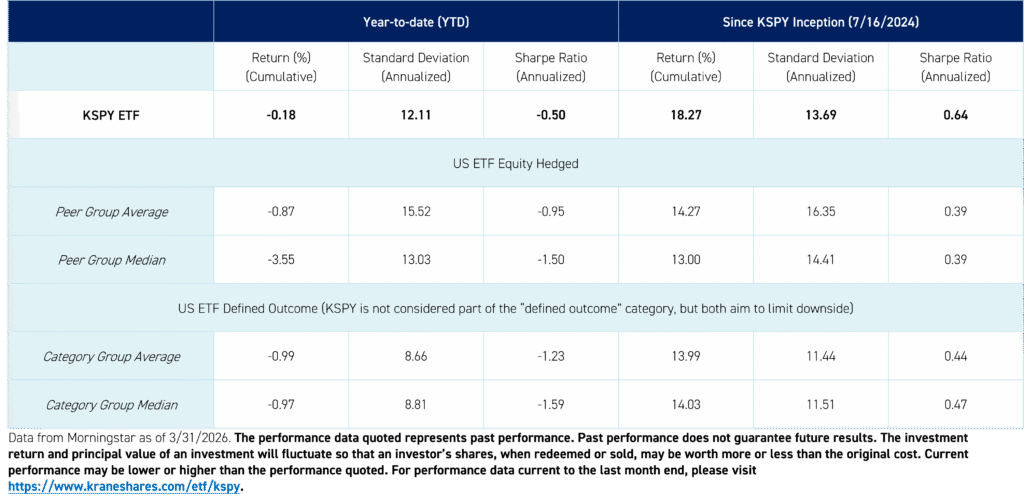
So, how has KSPY performed relative to the S&P 500 Index and its hedged equity peers? Well, since its inception on 7/15/2024, it has gained 18.27%.1 KSPY’s return was not far behind the S&P 500’s return over the same period, which was 18.45%.1 KSPY was able to achieve this while also significantly reducing volatility, creating a smoother return for investors. KSPY’s historical volatility since inception (30-day trailing) was 12.33 versus the S&P 500’s 16.94 historical volatility. 1
Now, how did KSPY stack up against its MorningStar hedged equity peer group?
KSPY’s peer group on average returned 14.27%, which trailed KSPY by 4%, respectively.2 Not only this, but KSPY’s annualized Sharpe ratio, which measures how much excess return you get per unit of volatility (risk), was 0.64 versus the peer group’s average of 0.39.2 Generally, a higher Sharpe ratio is preferable, and KSPY accomplished that since inception versus other hedged equity products.
Why Now May Be An Optimal Time To Consider A US Hedged Equity ETF
Today’s environment is defined by frequent, sharp swings in sentiment around inflation, policy, and geopolitics, rather than a smooth, trend‑driven market.
Oil markets remain sensitive to conflict headlines, the inflation debate lives on, and every macro release has the potential to move the entire curve of rate expectations and equity valuations.
At the same time, many investors seek to remain invested in US large‑cap equities, which continue to be a cornerstone of long‑term growth and retirement portfolios.
In such an environment, a U.S. hedged equity ETF such as KSPY may be incorporated into a broader investment approach focused on managing equity exposure and related volatility. For some investors, strategies of this type may be considered as part of an overall allocation that seeks to balance participation in equity markets with an awareness of potential market drawdowns.
For KSPY top 10 holdings, risks, standard performance, and other fund information, please click kraneshares.com/etf/kspy.
Citations:
- Data from Bloomberg as of 3/31/2026.
- Data from MorningStar as of 3/31/2026.
Index definitions:
Hedgeye Hedged Equity Index (Ticker: KSPYUI Index): The Hedgeye Hedged Equity Index provides exposure to the S&P 500 while actively reducing volatility and providing downside risk management. The Index is managed by Hedgeye Asset Management, LLC and utilizes a model based on Hedgeye’s proprietary Risk Range™ Signals that analyze the daily trading range of the S&P 500. The Index toggles between three options strategies based on where the S&P 500 falls within these ranges. These options strategies are intended to provide downside risk management, option income, and potential compensation for the loss of upside. Depending on market conditions, the Index can change options strategies as frequently as daily.
S&P 500 Index (Ticker: SPX Index): The S&P 500 is a stock market index that tracks the stock performance of 500 of the largest companies listed on stock exchanges in the United States.
Definitions:
Standard deviation: Standard deviation is a statistical measure of the dispersion or variability of a set of values relative to their mean. In finance, it is commonly used to quantify the risk or volatility of an asset or portfolio—higher standard deviation indicates greater variability in returns, while lower standard deviation means returns are more consistent.
Sharpe ratio: The Sharpe ratio is a measure of risk-adjusted return. It compares the excess return of an investment (the return above a risk-free rate) to its standard deviation (volatility).
Volatility 30d: The 30-day volatility often measured the annualized standard deviation of daily returns of a risk asset over the past 30 days.
US ETF Hedged Equity: A US ETF hedged equity strategy involves an exchange-traded fund (ETF) that invests in US equities (stocks) while employing hedging techniques to reduce downside risk.
US ETF Defined Outcome: A US ETF defined outcome is an ETF structured to provide investors with a predetermined range of potential returns (both upside and downside) over a specific period, such as one year.
© 2026 Morningstar, Inc. All Rights Reserved. The information contained herein: (1) is proprietary to Morningstar and/or its content providers; (2) may not be copied or distributed; and (3) is not warranted to be accurate, complete or timely. Neither Morningstar nor its content providers are responsible for any damages or losses arising from any use of this information."