
AI’s Next Moat: What Survives When Models Become Commodities
By Max Chen &  Derek Yan, CFA
Artificial intelligence (AI) models are becoming increasingly interchangeable, and their prices are gradually reflecting the cost of running them rather than the intelligence within them.1
We believe two forces will determine where AI profits ultimately land: capability on the hardest tasks, which we call the long tail of intelligence, and the operational assets, the evaluation sets, error libraries, and workflow memory a company builds by running the product, that accumulate around the models and survive every model upgrade.
Both forces are central to how AI ETF AGIX, the KraneShares Public-Private AI & Technology ETF, approaches the AI sector.
AI models are becoming interchangeable parts.
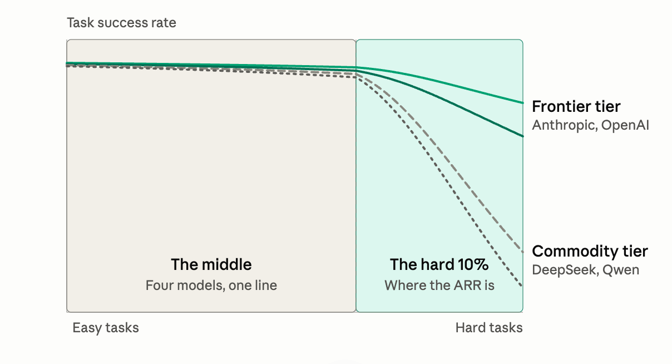
A year ago, choosing an AI model was a strategic commitment. Today, for the routine work that makes up most AI usage, such as drafting, summarizing, answering common questions, and writing standard software code, models from different providers produce results of broadly similar quality, and switching between them has become straightforward.
Pricing tells the story.
Industry analyst Jamin Ball has observed that per-token prices for leading open-weight models (models whose underlying parameters can be freely downloaded) have not fallen to zero but have instead settled into a band determined by the hardware cost of serving them. As a reminder, tokens are the standardized denomination used to measure the cost per output of the model. DeepSeek prices its V4 Flash model at $0.14 per million input tokens and $0.28 per million output tokens, roughly 30-100x cheaper than premium models.2 Meanwhile, in one standardized workload comparison, OpenAI's flagship model costs approximately 27 times as much as DeepSeek's, and OpenAI raised its flagship input price approximately fourfold over 12 months while budget-tier prices across the industry fell.3
In the middle of the distribution, the differences between models have fallen below the user's perception threshold. But we believe user experience has never been determined by the middle; it's determined by the tail. Trust is set by the worst experience, not the average one. What makes a user pay for a product, renew it, and stake their workflow on it is not that "it's good enough most of the time," but that at some critical moment, their model of choice didn't fail them. We believe the hardest 10% of tasks determine willingness to pay and, therefore, annual recurring revenue (ARR), a metric used to estimate recurring revenue generated over a one-year period.
Three trends we believe are shaping where AI profits land
First, although the long-tail capabilities will enable value capture for frontier models, the industry is deliberately commoditizing the model layer, and we believe this changes profit levels slowly. Economists Carl Shapiro and Hal Varian described the underlying strategy in 1998: a company benefits from making its complements cheap and standardized, because doing so raises customers' overall willingness to pay for the part of the system it still controls.4 We believe China's open-weight releases are commercially motivated, not charitable, which is precisely why the price pressure is durable.
DeepSeek has argued publicly that its inference operation is profitable at its published rates, we calculated that based on the founder's comments on their ten month payback period they end up with roughly 60-80% gross margin, which is in line with Anthropic's 2028 target.5 In our assessment, this does not change who leads on the hardest tasks, but it does put a lasting floor under how cheap routine AI work becomes and a ceiling on what anyone can charge for it. The key question is whether frontier labs can commercialize the long tail of difficult, high-value use cases, and turn the lessons from those deployments into product harnesses, faster than open-weight models can absorb and commoditize those capabilities. If they can, frontier-model economics remain defensible. If not, the model layer itself will increasingly converge toward a commodity market; the margin belongs to the semiconductor cycle, not the model race.
Second, model selection is moving inside products. OpenAI launched its GPT-5 model family with a built-in router designed to automatically direct each question to the most appropriate model, aiming to remove the model menu from the user's view. We believe most consumers do not split their work across multiple AI providers, so an assistant's perceived value is set disproportionately by its performance on the most difficult tasks. As routing becomes invisible, we believe products with the strongest long-tail capability could direct routine queries to inexpensive commodity models, capturing a low-cost structure for most of their traffic while retaining premium pricing where it matters.
Third,we believe durable AI advantages are accumulating in what we call the precipitate: the operational residue that builds up around a deployed AI system and does not evaporate when the model is upgraded. Unlike model weights (billions of tiny numbers that determine how it responds to an input), which can be approximated or distilled by competitors, we believe this residue is difficult to copy because it can only be accumulated through operation.
Anthropic's product sequence reads as a deliberate move in this direction. Claude Code established the pattern in engineering workflows; Claude Tag, launched in June 2026, extends it into shared Slack channels, where the system retains context from the channels it operates in and carries work across handoffs between teammates. The residue accrues inside the customer's workspace.
Why assets outside the model may matter more than the model
The pharmaceutical industry offers a historical parallel. When a drug patent expires, generic competition typically drives prices down sharply; a U.S. Food and Drug Administration analysis found that with multiple generic entrants, prices can fall to a small fraction of the original brand price. Yet established pharmaceutical companies have historically retained significant profits because value resides not only in the molecule but also in manufacturing know-how, distribution networks, and long-standing commercial relationships that generic entrants cannot replicate along with the formula.
The memory chip industry illustrates the other destination for profits under commoditization. After decades of price competition, nearly 90% of global DRAM (dynamic random-access memory, the main working memory in computers) revenue is concentrated among three suppliers, whose positions rest on tens of billions of dollars in fabrication capacity.1,3 We believe AI is likely to follow both precedents at once: profits migrating downward into capital-intensive computing infrastructure, and outward into the operational assets that surround the models.
AGIX seeks to capture a full ecosystem of AI profits
We believe the middle of the AI market will increasingly resemble a utility, held down by open-weight models and strategically funded capacity, while durable profits accrue to three places. AGIX is designed to hold all three.
At the frontier of long-tail capability, the fund's public-private structure lets it own frontier model builders directly, Anthropic alongside xAI (SpaceX), Alphabet, and Meta. In the compute layer beneath, where the margin question turns on who owns the silicon, the fund holds computing chips like Nvidia and AMD, memory chips like Sandisk and SK Hynix, and Photonic semiconductors such as Lumentum, Coherent, and a direct position in private companies like Ayar Labs. Above both sits the application layer, where the operational residue accumulates, companies such as Palantir, whose evaluation sets, error libraries, and workflow memory survive every model upgrade beneath them. As this migration becomes central to how value is created in AI, we believe exposure across these layers represents a compelling and growing part of the opportunity AI ETF AGIX is designed to capture.
Holdings are subject to change.
For AGIX standard performance, top 10 holdings, risks, and other fund information, please click here.
Citations
- Ball, Jamin. "Clouded Judgement." Clouded Judgement Newsletter, 2026, cloudedjudgement.substack.com.
- DeepSeek. "Models & Pricing." DeepSeek API Documentation, 2026, api-docs.deepseek.com.
- Solvimon. "OpenAI vs DeepSeek: A Comparison for AI Product Builders." Solvimon Pricing Guides, 2026, solvimon.com.
- Shapiro, Carl, and Hal R. Varian. Information Rules: A Strategic Guide to the Network Economy. HBS, 1998.
- TechCrunch, "Anthropic projects $70B in revenue by 2028: Report," as of 11/4/2025.