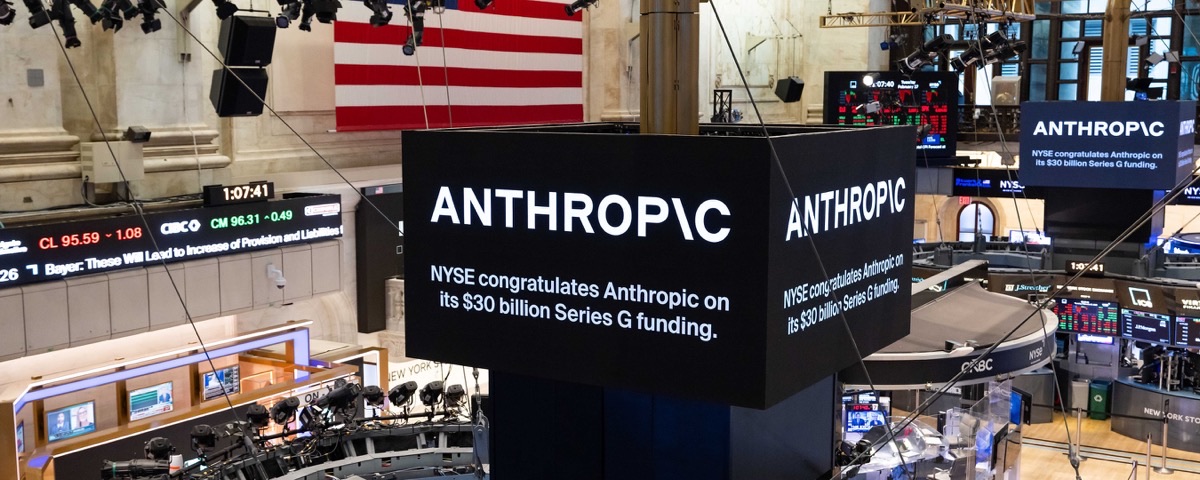
Weekly Private Markets Wrap: Anthropic Leak Shows A $518 Billion Bet To Compete In AI
Welcome to the KraneShares Private Markets Weekly Wrap! This is a free newsletter intended to identify and analyze the most important developments within the S&P® U.S. Private Stock Expanding Leaders Index and worldwide private markets every week. The newsletter will focus on companies, investors, and broader trends. We will also publish a weekly refresh of the S&P® Private Stock Expanding Leaders Index of the top 10 largest private companies in the United States.
Learn how to access these top private companies.
Index Updates
The S&P U.S. Private Stock Top 10 Index rose 3.0% last week, climbing from 323.51 to 333.22. Roughly three quarters of that increase occurred on September 29, when the index rose 2.3% following new details from the reported IPO prospectus of AI model developer Anthropic. Current implied valuations from PM Insights show growth from the most recent funding rounds in 8 of the 10 indexed companies. Brain computer interface company Neuralink has an implied valuation of $59 billion versus $9.65 billion in May 2025; defense technology company Anduril, at $135 billion versus $60 billion in April 2026; and Anthropic, at $1.58 trillion versus $965 billion in May 2026.
Anthropic's leaked IPO filing reveals the $518 billion cost of competing in AI
Private companies rarely disclose enough information for outside investors to fully evaluate their growth, expenses and financial risks. This week, Reuters leaked a copy of Anthropic’s confidential IPO prospectus offering the clearest look yet inside one of the world’s most valuable artificial intelligence companies.
The prospectus shows Anthropic is growing at a pace rarely seen at its scale. It is also committing extraordinary amounts of capital to the computing infrastructure needed to continue that growth.
Anthropic generated nearly $4.6 billion in revenue during 2025, approximately twelve times its 2024 total. However, its operating loss widened from $2.98 billion to $8.06 billion as the company invested heavily in developing and operating its Claude models.
The most striking disclosure is that Anthropic expects to spend at least $518 billion over the next decade on infrastructure through agreements with six of its partners. 80% of these agreements must be paid regardless of Anthropic's actual use of this capacity.
These agreements include a $111 billion deal with Google, a $110 billion deal with Amazon, a $31 billion deal with Microsoft, and a $161 billion equipment lease agreement with Broadcom. These contracts effectively represent an enormous advance order for computing power. Anthropic is betting that demand for increasingly capable AI models will grow rapidly enough to absorb the capacity it has secured.
This huge order shows Anthropic believes that compute capacity may be the largest bottleneck facing AI. They likely expect that securing this capacity will give them an advantage over firms with less infrastructure investment. Anthropic has committed itself to a decade long vision of increasing AI demand.
The prospectus also mentions Anthropic's concern over AI safety. They highlight the risk of AI agents taking irreversible actions such as deleting data or initiating financial transactions. These actions may not be deliberate. Rather, they may be taken in the pursuit of their task. The biggest worry is that Anthropic's contractual obligations may not entirely protect the company from litigation.
Despite this concern, Anthropic is clearly bullish on their outlook. They are considering an IPO valuation of over $2 trillion, more than twice its $965 billion valuation in May. The leaked prospectus gives credence to this ambition by highlighting exceptional revenue growth and strong enterprise adoption of its products.
Anthropic’s current implied valuation is approximately $1.58 trillion, 64% above its $965 billion May financing valuation. That comparison shows how strongly secondary price discovery has moved ahead of the last primary round. A potential IPO would provide another major price discovery event and subject the company’s growth, spending and risks to much greater public scrutiny.
| Reported 2025 Financial Metric | Amount |
|---|---|
| Revenue | Nearly $4.6 billion |
| Operating loss | $8.06 billion |
| Compute and infrastructure expense | $7.33 billion |
| Total operating expenses | $12.65 billion |
| Cash and short-term investments | $20.28 billion |
| Long-term infrastructure commitments | At least $518 billion |
| Potential IPO valuation | More than $2 trillion |
OpenAI's funding validates demand and the extraordinary cost of competing
Generative AI developer OpenAI completed another major financing step on October 1. Japanese technology investment group SoftBank funded the final $10 billion tranche of its $30 billion follow-on investment, bringing its cumulative investment in OpenAI to $64.6 billion and its reported ownership to roughly 13%. Reuters reported that the broader round attracted approximately $122 billion of commitments at an $852 billion valuation.
The financing demonstrates the depth of institutional demand for frontier AI, but the other side of the ledger matters. OpenAI reportedly expects to burn nearly $278 billion of cash from 2026 through 2030 as it builds the computing capacity required to train and operate its models. Reports that safety incidents prompted the company to pause or delay model work also show why speed, safety and capital efficiency are now parts of the same investment case.
OpenAI’s current implied valuation is approximately $1.06 trillion, 24% above its $852 billion August financing valuation. The scale of the increase matters for private market price discovery, while the company’s capital requirements and operating decisions can influence sentiment across the broader private AI market.
Stripe is building beyond payments
Payments infrastructure company Stripe made three strategically important announcements on September 30. It agreed to acquire small business financing platform Parafin, introduced additional stablecoin (digital money tied to real world assets) infrastructure including OUSD, and marked ten years in Japan with new products for local businesses.
Together, the moves show Stripe using its payments network as a platform for lending, digital dollar settlement and AI enabled commerce. Its growth depends on payment volume, financial software adoption and product expansion rather than the economics of training frontier models, making it a useful counterweight within an index increasingly influenced by AI developers.
Stripe’s current implied valuation is approximately $182 billion, 14% above its $159 billion February financing valuation. The increase is more restrained than the changes at Anthropic or OpenAI, but Stripe’s acquisitions and new products show another way a mature private company can create value while remaining private.


Change since last funding round = (current implied valuation / last-round valuation - 1). Current implied valuations, last-round values and dates are from the supplied Index Companies sheet; funding dates vary by company.
Five stories defining the broader private market
AMD’s $8.2 billion World Labs deal gives AI investors another route to liquidity
Semiconductor designer AMD agreed to acquire World Labs, the spatial intelligence startup founded by AI researcher Fei-Fei Li, in an all stock transaction valued at approximately $8.2 billion. The deal would bring Li to AMD as executive vice president and chief scientist and extend the chipmaker’s ambitions beyond computing hardware into models that understand and generate three dimensional environments. For private markets, the acquisition is significant because it shows that strategic buyers can provide large scale exits even when the IPO window is uneven. It also demonstrates how public technology companies are using their stock and balance sheets to buy scarce AI talent and intellectual property.
ElevenLabs’ secondary sale doubles its valuation to $22 billion
AI voice generation company ElevenLabs completed a roughly $300 million secondary share sale at a reported $22 billion valuation, twice the valuation attached to its February financing. The transaction, led by asset managers including Wellington Management and T. Rowe Price, gave existing holders liquidity without requiring the company to go public or issue a large amount of new stock. The combination of strong valuation growth, institutional demand and controlled secondary liquidity is becoming an increasingly important bridge for late stage companies that want to remain private longer. It is also a useful reminder that the price of a secondary transaction can provide market evidence, but may reflect a particular share class, seller and transaction structure rather than a single definitive company value.
Oura’s IPO delay shows that the public market window remains selective
Smart ring maker Oura postponed a planned U.S. IPO that could have raised about $2.2 billion, according to Reuters, as rising yields and market volatility made investors more cautious. The delay contrasts sharply with Anthropic’s reported ambitions and highlights that strong consumer recognition and growth are not enough to guarantee a successful listing on attractive terms. Public investors are still willing to fund differentiated businesses, but they are scrutinizing profitability, valuation and the durability of demand. For late stage private investors, that selectivity can extend holding periods and increase the importance of tender offers, secondaries and other sources of interim liquidity.
Accelevation’s IPO priced below its marketed range
AI infrastructure supplier Accelevation and its selling shareholders raised approximately $540 million in a U.S. IPO, but the shares priced at $18, below the marketed range of $20 to $24. The offering shows that the IPO market is open, particularly for companies tied to data center and AI spending, while also showing that public investors retain pricing power. Private valuations can be supported by scarcity and negotiated funding rounds; an IPO introduces continuous price discovery and a broader investor base. That gap between access to the market and acceptance of the desired valuation is one of the most important signals for private companies considering a listing.
Varda raises $250 million to scale manufacturing in orbit
In space pharmaceutical manufacturer Varda Space Industries raised $250 million at a reported $1.6 billion valuation to expand its orbital drug manufacturing business. The company has booked 28 launches through 2029 and has now raised approximately $598 million in total. Varda stands apart from this week’s software heavy headlines: it is capital intensive deep technology with long development timelines, physical assets and significant regulatory and execution requirements. Its financing nevertheless follows the same broader pattern visible across private markets. Large checks remain available when investors see differentiated technology, a credible path to commercial demand, and defensible infrastructure.
What this week tells us
The common thread is not simply “more AI.” Capital is concentrating around private companies that can demonstrate one or more of three things: scale, strategic scarcity or a credible path to liquidity. Anthropic and OpenAI have scale but face extraordinary capital requirements. World Labs found a strategic exit. ElevenLabs used a secondary transaction to create liquidity while staying private. Oura and Accelevation show that public markets remain open, but only on terms public investors will accept. Varda shows that capital can still reach areas outside software when the technology and commercial pathway are sufficiently differentiated.
Citations:
- Anthropic’s IPO prospectus shows sweeping AI vision, surging costs, Reuters, September 28, 2026.
- Anthropic warns government attitudes may hurt customer ties, Reuters, October 2, 2026.
- SoftBank Group completes additional investment in OpenAI, SoftBank Group, October 1, 2026.
- Stripe Newsroom, Stripe, September 30, 2026 announcements.
- AMD to acquire Fei-Fei Li’s World Labs in $8.2 billion deal, Reuters, September 28, 2026.
- ElevenLabs doubles valuation to $22 billion in share sale, Financial Times, September 2026.
- Oura delays U.S. IPO, Reuters, September 29, 2026.
- Accelevation and shareholders raise $540 million in U.S. IPO, Reuters, September 29, 2026.
- Varda raises $250 million at $1.6 billion valuation, Reuters, September 30, 2026.