Volatility ETFs May Offset Hidden Fixed Income Risk in Your Portfolio
Equity markets are near all-time highs. Implied volatility is near multi-year lows. For most investors, that's reassuring. Nancy Davis thinks it's a reason to pay closer attention.
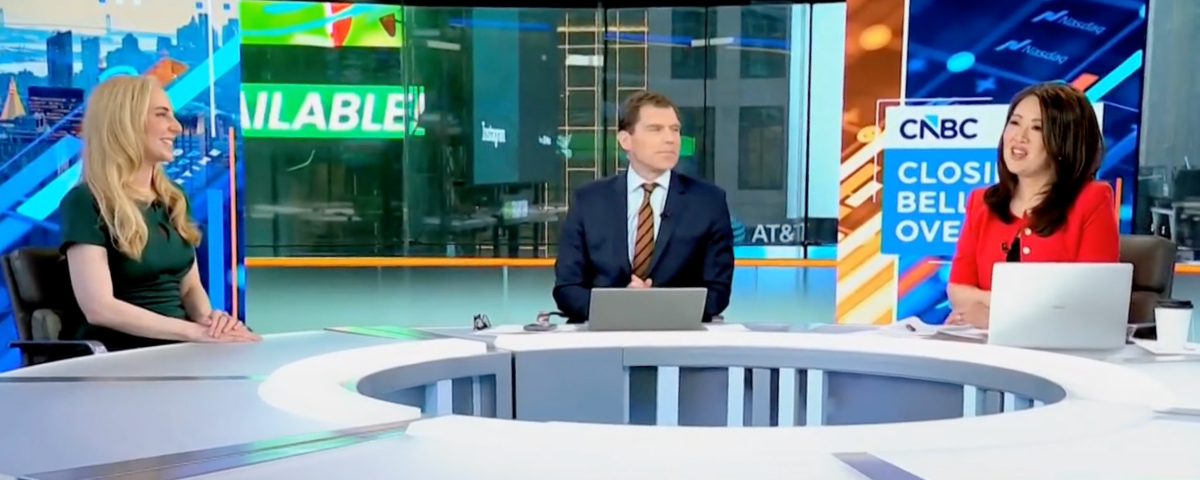
In a recent CNBC interview, Nancy made the case for why cheap volatility is a potential opportunity. Interest rate volatility has fallen approximately 50% since the Silicon Valley Bank crisis in 20231, and when options are this cheap, she argued, the cost of adding volatility exposure is too low to ignore.
She believes that when implied volatility is low, investors may consider adding a volatility ETF, such as our volatility ETF IVOL, to their portfolio.
The Hidden Short in Your Bond Portfolio
Most investors think of bonds as the "safe" part of their portfolio. But there's a structural feature in some of the most widely held fixed income benchmarks worth understanding.
The Bloomberg U.S. Aggregate Bond Index (“The Agg”) is composed of approximately 35% mortgage-backed securities and callable corporate bonds. Because homeowners hold the right to refinance and corporations hold the right to call their debt, investors who own those bonds are effectively short interest rate options. That embedded short volatility, known as prepayment risk, means that when rates become more volatile, bondholders may end up paying the price.
In other words, the index many investors rely on for stability is, by construction, a short volatility position. IVOL is designed to sit on the other side of that trade, providing long volatility exposure to potentially offset this structural risk. That dynamic is always present, but today's environment may make it both more meaningful to address and more affordable to do so.
Why a Volatility ETF Stands Out Right Now
Interest rate volatility is cheap by historical measures. The MOVE Index, which measures implied volatility in U.S. interest rate markets, has dropped 45% over the past three years.1 IVOL's own volatility measure has fallen 58% over the same period.1
At the same time, the 2-year/10-year (2s10s) U.S. SOFR yield curve has compressed sharply, from 49 basis points at the end of 2025 to approximately 23 basis points as of May 2026.1 The long-run historical average spread is roughly 100 basis points, with prior-cycle peaks near 300 basis points.1 The current level is exceptionally flat by historical measures.
When volatility is cheaply priced, the cost of owning options is low. The current entry point may be compelling for investors looking to add long volatility exposure to their fixed-income portfolio.
What the Rates Market Is Telling Us
With approximately 7 basis points of Fed hikes (not cuts) currently priced in for the rest of 20261, the market may be underappreciating the broad range of potential outcomes. AI-driven productivity gains could weaken employment and prompt a deeper Fed cutting cycle. Kevin Warsh's expected confirmation as Fed Chair may act as a dovish catalyst. Furthermore, ongoing geopolitical uncertainty and rising oil prices may eventually lead to demand destruction and, ultimately, a delayed but sharper cutting cycle.
As Nancy Davis put it during her interview with CNBC, "if you think about the unknowns that we have right now, whether it's the Fed's policy, the fiscal situation, the geopolitical risks, vol is incredibly cheaply priced."
How IVOL Works as a Volatility ETF
IVOL holds at least 80% of its portfolio in inflation-protected Treasuries or cash, providing inflation-linked income as its defensive core. The remaining allocation goes into fully funded, long-only over-the-counter (OTC) options on the 2-year/10-year yield curve, maintaining long interest rate volatility exposure. Because IVOL is long interest rate options, it provides an offset to what most bond indexes embed, a structurally short volatility position.
IVOL's historical correlation with other asset classes reinforces its potential as a diversifier.* Since its inception, IVOL has exhibited near-zero daily correlation to the S&P 500 and Dow Jones and low correlations to investment-grade bonds and high-yield bonds.2
For investors already running both equity and bond exposures, IVOL’s correlation profile may be particularly relevant in environments where stocks and bonds become more correlated.
A Constructive Case for Adding a Volatility ETF
IVOL was created on a simple idea: most bond investors are short interest rate volatility, and the time to address that is before it becomes a problem, not after.
Investors looking to complement their fixed income exposure with long volatility and steepening exposure should consider IVOL with both interest rate volatility and the yield curve at near multi-year lows.
*Diversification does not ensure a profit or guarantee against a loss.
For IVOL standard performance, top 10 holdings, risks, and other fund information, please click here.
Citations:
- Bloomberg and Quadratic Calculations as of 5/11/26
- Correlation data since IVOL inception on 5/14/2019 through 3/31/2026.
Definitions:
Yield curve: The spread between short-term and long-term U.S. Treasury interest rates; a key indicator of economic expectations
2s10s: The difference in yield between 2-year and 10-year U.S. Treasury securities
Basis points (bps): A unit equal to 0.01%; 100 bps = 1%
TIPS: Treasury Inflation-Protected Securities — U.S. government bonds whose principal adjusts with inflation
Implied volatility: A market-derived measure of expected future price swings in an asset
MOVE Index: A measure of implied volatility in U.S. Treasury markets, analogous to the VIX for equities
OTC options: Over-the-counter options — customized derivatives traded directly between parties, not on public exchanges
Prepayment risk: The risk that a bond issuer repays principal early (e.g., homeowners refinancing), creating embedded short optionality for bondholders
Bloomberg U.S. Aggregate Bond Index: A broad benchmark tracking the U.S. investment-grade bond market, including Treasuries, corporates, and mortgage-backed securities