Top 5 Viral Humanoid Moments That Made 2025 The Year Of Robotics
By  Cole Wenner
Seemingly overnight, humanoids are crowding social media feeds and headlining major financial news outlets. Five viral moments in particular, driven by breakthroughs from Tesla, 1X, Xpeng, Figure AI, and UBTECH, have not only captured global attention but redefined the trajectory of the industry itself. Now, the same companies are racing to turn viral moments into results, scaling mass production and staking their claim in what could become a $5 trillion industry.1
KraneShares sparked our own wave of media buzz earlier this year when we had a Unitree G1 Ultimate humanoid robot, nicknamed “KOID-bot” ring the Nasdaq opening bell to celebrate the launch of the KraneShares Global Humanoid & Embodied Intelligence Index ETF (Ticker: KOID). KOID-bot trended on social media platforms like TikTok and Instagram, appeared on live segments from FOX Business, Yahoo Finance, and Cheddar, and was featured in print in Barron's, the New York Post, and The Times in the UK.
The KOID ETF is designed to capture the broad opportunity in the robotics and embodied intelligence ecosystem. KOID’s portfolio focuses on three key categories: the “brain” (semiconductors & technology), the “body” (actuation systems, mechanical systems, sensing & perception, and critical materials), and humanoid “integrators” (manufacturing companies).
In this article, we will cover five “integrators” beyond Unitree that we believe have a first-mover advantage towards mass production and market adoption.
Tesla’s Optimus Gen 3
Tesla has ushered in multiple viral moments showcasing its Optimus Gen 3 humanoid. Perhaps its most impressive public appearance was in a Tesla diner. An all black Optimus Gen 3 showcased lifelike movement and dexterity as it served popcorn to customers, adding fuel to the humanoid robotics media frenzy.
@teslaownerssv Optimus serving popcorn at the Tesla Diner #fyp #viral #tesla #optimus #teslarobot ♬ original sound - Tesla Owners Silicon Valley
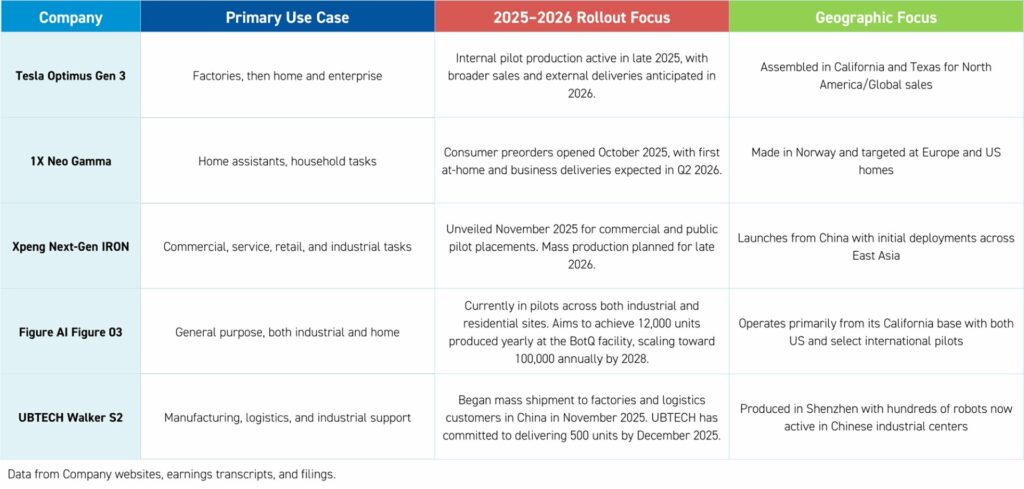
Plans for Tesla’s latest humanoid were highlighted during the company’s 2025 shareholder meeting and have created widespread excitment among both investors and consumers. According to Tesla’s website, the company wants to “create a general purpose, bi-pedal, autonomous humanoid robot capable of performing unsafe, repetitive, or boring tasks.” We believe this aligns with long-term industry goals and provides a clearer path to easy adoption compared to a robot designed for a specific use case.
Tesla stated that initial deployments will begin with internal use at Tesla factories before becoming available to the public. Tesla currently has a “pilot production line” (an early, small-scale manufacturing setup) active at its Fremont, California factory. This means the company is already assembling early versions (“pilots”) of the Optimus robots to test procedures and refine the design before mass production.
Updates on Tesla’s official X account indicate that the company is targeting a total cost of goods sold (COGS) of $20,000 per robot “at scale” (meaning once they reach high-volume manufacturing), which is the expense required to manufacture each robot.2 We believe that lowering the COGS will be crucial for achieving profitability and affordability for customers. Like Apple’s iPhone, Tesla is also planning a rapid annual upgrade cycle: Gen 4 is expected in 2027, and Gen 5 in 2028.2
Tesla's competitive edge lies in its vertically integrated supply chain and substantial factory network. Nearly all core components, electronics, and actuators are designed in-house, including overlap advantages with its electric vehicle business, which we believe will help Tesla successfully implement aggressive cost-down strategies. In addition to ramping up production lines in its' Fremont factory, Tesla is also expected to utilize its' Gigafactory Texas for Optimus production. Elon Musk stated at Tesla’s 2025 shareholder meeting that the “Optimus’ pilot line will be capable of producing up to one million units annually... and this would just be the beginning. In the future ... production could literally be out of this world.”
Tesla's unique scale, margin potential, and industry know-how make it a potential frontrunner in the robotics space. Tesla has a 2.08% weight in KOID as of 10/31/2025.3
1X’s Neo Gamma
In October 2025, Norwegian robotics company 1X stunned consumers with the unveiling of its Neo Gamma robot. In 1X’s viral Neo robot video, the Neo robot featured unique capabilities, such as scheduling and executing tasks like cleaning, doing laundry, answering the door, turning off lights, and organizing spaces with simple app or voice commands.
@1x.tech NEO Gamma in homes near you #fyp #robotics #tech #ai #humanoid #technology ♬ original sound - 1X
Neo is designed as an all-in-one home assistant robot that can seamlessly integrate into daily routines. 1X CEO Bernt Børnich said, “With NEO Gamma, every engineering and design decision was made with one goal in mind: getting NEO into customers’ homes as quickly as possible… We’re close. We can’t wait to share more soon.” Priced at $20,000 for complete ownership (or consumers can opt for the $499 monthly subscription fee), Neo is available for pre-order now, with first deliveries expected in Q2 2026.4
For any task Neo doesn’t yet understand, owners will be able to book a remote session with a 1X expert who can teach the robot this new chore. Børnich stated, “There is a not-so-distant future where we all have our own robot helper at home, like Rosey the Robot or Baymax. But for humanoid robots to truly integrate into everyday life, they must be developed alongside humans, not in isolation.” This workflow would enable the Neo robot to learn continuously from both human experts and real-world use, even after being sold, and for Neo to be tailored to individual customer needs.
Neo stands 5’6” tall, weighs 66 pounds, and features a soft 3D lattice polymer body for safe movement and easy machine washing, making it comfortable and practical for home environments.4 Its advanced Redwood AI vision-language model powers autonomous navigation, human gesture understanding, and personalized memory, empowering Neo to recommend recipes from fridge contents, converse naturally, and even provide reminders for misplaced keys or medication schedules.
As the market for home robotics heats up, we believe Neo represents a watershed moment: an affordable, consumer-ready helper that learns, adapts, and improves with every software update.
XPeng’s Next-Gen IRON
XPeng’s Next-Gen IRON humanoid robot stole the show at XPENG AI Day, which also featured plans for flying cars and robotaxis in Guangzhou, China, on November 5, 2025. Consumers were impressed not just because of its technical breakthroughs, but because they thought it was a real human in a costume. When IRON walked on stage, its movements were so natural and lifelike that social media lit up with rumors and disbelief. People speculated that this was a publicity stunt or a “fake,” convinced that IRON’s body language and mannerisms couldn’t possibly be a robot.
XPeng leaned into the excitement and addressed the skepticism head-on: the company’s CEO performed a “robot reveal” in front of a live audience, opening IRON’s artificial skin and exposing its metal frame, wiring, and actuators right on stage while the robot continued to operate. This dramatic moment, caught on video and widely shared, definitively proved IRON was not a human in disguise, but a breakthrough in what engineers call “extreme anthropomorphism.” In plain terms: IRON is built with a spine-like structural core, muscle-mimicking actuators, and soft skin designed to look and flex like real flesh. The hands themselves have 22 degrees of movement, allowing IRON to gesture, wave, and interact fluidly with people, mirroring human motion so closely that even experts were initially fooled.5
@chinaminutes China’s XPeng recently revealed a humanoid robot named IRON, drawing global attention after the CEO cut open its leg on stage to prove it wasn’t a human in disguise. Designed with a bionic spine, 82 joints and ultra-realistic “skin,” IRON’s gait and movement were so lifelike that audiences speculated a human was inside. IRON is powered by three AI chips capable of processing over 2,000 trillion operations per second. It can walk, balance, and make gestures that closely resemble human movement. The company says IRON is built for real-world roles, from corporate assistance to retail and possibly domestic settings, and is aimed for commercial rollout by late 2026. The company demonstrated IRON during its AI Day event in Guangzhou, presenting it as part of China’s growing push into humanoid robotics. • • • #humanoid #chinatech #airevolution #xpeng #robot ♬ son original - Trendformusic🤍🇲🇺
XPeng’s goal for IRON isn’t to replace people, but to make robots feel comfortable, trustworthy, and approachable in public spaces like stores, museums, and offices. The company is starting IRON’s real-world journey in these human-facing jobs, including shop guides, receptionists, and tour assistants. Mass production is planned for 2026, and as the technology improves and costs fall, we believe IRON will become even more accessible.5 This media sensation has now positioned IRON as one of the world’s most talked-about robotics innovations, demonstrating that the future of “physical AI” isn’t just about advanced chips and engineering, but about making robots feel at home among us.5
We believe XPeng’s IRON represents both a leap in what robots can physically do and a cultural milestone in how society will accept them, thanks to a debut that truly blurred the line between human and machine. XPeng has a 1.97% weight in KOID as of 10/31/2025.3
Figure AI’s Figure 03
Figure AI’s Figure 03 made a splash in October 2025 with a headline-grabbing debut, following months of anticipation in the robotics world. Figure's viral moment was similar to 1X's, as videos of its autonomous robot showcased skills like organizing a messy living room and gathering dirty dishes to clean in the kitchen. On Figure AI's official YouTube page, they racked up over 5.5 million views.
@xrobohub 🤖Watch it work! Figure 03 doing long-horizon tasks FULLY autonomously at home! #HumanoidRobot #FigureAI #robotics ♬ 原声 - XRoboHub
Figure AI’s website plainly states the company’s mission: “Our goal is to deliver a truly general-purpose robot - one that can perform human-like tasks and learn directly from people.” Videos circulating online show the robot smoothly folding laundry, loading dishwashers, wheeling out trash, and chatting politely, giving consumers a strong sense that this isn’t just some “future tech” demo, but something ready for regular, everyday use.
The story behind Figure 03’s development is one of total reinvention. Figure AI rebuilt everything according to its company website: “To realize this vision, our engineering and design teams completed a ground-up hardware and software redesign to ship Figure 03.” Its signature Helix brain was upgraded, its vision system was improved for better navigation in messy homes or busy offices, and its hands and skin were reworked for a gentler, safer touch.6 The robot can now navigate through narrow hallways, avoid pinching hazards, and even identify slippery or delicate objects with new tactile sensors in its fingertips that can sense the weight of a paper clip.6
Figure AI’s BotQ factory, which is “Figure’s dedicated manufacturing facility designed to scale robot production,” is a “first-generation manufacturing line that will initially be capable of producing up to 12,000 humanoid robots per year, with the goal of producing a total of 100,000 robots over the next four years.”6 Additionally, Figure AI is rolling out Figure 03 in pilots across both commercial sites and residential communities, collecting real-world data to refine its performance.
Figure 03’s $80,000+ price tag initially targets deep-pocketed partners, but each new deployment draws Figure closer to serving ordinary households and transforming work as we know it.6
UBTECH’s Walker S2
UBTECH’s Walker S2 has captured global manufacturing headlines in 2025, with footage of entire robot armies, reminiscent of scenes in movie iRobot, being prepared for shipment in China. This video was the most recent viral humanoid robotics moment, unsurprisingly garnered over 15 million views on three separate TikTok accounts.
@dailymail Chinese tech company, UBTECH Robotics, shows off their latest humanoid robots with a video that looks closer to a marching army rather than a showcase. UBTECH, located in Shenzhen, China, has an array of designs in stock, including some AI bots that take more of an animal-like form. The 'Walker S2' model is able to autonomously switch out its own battery, which takes approximately 3 minutes to complete, and it can walk around at a top speed of 4.5 mph. 📷 UBTECH Robotics #china #tech #robot #science #news ♬ original sound - Daily Mail
The focus here is all business: Walker S2 isn’t being pitched as a home companion; it’s being handed straight to the world’s busiest factories and logistics warehouses, where labor shortages and 24/7 demands are the norm. When BYD, Geely, Foxconn, and other leading firms need boots on the ground, they’re now picking Walker S2 to carry inventory, assemble parts, and keep operations running at high speed.
The Walker S2’s strongest suit is its seamless integration into high-pressure industrial settings. When it runs out of battery life, the robot takes itself to a swap station, pops in a charged pack, and is back at work in under 5 minutes.7 We believe this process is key to maximizing output on production lines that don’t rest. UBTECH’s orders, totaling over $110 million already, underscore that this isn’t about replacing workers, but making factories more resilient to staffing shortages, last-minute order surges, and late-night shifts.7
For investors looking for where “robots at work” is a business reality and not just a tech promise, few images capture the shift better than the rows of Walker S2 units lined up and ready for deployment. UBTECH has a 1.96% weight in KOID as of 10/31/2025.3
KOID ETF Performance Since Inception

Conclusion
The landscape for humanoid robotics in 2025 has matured at an unexpected pace, with global players such as Tesla, 1X, Xpeng, Figure AI, and UBTECH advancing both technical capabilities and production scale. These companies are not only demonstrating breakthroughs in lifelike movement, adaptability, and autonomous reasoning, but are also driving down costs and forging supply chain advantages we believe could bring millions of robots into homes, factories, and service roles within the next few years.
For investors, the KraneShares Global Humanoid & Embodied Intelligence Index ETF (Ticker: KOID) offers exposure to this potential megatrend at the ground floor. KOID is the first ETF of its kind to focus on companies directly enabling humanoid robots, through foundational technologies like sensors, actuators, AI chips, and advanced manufacturing, in addition to the headline robot makers themselves.8 By equally weighting holdings and investing across multiple geographies, we believe KOID provides investors with a balanced, future-forward stake in the market’s evolution, while potentially lowering the risk of overconcentration in a single player or geography.
Holdings are subject to change.
For KOID risks, and other fund information, please click here.
Citations:
- Data from "A $5 Trillion Global Market," Morgan Stanley, retrieved 12/10/2025.
- Data from Tesla’s website and the company’s 2025 annual shareholder meeting.
- Data from Bloomberg as of 10/31/2025.
- Data from the 1X company website.
- Data from the Xpeng company website.
- Data from the Figure AI company website.
- Data from the UBTECH company website.
- Data from Bloomberg.